
 Print
Print E-Mail
Neil McCarthy is Co-Founder and Chief Product Officer, G. Michael Weiksner is Co-Founder and Chief Technology Officer, and James Palmiter is CEO and Co-Founder at DragonGC. This post is based on a DragonGC memorandum by Mr. McCarthy, Mr. Weiksner, Mr. Palmiter, Jennifer Carberry, and Nicholas Sasso.
Background
SEC rules require that all public companies hold a separate shareholder advisory vote to approve the compensation of executives, known as “say-on-pay”. This includes compensation disclosed under S-K Item 402 such as CD&A, the compensation tables, and other narrative executive compensation disclosures. In most years for the majority of companies this vote passes with greater than 80% support from those shareholders who vote on the matter. However, for some companies the approval rate is less than 80%. Sometimes the resolution receives less than a majority and fails to pass at all. A vote receiving less than 70% of the shares in favor is generally regarded as a failure.
These adverse outcomes are often triggered by negative voting recommendations from ISS or Glass Lewis, or by actions that conflict with the executive compensation policies of major institutional investors. While SEC rules only require a non-binding advisory vote, in practice these entities provide an enforcement mechanism. Companies that have received an adverse say-on-pay vote typically respond with a shareholder engagement program during the following season.
Methodology
To analyze how companies responded to adverse say-on-pay votes, we:
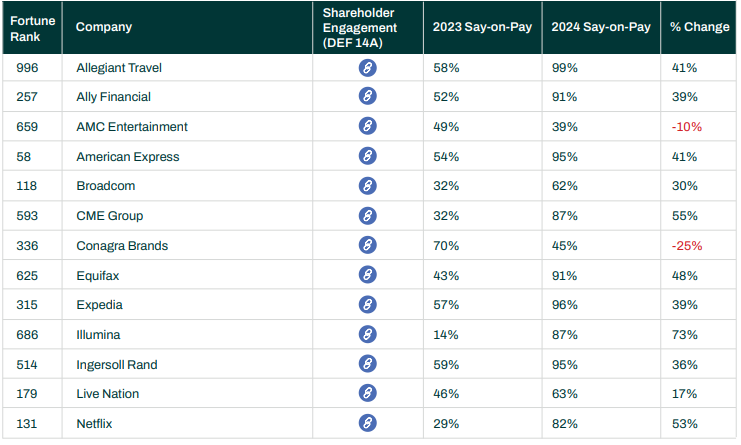
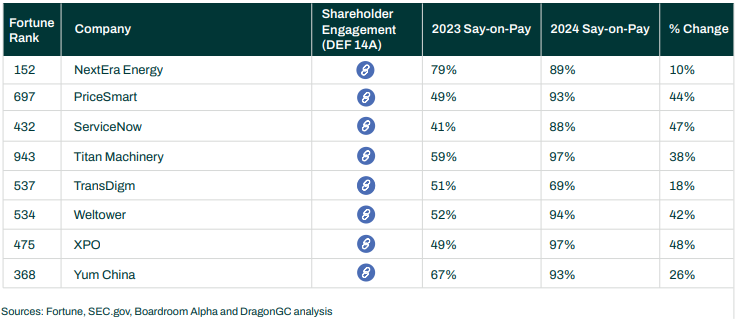
- Reviewed say-on-pay voting results for the 2023-2024 annual meeting season and identified 154 examples where less than 80% of voted shares approved.
- We then took a deeper look at the 21 such companies that were in the Fortune 1000.
- Subsequently, 19 of the 21 companies saw an improved say-on-pay vote at their 2024 AGM, with most experiencing a significant increase in support.
- The say-on-pay votes declined at AMC Entertainment and Conagra Brands, while other companies saw an increase in their voting outcomes.
Fortune 1000 Say-on-Pay Vote Results
Footnotes
1. AMC Entertainment has struggled as movie viewership at its theatres has declined. Its stock price fell from over $300 per share in 2022 to just over $4.00 today, and shareholders have run “withhold the vote” campaigns against its directors at its 2023 AGM and 2024 AGM.
2. Following sales declines, Conagra Brands’ stock price declined from an all-time high of $40.96 on January 8, 2023, to $26.41 on October 8, 2023, its lowest close since 2018.
3. The voting results were calculated based on the “for” and “against” votes.
Assessment of Shareholder Engagement Programs
Companies have responded to disappointing say-on-pay votes in various ways. The framework below illustrates how these companies used both targeted engagement and specific program modifications to align executive compensation with shareholder interests. Many emphasized retention and long-term value creation by incorporating performance-based equity, improving transparency, and adopting stronger governance measures, especially in response to direct shareholder feedback on executive incentives, accountability, and ESG goals.
This table shows the variety of ways in which F1000 companies engaged with their shareholders in the 2024 season after they had an adverse say-on-pay vote during the 2023 season. Links go to the pertinent part of their 2024 AGM proxy statement.
Engagement Strategy
| Broad and Direct Engagement | Equifax Welltower Ally Financial |
| Structured and Recurring Engagement | ServiceNow Netflix Allegiant Travel |
| Topic-Specific Outreach | Conagra Yum China XPO |
Long-Term Incentive Structure and Retention Mechanisms
|
Shift to Long-Term Equity and Retention-Oriented Awards |
Conagra Netflix ServiceNow |
| Retention of Stock-Based Awards | Allegiant Travel Welltower XPO |
Governance and Policy Reforms
| Enhanced Clawback and Stock Ownership Policies | TransDigm AMC Entertainment Illumina |
| Double-Trigger and Accountability Provisions | Netflix NextEra CME Group |
Response to Feedback on Executive Compensation
| Limitations on CEO Awards and Incentive Caps | Equifax American Express Yum China |
| Increase in Performance-Based Pay | Illumina Expedia Live Nation |
| Incremental Adjustments | PriceSmart TransDigm Equifax |
Shareholder Feedback Integration and ESG Inclusion
| Program Overhauls | Netflix Yum China ServiceNow |
| Incremental Adjustments with Core Retention | Conagra NextEra Welltower |
Enhanced Transparency and Disclosure Improvements
| Detailed Reporting and Proxy Enhancements | ServiceNow Welltower NextEra |
| Proxy Statement Redesigns | Netflix Ingersoll Rand TransDigm |
1. Engagement Strategy
- Broad and Direct Engagement: Equifax, Welltower, and Ally Financial conducted extensive shareholder outreach, targeting large portions of their shareholder bases. Equifax engaged with holders of 70% of its shares, involving the Independent and Compensation Committee Chairs, while Welltower engaged with 55%, incorporating board feedback into governance and compensation decisions. Ally reached out to 58% of its shareholders, with its Compensation Committee Chair participating in meetings with holders of 33%. These efforts emphasized transparency and accountability, using shareholder feedback to refine executive compensation, disclosure, and policy practices.
- Structured and Recurring Engagement: ServiceNow, Netflix, and Allegiant Travel have all adopted structured, year-round shareholder engagement programs. ServiceNow and Netflix, in particular, implemented multi-session engagements throughout the year, giving shareholders regular updates on ongoing improvements to executive compensation and governance practices. These multi-session approaches have strengthened transparency and responsiveness, addressing evolving shareholder concerns directly. Allegiant Travel also held a series of targeted outreach sessions, specifically designed to clarify executive compensation practices and align them with long-term shareholder value.
- Targeted and Topic-Specific Outreach: Conagra, Yum China, and XPO prioritized top shareholders in their outreach strategies, addressing focused compensation concerns through structured engagement. Conagra reached over 55% of its public float to discuss governance and compensation, while Yum China utilized phased engagement post-pandemic to address executive compensation adjustments. XPO maintained continuous dialogue with major stakeholders, adjusting compensation in response to strategic transformation feedback.
2. Response to Feedback on Executive Compensation
- Limitations on CEO Awards and Incentive Caps: Equifax, American Express, and Yum China committed to limiting one-time or special CEO awards. Equifax pledged to avoid future one-time awards unless under extraordinary circumstances, while American Express announced an end to special CEO awards, focusing on consistent, performance-aligned compensation. Yum China also limited the use of one-time awards, committing to not granting future one-time awards to executive officers outside of their annual incentive programs, ensuring alignment with long-term performance goals.
- Increase in Performance-Based Pay: Illumina, Expedia, and Live Nation have adjusted their long-term incentives to be more performance-based, responding to shareholder feedback for greater alignment between executive compensation and company performance. Illumina has tied 70% of make-whole equity grants to a three-year relative Total Shareholder Return (TSR) performance metric and committed to increasing Performance Stock Units (PSUs) to 70% of target equity incentives by 2024. Similarly, Expedia is redesigning its PSU award program to enhance its performance orientation, while Live Nation is adopting a multi-metric approach for its incentive compensation to ensure that executive pay is directly linked to long-term shareholder value creation.
- Retaining Core Compensation Structures with Incremental Adjustments: PriceSmart, TransDigm, and Equifax chose targeted modifications while keeping their core compensation frameworks intact. PriceSmart eliminated its over-achievement incentive pool and capped cash incentives at 100% of target levels while significantly increasing the equity portion of executive compensation and tripling stock ownership requirements for executives other than the CEO. TransDigm preserved unique carry-forward equity provisions, with improved transparency to align with shareholder interests. Equifax, after extensive engagement, maintained its pay-for-performance approach, enhancing CEO equity deferral transparency and TSR peer group disclosures in response to shareholder feedback.
3. Long-Term Incentive Structure and Retention Mechanisms
- Shift to Long-Term Equity and Retention-Oriented Awards: Conagra, Netflix, and ServiceNow strengthened their Long-term Incentive (LTI) plans by shifting to performance-based equity structures that align executive incentives with shareholder interests. Both Conagra and Netflix introduced TSR metrics linked to peer groups, while ServiceNow extended Performance-Restricted Stock Units (PRSUs) vesting periods to three years, following a one-year transition period, to drive long-term value and executive retention.
- Retention of Stock-Based Awards: Allegiant Travel, Welltower, and XPO adjusted stock-based awards to enhance executive retention and performance alignment. Allegiant implemented front-loaded restricted stock grants designed to vest over the executives’ employment terms, securing long-term commitment. Welltower adjusted the maximum payout in its LTI Plan from 300% to 225% to address shareholder preferences for balanced upside potential. XPO’s 2023 plan incorporated a long-term incentive structure with at least 50% PSUs, with executive leadership compensation adjusted to align with market standards, underscoring its commitment to performance-based rewards and continuity in its post-transformation phase.
4. Enhanced Transparency and Disclosure Improvements
- Detailed Reporting and Proxy Enhancements: ServiceNow, Welltower, and NextEra improved their disclosures around compensation metrics and governance processes. ServiceNow clarified overlapping metrics within their incentive plans, enhancing transparency for shareholders. Welltower expanded reporting by outlining shareholder feedback on compensation and detailing its rigorous TSR targets and capped payouts, while NextEra provided clear explanations of performance hurdles and metric definitions, making its compensation calculations more accessible.
- Proxy Statement Redesigns: Companies like Netflix, Ingersoll Rand, and TransDigm improved their proxy statements for better readability and transparency. Netflix focused on explaining compensation adjustments made in response to shareholder feedback, including the elimination of cash options and adoption of double-trigger change-in-control provisions. Ingersoll Rand revamped its proxy statement to provide clearer and more easily readable disclosures, enhancing both the layout and content to improve shareholder understanding of executive compensation, and included a new section in the Compensation Discussion and Analysis regarding the specific goals and payout levels for NEOs at each level of performance. TransDigm’s comprehensive enhancements included detailed explanations of stock ownership guidelines, the newly adopted clawback policy, and updated peer group methodology, providing shareholders with a clearer understanding of its compensation philosophy.
5. Governance and Policy Reforms
- Enhanced Clawback and Stock Ownership Policies: TransDigm, AMC Entertainment, and Illumina adopted or expanded clawback policies, aligning with shareholder and regulatory standards. TransDigm introduced a clawback policy to comply with SEC and NYSE regulations and set stock ownership requirements of 6x salary for the CEO and 3x for continuing NEOs. AMC Entertainment’s clawback policy, effective October 2, 2023, provides for the recovery of incentive compensation in cases of financial restatements, while also including provisions for executive repayments tied to inaccurate financial metrics. Illumina added clawback provisions for make-whole cash payments and restricted stock units, requiring two-year continued employment to prevent “pay for failure.”
- Double-Trigger and Accountability Provisions: Netflix, NextEra, and CME Group strengthened accountability by implementing or reinforcing double-trigger vesting criteria for change-in-control events, aligning with shareholder expectations for robust performance measures. These provisions ensure that executives receive accelerated benefits only upon both a change in control and an involuntary termination, reducing undue payouts and promoting long-term alignment with shareholder interests.
6. Shareholder Feedback Integration and ESG Inclusion
- Program Overhauls: Netflix, Yum China, and ServiceNow made substantial adjustments to their compensation structures. Netflix eliminated cash options, extended vesting schedules, and enhanced performance-based components. Yum China integrated quantifiable ESG goals into its LTI program, emphasizing climate-related metrics. ServiceNow implemented structural changes, including longer vesting schedules and the addition of relative TSR metrics within its PRSUs.
- Incremental Adjustments with Core Retention: Companies like Conagra, NextEra, and Welltower retained their core compensation frameworks while implementing targeted modifications. Conagra and NextEra made changes such as adding TSR modifiers or adjusting performance caps. Welltower engaged extensively with shareholders to refine their compensation program, including the incorporation of rigorous ESG goals into their initiatives. These incremental updates effectively aligned incentives without necessitating a complete overhaul of compensation structures, ensuring consistency for long-term growth and alignment with shareholder interests.
Conclusion
Our analysis of shareholder engagement following adverse say-on-pay votes highlights the importance of leveraging shareholder feedback to enhance compensation practices and disclosures. When a company receives low support, engaging with shareholders helps identify underlying issues, allowing for targeted corrective actions. Ultimately, shareholders seek transparency on how compensation aligns with the company’s long-term performance. Clear disclosures that demonstrate this alignment foster greater trust with shareholders. The experience of the “Class of 2023” demonstrates that a well-planned shareholder engagement program can effectively address and reverse the impact of a negative say-on-pay vote.
