
 Print
Print E-Mail
Joyce Chen is an Associate Editor at Equilar, Inc. This post is based on her Equilar memorandum.
Gender diversity on corporate boards showed signs of stagnation in the second quarter of 2025. The latest Equilar Gender Diversity Index (GDI) sits at 0.60, where 1.0 represents gender parity between men and women across Russell 3000 boards. This marks only a slight change from Q4 2023, when the GDI measured 0.59. Other than a brief increase to 0.61 last quarter, the needle has held steady at 0.60 since Q1 2024.
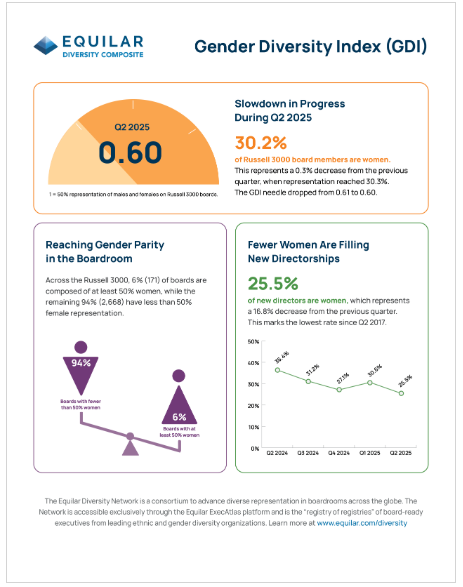
During the second quarter of 2025, the percentage of women on Russell 3000 boards experienced a modest decline from 30.3% in Q1 to 30.2% in Q2.
Director appointment data from this quarter highlights a divergence between overall board growth and gender representation progress. The total number of new directors rose 14.5%, increasing from 627 in the previous quarter to 718 this quarter, making it the highest total of new directors since Q2 2021 when the figure reached 740. However, this growth is not mirrored in female representation. The number of new female directors declined 4.7%, falling from 192 last quarter to 183 this quarter.
Taking a closer look at the numbers, the prevalence of women who filled new board appointments decreased dramatically, declining 16.8% from 30.6% in Q1 2025 to 25.5% in Q2 2025. This is a significant decrease, and, more notably, it brings the prevalence of new female directors to its lowest point since Q2 2017 (24.9%). Despite the ongoing efforts to advance gender diversity in the boardroom, the pace of change remains slow. As the anti-DEI movement gains momentum, women continue to face significant hurdles to securing directorial positions at major corporations.

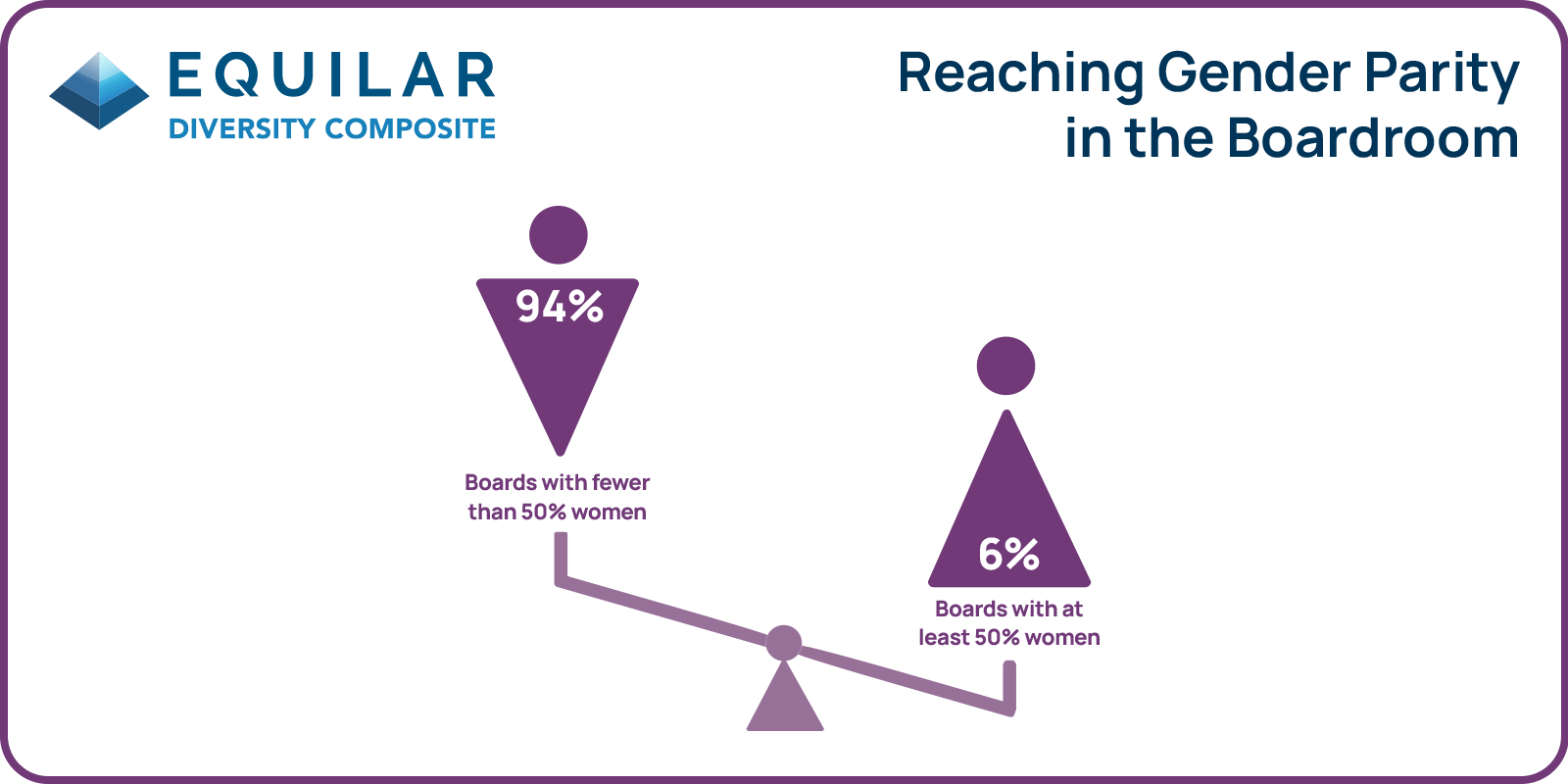
The number of boards where 40% to 50% of directors are women reached 388 this quarter, up from 356 boards in the previous two quarters. The Q2 analysis also shows that 6% (171) of boards are composed of at least 50% women, a drop from the 6.4% in the previous quarter, leaving the remaining 94% (2,668) still working toward this milestone.
Moving forward, it will be interesting to see if any significant progress towards gender parity will be made in the next quarter. While the current data suggests stagnation in gender diversity in the boardroom, the coming quarters will determine whether the momentum toward gender parity can be regained and sustained.
The following Equilar Researchers provided data and analysis: Sehee Han, Jeremy Ho, Grace Huang, Gabriel Klewin, Olivia Simon, Yuiko Shimizo, Amory Tong, and Starlee Hoc.
