
 Print
Print E-Mail
Alex Madronal is a Director and Dick Patton is a Consultant at Russell Reynolds Associates. This post is based on a Russell Reynolds memorandum.
CEO turnover in consumer companies hit a record high last year, in the face of rapid, compounding change. The job has never been harder — tenures are shortening, the environment is less predictable, and the pipeline of leaders ready and willing to step into the role is thinning.
Boards are already responding, reaching more often for leaders with prior CEO experience. But hiring differently is only part of the answer. The boards that treat succession as an ongoing discipline are positioning their organizations to navigate what comes next, rather than just reacting to it.
 Prolonged uncertainty drives higher CEO turnover and earlier exits among consumer CEOs
In 2025, 54 consumer CEOs at publicly listed companies around the world left their roles, the most since we began tracking CEO turnover in 2018. In percentage terms, this was the highest turnover rate of any sector we track across listed global indices, at 17%.1 Those who left spent less time in seat than their peers in any other industry, serving just 6.3 years on average (compared to the 7.1-year global average), continuing the shortening tenure trend.
This wasn’t an anomaly. Consumer CEO turnover tends to spike during periods of disruption; we saw it during COVID in 2020 and 2021, and again last year (Figure 1). Consumer companies’ performance is correlated with the front line of consumer behavior; when uncertainty rises and spending shifts, it’s quickly reflected in results. And boards respond.
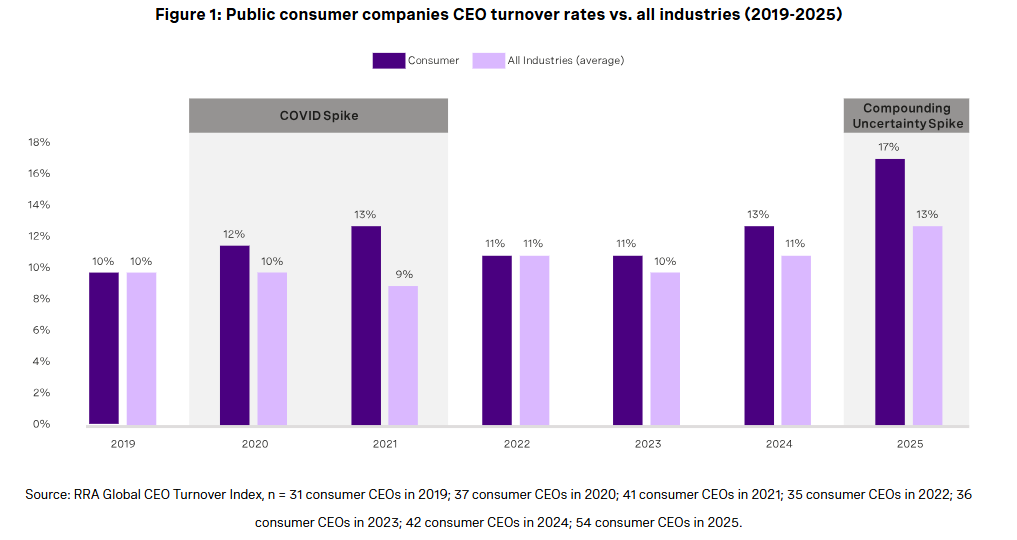
What makes 2025 particularly striking is how underprepared many consumer boards appear to be for this moment. In our 2025 Board Culture and Director Behaviors Study, almost half of consumer board members said they either didn’t have a CEO succession plan or weren’t sure if they had one. Of those who did have a plan, almost half said it extended three years or less into the future. Across the full sample, about half of board directors weren’t confident that an internal successor candidate would be named to the role if they had to replace their CEO tomorrow. In an environment where turnover is likely to remain elevated, the cost of being unprepared is increasing.
Compounding uncertainty: A new era of consumer disruption
The pandemic permanently changed how consumers behave. Digital habits, omnichannel expectations, and restructured operating models became the new normal. Boards rewarded agility and transformation speed, elevating leaders who could make fast decisions under pressure. But before many companies could fully absorb those changes, a different kind of disruption arrived, no less intense, and harder to read.
Unlike COVID, which pointed companies on a clear (albeit difficult) vector, the forces shaping 2025 and beyond pull in different directions with no clear playbook. Prolonged inflation and a period of high interest rates continue to pressure household budgets, making consumers more value-focused and selective, further contesting wallet share across categories and geographies. As leaders navigate shifting trade policy, AI-accelerated technology transformation, and slowing consumer spending, decisions rarely stay in one lane; a supply chain call can quickly become a pricing call, and then a brand call. Managing simultaneous short-term results and long-term resilience shortens boards’ patience for visible progress. While many leaders persevered in 2025, the compounding of these competing demands has driven higher CEO turnover across the industry.
The profile of the incoming consumer CEO
Although listed consumer boards remain comfortable with appointing first-time CEOs, they are less willing to negotiate on prior public company experience. First-timers remain the majority of appointments, at 78% of incoming CEOs, yet boards are increasingly looking for CEOs who’ve done the job before. Appointments of CEOs with prior public company CEO experience nearly doubled year over year, and appointments of CEOs with any prior CEO experience—public or private—nearly tripled.
That shift reflects the weight of the current environment. Boards are seeking leaders who have weathered uncertainty or led transformations before, particularly at larger companies where the stakes are high, and the margin for error is low. They still rely heavily on first-time CEOs, often because internal candidates bring company-specific knowledge and credibility, but the appeal of leaders who have done it before grew notably stronger in 2025. As AI is pushing the pace of change faster than most organizations can absorb, boards are looking for leaders who can match that speed from day one.
The succession imperative in the consumer industry
CEO succession is one of the board’s most important responsibilities. In consumer, the urgency has never been greater.
Consumer behavior sets the pace for everything that follows. It drives results, which draws investor scrutiny and board pressure, which ultimately shapes CEO tenure. When that behavior shifts quickly, boards have to respond quickly.
The challenge isn’t just finding the right candidate today. It’s that the pipelines boards are counting on for tomorrow are eroding. Per our Global Leadership Monitor, 65% of C-suite and next-generation consumer leaders aren’t expressly interested in the CEO role, meaning the bench of interested and motivated executives is likely thinner than boards expect. And the consumer leaders who might otherwise develop that ambition may not stay put: almost ¾ (73%) of next generation consumer leaders expressed interest in leaving their employers and 70% were interested in looking beyond consumer altogether. Yet most boards are responding to transitions, rather than preparing for them. Our prior research found that fewer than half of consumer board directors believe their CEO succession plans will succeed. In a sector where the environment rarely slows down enough to catch up, that gap is getting harder to close.
Strengthening succession pipelines requires more than updating a plan. Most boards aren’t looking far enough ahead. Many are working with incomplete pictures of their own talent, leaving the internal pipeline largely invisible until a transition makes it urgent. Boards that get ahead of this invest in transparent succession processes, tailored development, and building a leadership culture where senior teams role model the behaviors next generation leaders need to see. In a sector already contending with record turnover, those investments aren’t just good practice. They can be the difference between having a pipeline and discovering too late that you don’t.
For consumer board directors, three recommendations stand out:
-
Start earlier—and plan for optionality, not just replacement
Many consumer boards still begin succession planning 12 to 18 months before a transition. In today’s environment, that is too late. The boards that start three to five years in advance—or better yet, as soon as a new CEO begins their tenure—give themselves the optionality to 1) develop multiple credible candidates, 2) close experience gaps, 3) scenario-plan for activist pressure, 4) maintain speed on transformation mandates, and 5) strategize around the next potential external shock.
-
Redefine readiness for a compressed CEO lifecycle
Consumer CEOs already face the shortest tenures of any sector, and with first-time CEOs making up most new appointments, boards must redefine what “ready” truly means. It is less about having done the job before and more about curiosity and adaptability, learning agility, decision-making under pressure, leading transformations, and the ability to build and mobilize a senior team quickly. Directors who are explicit about the mandate, expected outcomes, and trade-offs from the start are the ones who avoid shortened tenures becoming self-fulfilling—judgments made before performance can reasonably materialize.
-
Treat CEO development as a governance responsibility, not a remedial one
Boards that treat first-time CEO appointments as a strategic choice understand that the decision does not end at selection—it begins there, including when the appointment is internal. Development must be embedded into the succession plan itself, not treated as something a CEO opts into or requires only when performance falters. Boards that invest early and visibly through structured transitions, targeted coaching, and strong chair-CEO partnerships give their CEOs the best chance of reaching peak effectiveness faster than learning on the job alone would allow. Developing the CEO is as much about protection as it is about acceleration.
