Print
Print E-Mail
Barbara Berlin is Managing Director at the PricewaterhouseCoopers (PwC) Governance Insights Center. This post is based on her PwC memorandum.
We are in what might be termed the early days of generative AI (GenAI). It was only in November 2022 that the consumer release of ChatGPT captured the world’s imagination. Since then, companies have been struggling to keep pace as GenAI’s potential and risks continue to expand. Early leaders have developed a strategy to address six critical priorities for effective GenAI adoption. To fashion and maintain a successful early days GenAI strategy, boards should engage with management and consider focusing their attention on the following key priorities.
Priority 1
Oversee the balancing of AI risks and rewards
Organizations need to strike a balance, finding ways to tap GenAI’s undeniable excitement and potential while taking the associated risks seriously. Opportunity seekers and risk-minded leaders need a healthy dose of appreciation for the priorities and concerns of the other and to be on the same page. This demands management and board alignment on the company’s risk tolerance and appetite around GenAI. Achieving healthy tension often starts with developing an agreed-upon core set of principles and adopting a framework for responsible AI use. These activities can provide practical safeguards and guidelines for directors and management to steer decision-making and help the organization move forward faster and with more confidence.
Priority 2
Manage alignment of your GenAI strategy with your digital strategy
GenAI is already impacting companies’ ongoing digital transformation campaigns. GenAI’s primary output is digital, after all — digital data, assets and analytic insights. On the other hand, it’s also easy, given the excitement around GenAI, for experimental efforts to germinate that are disconnected from broader efforts to accelerate digital value creation.
Boards should discuss with management how the GenAI strategy can align with the overall digital strategy, both current and prospective, and confirm management doesn’t forgo the opportunity to turbocharge existing digital efforts. Given how much companies have already invested in digitization, and the significance of GenAI’s potential, integrating the two is essential to see real benefits.
Priority 3
Focus on experimentation with an eye for scaling
With GenAI broadly available throughout the organization, people at all levels are initiating and developing use cases. The implications are major: Breakthroughs and pilot projects, appropriately scaled, can not only generate revenue but shift entire business models. Board oversight could hardly be more important, viewing experimentation through a holistic lens to see long-term value creation as well as risks managed.
The board should encourage management to form an enterprise-wide committee to bring together information, set policies, and discuss business opportunities and risks. Establishing such a committee can facilitate sharing of data, insights and leading practices, helping to identify potential GenAI use cases that can be deployed at scale across the organization. The committee can also focus on the talent strategy, and the capabilities and upskilling to succeed at scale.
Priority 4
Manage strategic thinking about productivity gains
AI applications have long increased workplace productivity, of course, but the rise of GenAI has boosted leaders’ awareness of and interest in AI-enabled productivity gains. Companies can look to use those gains to reduce labor input; or for reinvestment to boost quality, volume, and speed of goods and services; or pursue a combination of the two. The right answer differs depending on the industry and the organization. Not thinking strategically about this may lead to missing opportunities for increasing efficiency, reducing costs or improving job satisfaction by avoiding time-consuming, repetitive tasks.
The board should discuss with management their plans around productivity gains. They can ask key questions: What is the relative importance of speed, quality and cost improvements? What time horizon are we solving for? How will we upskill employees whose skills have become redundant as a result of new GenAI capabilities? Clarity is important looking forward.
US CEOs are growing more enthusiastic about deploying GenAI as part of their strategic plans to accelerate business model reinvention
Most US CEOs say this will be the year that they reap returns on their investments in GenAI, with 61% expecting it to improve the quality of their products and services.
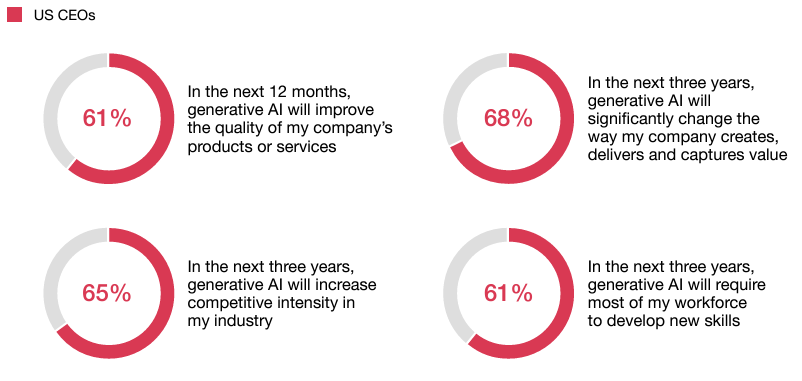
Q: To what extent do you agree or disagree with the following statements about generative AI? (Showing responses to ‘NET: Agree’) Source: PwC’s 27th Annual CEO Survey, base of 4,702, US base of 231
Priority 5
Place people at the heart of your GenAI strategy
Management may see GenAI as an engine of opportunity, but employees are uncertain and less optimistic: Our Global Workforce Hopes and Fears Survey highlights that fewer than 30% of workers see AI creating new job opportunities. The board should look to help position the organization to capitalize on GenAI’s promise to everyone’s benefit, encouraging management to communicate early and often so employees understand how the technology aligns with the company’s goals and how it can enhance work rather than replace it. An innovative culture also makes a real difference in determining success. If your people aren’t at the heart of your GenAI strategy, your organization may not be able to pivot to capture new opportunities.
The board should also encourage management to invest in customized training and upskilling, foster a culture of learning and experimentation with AI, provide clear guidelines to enable responsible AI use, and measure what’s working and not working with employee feedback and KPIs for productivity, customer satisfaction and more.
Most US CEOs see GenAI increasing the amount of work that employees can accomplish
How will GenAI affect your company in the next 12 months?
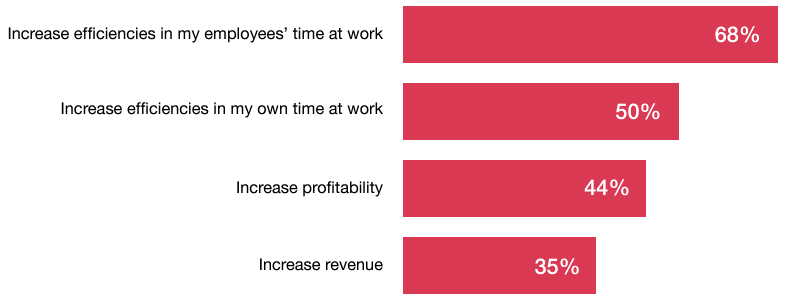
Q: To what extent will generative AI increase or decrease the following in your company in the next 12 months? (Showing summary ‘NET’ Increase)
Source: PwC’s 27th Annual CEO Survey, base of 4,702, US base of 231
Priority 6
Understand your ecosystem to unlock potential benefits
As GenAI experimentation ramps up, it’s important to look beyond the company’s four walls. The GenAI strategy should look at the company’s ecosystem and how broad initiatives might unlock benefits. For example, does management know how partners such as suppliers and service providers are leveraging GenAI? Could closer collaboration lead to fresh opportunities? The board should ask management about its ecosystem strategy. Not asking such questions may lead to companies missing breakthroughs in product, process and service innovations.