
 Print
Print E-Mail
Ray Garcia is a Partner, Paul DeNicola is a Principal, and Ariel Smilowitz a Managing Director at PricewaterhouseCoopers LLP. This post is based on a PwC memorandum, produced in collaboration with Stanford, by Mr. Garcia, Mr. DeNicola, Mr. Smilowitz, Mayree Clark, and Linda Reifler.
Exceptional boards don’t happen by accident. They’re driven by leaders — board chairs, lead directors and committee chairs — who combine strategic foresight, emotional intelligence and an unrelenting commitment to the organization’s long-term health. These leaders unite directors into a high-impact team, work towards a shared vision, challenge and coach the CEO in equal measure, refresh talent relentlessly and stay unflappable when crises hit. When leadership falters — signaled by groupthink, a poor relationship with the CEO or underperforming directors — they act fast: commissioning frank evaluations, rotating roles, clarifying responsibilities and, if needed, making a change. Outstanding board leaders treat governance as a living system, adapting structures and processes to match strategy and turning oversight into an engine for value creation. By embracing these principles, board leaders can move from “good enough” to game-changing, steering their companies into the future with confidence and purpose.
A company’s health and success rely on the effectiveness of the CEO as a leader and manager as well as the effectiveness and independence of board leadership. Given the average tenure of CEOs is relatively short, it is in fact the board of directors as the governing body that is ultimately responsible for the long-term health of the organization. Considering the many disruptive challenges companies face, the board’s role is more demanding than ever. Charged with setting direction, overseeing risk, aligning incentives and holding management accountable, boards must balance short-term performance with long-term goals — adapting to evolving market conditions and stakeholder expectations along the way.
In this context, effective leaders cultivate a board and board culture with distinct attributes, practices and responsibilities.
There are several different leadership models that boards may choose to employ. Whether authority is combined in a single chair/CEO role, separated through a nonexecutive or independent chair, or balanced via a lead director, the board leader must prioritize governance and the board’s fiduciary responsibilities, even when managing executive responsibilities.

Unlike a C-suite executive, a board chair or lead director guides a team of peers without traditional hierarchical structure, steering the board toward shared goals through influence and collaboration. Elected by fellow directors and accountable to both shareholders and stakeholders, he or she must inspire trust, foster engagement and navigate complex group dynamics in the boardroom and with the management team. Success requires sound judgment, emotional intelligence and the ability to lead candid, constructive dialogue while supporting management and safeguarding the board’s independence and effectiveness. It also requires dedicating significantly more time compared to other directors. He or she must maintain flexibility in scheduling and personal responsibilities to proactively keep in touch with the board and to effectively respond to unpredictable events or crises.
Combining the roles of chair and CEO places significant demands on the individual, who must stay conscious of wearing two distinct hats — sometimes simultaneously — and be clear about which role is being exercised at any given moment. In this context, the lead director must remain vigilant and unambiguous, ready to step in and fulfill many of the leadership functions described here.

We offer insights into how to foster outstanding board leadership by providing:
- A framework for what exceptional leadership looks like in practice, with examples of good and least effective behaviors
- How to move the needle from good to great
- What to do if things aren’t working, including guidance on how to catalyze change
What makes an effective board leader?
In our experience, eight attributes define outstanding board leadership:
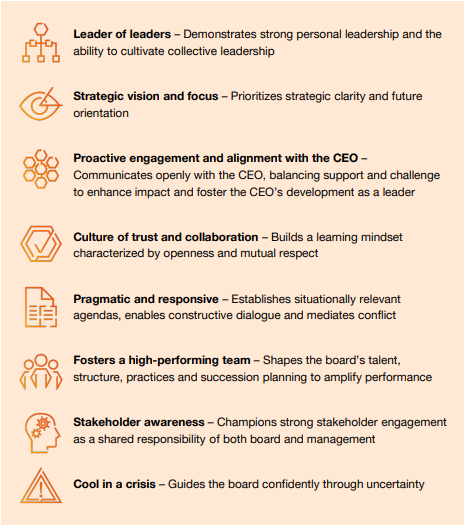
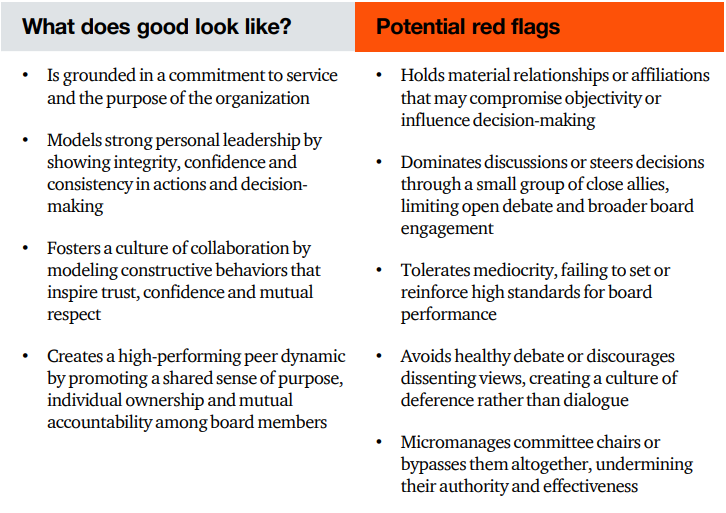
Whether serving as board chair, lead director or even committee chair, these attributes are essential to fulfilling the responsibilities of the role with distinction. We describe each of these qualities in greater detail, along with a framework for assessing effective practices and potential red flags.
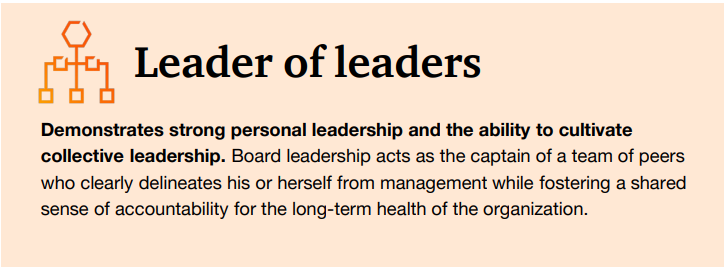
What does this look like in practice?
This involves leading by example — coming prepared, acting with integrity and decisiveness, and focusing on long-term impact — while cultivating a culture of shared responsibility. Board leadership builds trust with management while maintaining independence, engages all board members to encourage diverse perspectives and promotes accountability and continuous development. By aligning the board with the organization’s purpose and future goals, they transform a group of individuals into a cohesive, high-performing team.

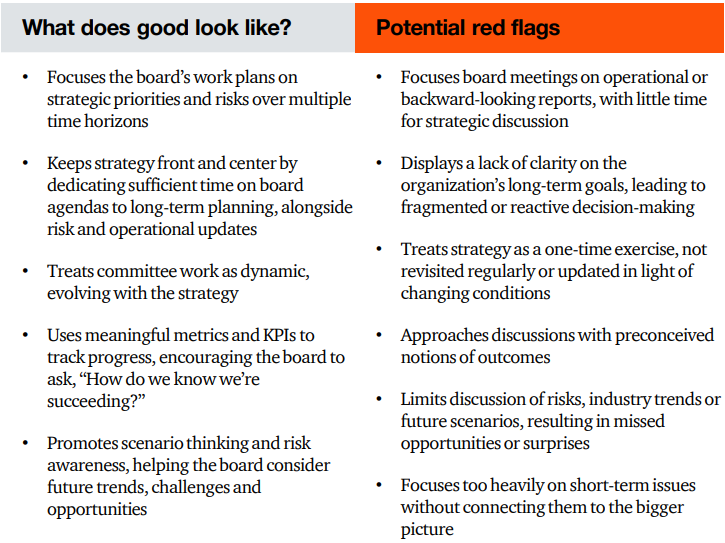
What does this look like in practice?
This involves prioritizing strategic discussions on meeting agendas, cultivating a collaborative dynamic between the board and management throughout the strategy development process, aligning directors around a well-defined strategic vision and using key performance indicators to track the organization’s progress against long-term goals. Board leadership facilitates regular reviews of strategic execution, integrates strategy into CEO evaluation and succession planning, and fosters a culture of open, future-focused dialogue. By encouraging ongoing education on emerging trends and dedicating time to strategic deep dives, they position the board to add meaningful value beyond compliance — guiding the organization’s sustainable growth and resilience over time.
What does this look like in practice?
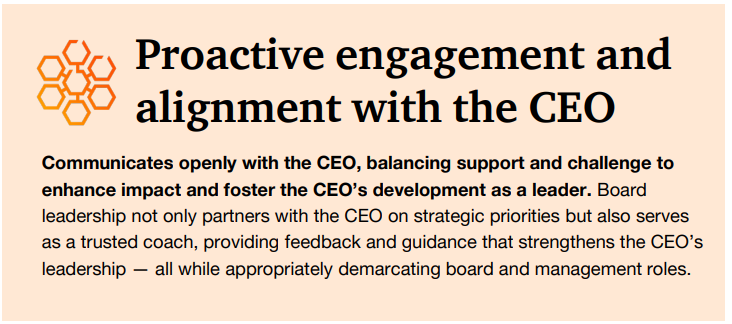
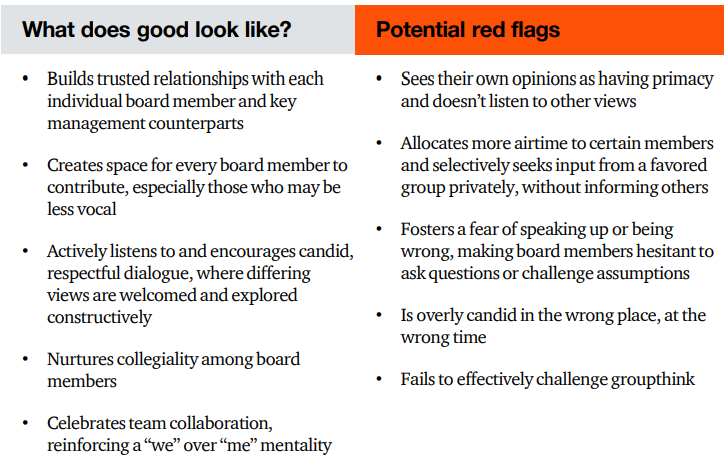
This involves maintaining clear boundaries between oversight and execution while cultivating a high-functioning relationship with the CEO. Board leadership coordinates regularly with the CEO on emerging issues and long-term priorities, offering thought partnership and development coaching as needed. They support open dialogue between the board and executive team, build trusted relationships and facilitate the right level of board involvement. Through thoughtful agendas, clear expectations and a focus on strategic outcomes, board leadership helps the board stay engaged and effective without overstepping. When tensions arise, they address it early to preserve healthy board-management dynamics.


What does this look like in practice?
This involves modeling openness and respect. Board leadership promotes inclusive participation and creates a psychologically safe environment for both board members and management. Additionally, board leadership asks questions, admits when they don’t have all the answers and encourages the board to consider what’s working and what’s not. By fostering curiosity, reflection and shared learning, they help the board evolve and harness its collective insight to improve decision-making and long-term impact.

What does this look like in practice?
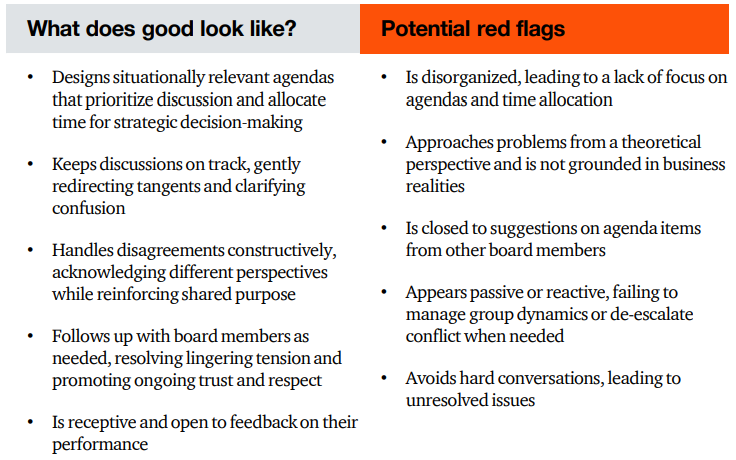
This involves dynamic ownership and management of agenda-setting to promote relevant and constructive dialogue between the board and the management team. Board leadership manages discussions with clarity and composure, and fosters open, respectful dialogue while keeping conversations purposeful and on track. They guide the board through differences of opinion and mediate conflicts with neutrality and empathy. By setting a tone of constructive engagement, board leadership helps the board work through challenges productively and maintains trust — even when tensions arise. Their presence helps the board remain focused, united and effective in its deliberations.
What does this look like in practice?
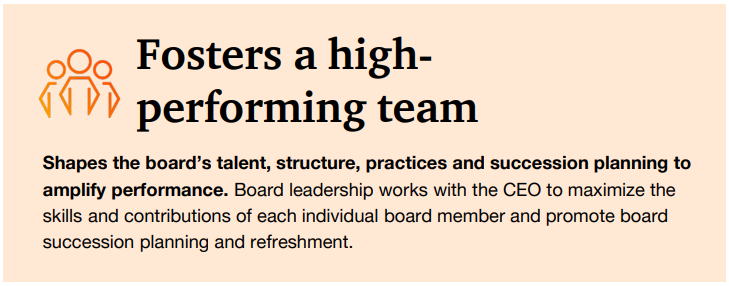
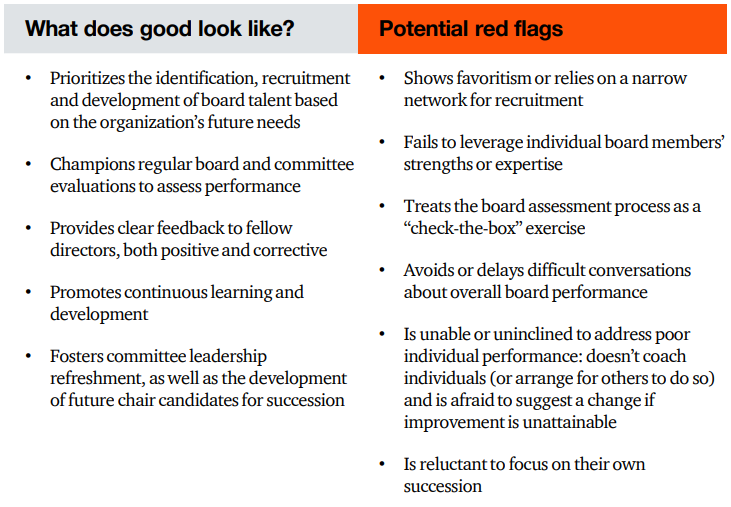
This involves taking ownership for sustained board performance by aligning the right people with appropriate roles and fostering the desired culture. Board leadership works closely with the CEO to assess board composition, identify strategic gaps and guide recruitment aligned with the organization’s goals. They coach underperforming members or encourage transitions when needed, while actively developing successors for all leadership roles, including their own. By setting clear expectations and fostering continuous development, board leadership cultivates a dynamic, diverse board that evolves with the needs of the organization.

What does this look like in practice?
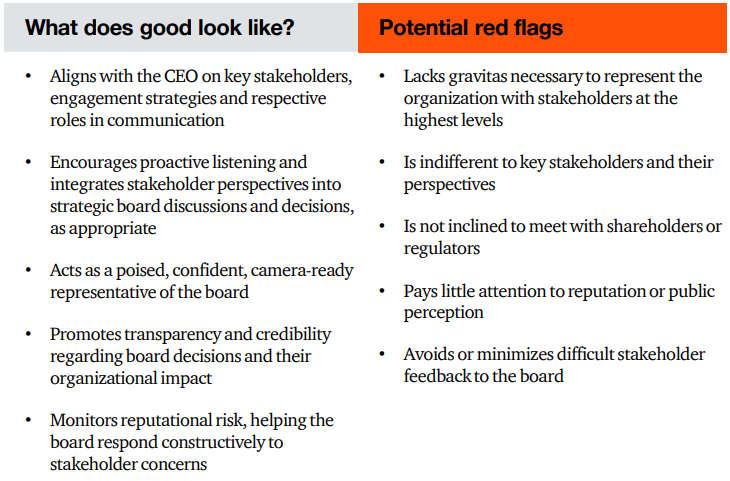
This involves shaping how the board and management engage with stakeholders. Board leadership helps identify who matters most, coordinates messaging and strategy, and models thoughtful, coordinated engagement. While respecting management’s lead role, they represent the board when appropriate and encourage the board to consider stakeholder perspectives in decision-making. By fostering transparent, credible communication and proactively monitoring stakeholder sentiment, board leadership helps the organization build trust externally, manage reputational risk and strengthen relationships critical to long-term success.
What does this look like in practice?
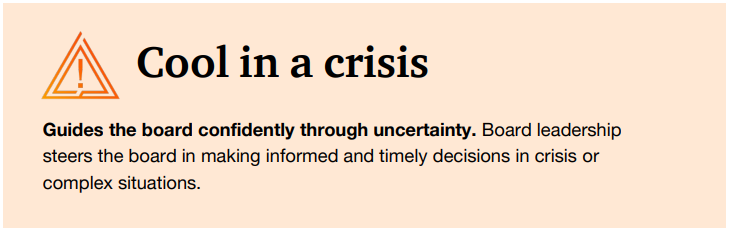
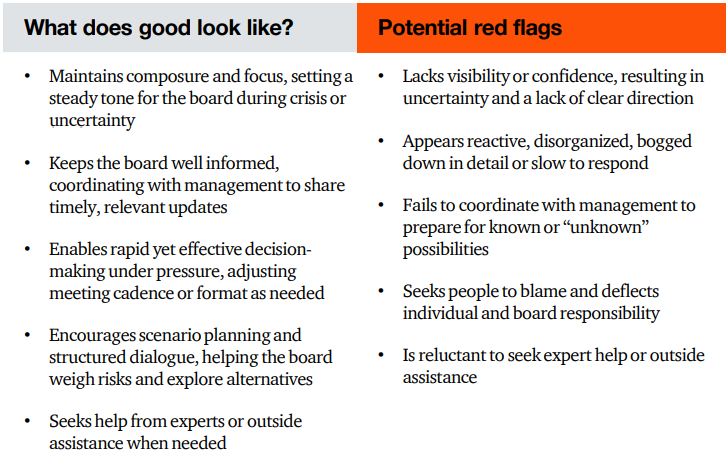
This involves guiding the board with steadiness and clarity during uncertain or high-stakes situations. Board leadership stays composed under pressure, equips directors with the right information and leads timely, focused discussions that prioritize informed decision-making. They work closely with the CEO, adapt board processes as needed and use scenario planning to explore risks and options. By fostering open dialogue and a shared purpose, board leadership helps the board navigate uncertainty with confidence, cohesion and resilience.
How can board leadership move the needle from good to great?
Because an organization’s circumstances are constantly evolving, leadership that proves outstanding in one year may fall short in the next. Great boards adapt. This framework provides a starting point for board leaders to continuously refine their effectiveness and sustain excellence over time. However, those who aspire to elevate their impact must go beyond the basics of meeting facilitation and governance mechanics. Transitioning from good to great leadership requires a commitment to continuous learning, intentional reflection and proactive engagement with both the board and the broader organization.
One of the most effective ways to begin this journey is by leveraging structured performance assessments and independent reviews to gain insight into how the board is functioning and how leadership is perceived. Though 59% of directors believe their board leadership manages the board assessment process effectively, only 34% feel that leadership is very effective at dealing with underperforming directors. [1] This highlights the importance of using the assessment process not only as a compliance tool, but as a springboard for growth.
In addition to formal assessments, self-reflection is a powerful yet underutilized tool. A great board leader regularly examines his or her own behaviors, leadership style and blind spots. This might include seeking informal feedback from peers, reflecting on challenging board moments or working with an executive coach to strengthen emotional intelligence and interpersonal effectiveness.
If it’s not working: how can boards address leadership issues or gaps?
When a board identifies a potential leadership gap or concern, taking timely action is essential, well before unanticipated events reveal the weakness. Below are several strategies for addressing challenges and closing any leadership gaps.
An ounce of prevention is worth a pound of cure: establish strong governance foundations
- Promote leadership succession and refreshment. Establishing a process that encourages leadership transitions through mechanisms such as mandatory retirement and board and committee chair rotation may help boards address potential leadership red flags, bring in fresher perspectives and maintain an independent mindset. Currently, it is uncommon for boards to set formal refreshment policies for those serving in a leadership position.
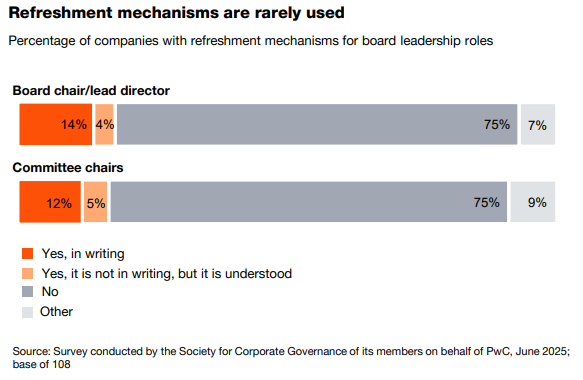
We think board leaders need a minimum of three to five years to peak. It takes time to fully understand the leadership position on any board, to adopt its rhythms and to achieve excellence. It’s a demanding position, and one that requires attention to new ideas. But it may be time to consider board leadership succession changes after eight to ten years.
- Clarify roles and responsibilities. Revisit the board’s governance framework (e.g., corporate governance guidelines, committee charters, bylaws, role descriptions, etc.) to make sure there are clearly defined leadership expectations and accountability mechanisms. That way, you can build explicit, recurring feedback loops that tie those roles to real-world performance. If performance assessment criteria flow directly from written role descriptions, the board has an objective basis to develop a plan which addresses the gaps.
- Use external feedback and evaluations. Consider bringing external perspectives or parties into the assessment process to help create a more holistic picture of board leadership’s strengths and weaknesses. One way is requesting 360° feedback from board members, management, investors and other stakeholders. Another is hiring an independent third party to facilitate the assessment process, something that only 22% of directors say their boards currently do.2 External advisors or counsel, as neutral intermediaries, can help create a more comfortable atmosphere that fosters openness and honesty from directors.
Take decisive action when concerns arise
- Tread carefully and build consensus. Arriving at a consensus that board leadership needs feedback or that a change is required is not easy to do since there is often no established process for raising the issue or pursuing it. At the same time, it is unusual that a single board member can successfully raise the topic without support from others. Quiet conversations by those who have trusted relationships with board leadership are likely to be most effective.
- Use the nominating/governance committee as a venue. A robust nominating/governance committee is instrumental in building and maintaining an effective board leadership structure. This can be a forum to coalesce observations. Given the committee’s focus on recruitment, development and evaluation, it should work in tandem with board leadership to consider role criteria, evaluate the current incumbent(s) and begin to recommend alternatives. This committee can serve as a place to bring together director observations, evaluate performance and propose changes. If, for some reason the nominating/governance committee is not the appropriate forum, consider using another committee to raise the topic and begin to get clarity across a broader group.
- Use assessments to justify leadership change when needed. When performance issues persist, formal evaluations and peer, investor or other stakeholder feedback can provide the basis for change, while minimizing personal conflict or disruption.
Conclusion
Outstanding board leadership is not accidental — it is intentional, exacting and indispensable. At a time when stakeholder scrutiny is high, strategic complexity is rising and the consequences of failure are profound, boards cannot afford to be complacent. The best board leaders are more than facilitators. They challenge norms, cultivate trust, enable strategy and enhance the entire boardroom dynamic. Greatness in this role requires more than skill. It requires purpose, accountability and humility to evolve.
Ultimately, elevating board leadership is not just a matter of good governance; it is a strategic imperative. Whether you’re a current board leader or fellow director, the responsibility to foster better leadership belongs to you. By applying the principles outlined in this paper, you can support boards in being better positioned to adapt, perform and lead their organizations into the future.
