
 Print
Print E-Mail
Rickard Nilsson is Director of Stewardship, Elena Leofanti is Senior Director of Stewardship, and Diederik Timmer is President at Glass, Lewis & Co. This post is based on their Glass Lewis memorandum.
Introduction
This document provides results and key findings from Glass Lewis’ Investor Stewardship Survey, performed in Q4 2025.
The goal of this survey has been to better understand how investors structure, resource, and execute stewardship in an increasingly complex operating environment.
The findings highlight how stewardship has become an established and increasingly sophisticated discipline, where organizational size and investment approach define operational models. We see continued regional divergence, and a focus on improving existing practices by strengthening for example integration, engagement prioritization, and accountability across stewardship efforts.
Covering a total of 27 questions, survey results reflect anonymized findings from both asset managers and assets owners globally, representing trillions of dollars in assets under management (AuM).
Findings are based on self-reported responses from participating organizations and are intended to be indicative rather than statistically representative of the full market. Results shown focus on the most decision-relevant findings; full question wording and response distributions are provided in the appendix. Where appropriate, analysis is supplemented by Glass Lewis’ broader industry experience.
Key Findings
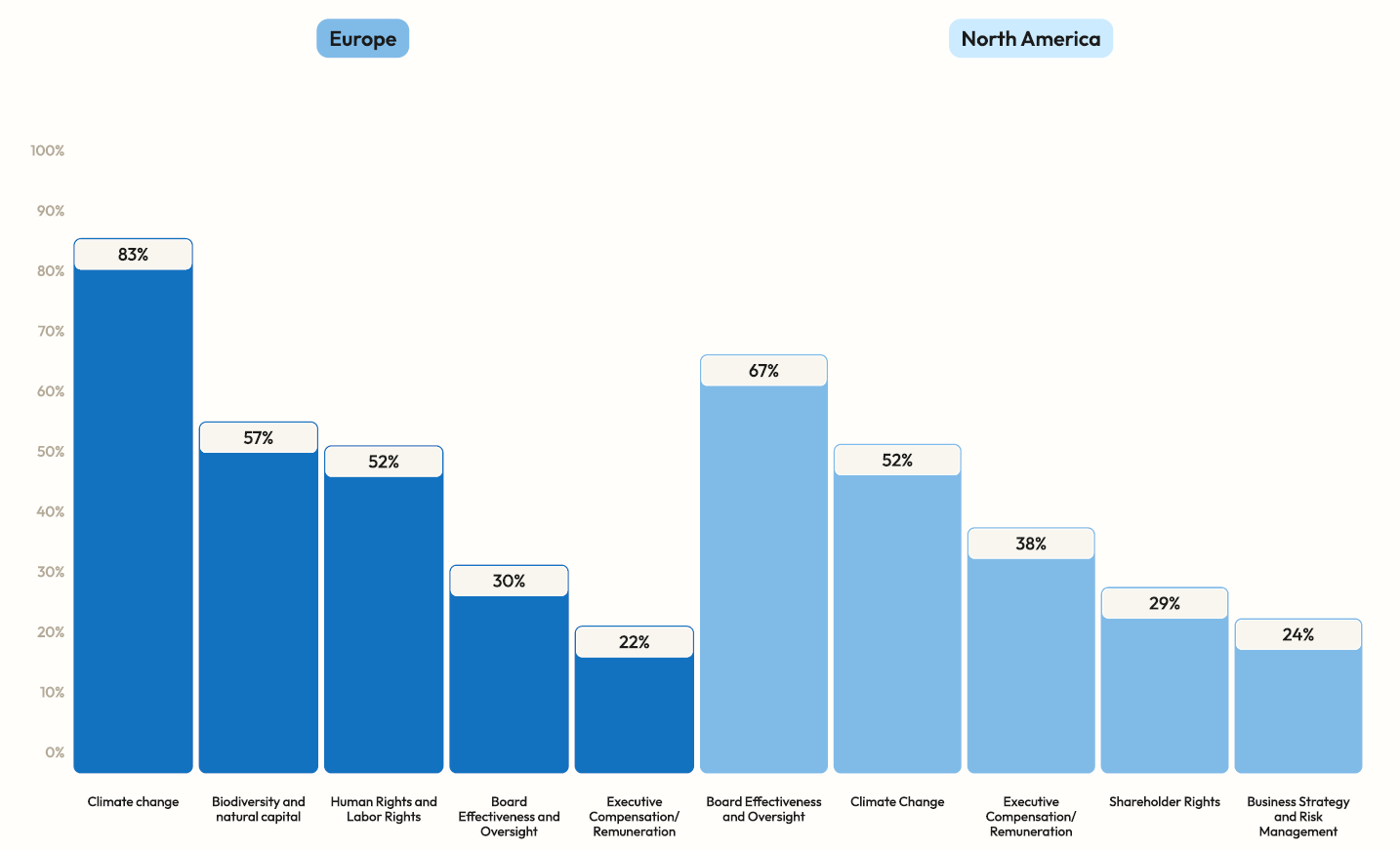
Engagement Priorities Converge on Climate and Governance, but Diverge by Region
Engagement activity focuses on climate change and board effectiveness and oversight, reinforcing their central role in stewardship agendas. At the same time, in line with broader market trends, regional differences emerge with European investors placing relatively greater emphasis on sustainability topics, while North American investors focus more on traditional governance issues.
Hybrid Stewardship Is the Norm, but It Increases Operational Complexity
With most respondents diversified across hundreds or thousands of assets, a majority describe a hybrid approach to stewardship; combining baseline market expectations for many holdings with deeper focus on a subset of engagement targets.
Organizational Approach to Stewardship

This requires significant effort to analyze holdings, set stewardship priorities, and track and report on progress prompting an introspection of capabilities to empower operational success in these areas.
Lean Teams, Steady Ambition: Why Stewardship Capacity Isn’t Primarily a Headcount Problem
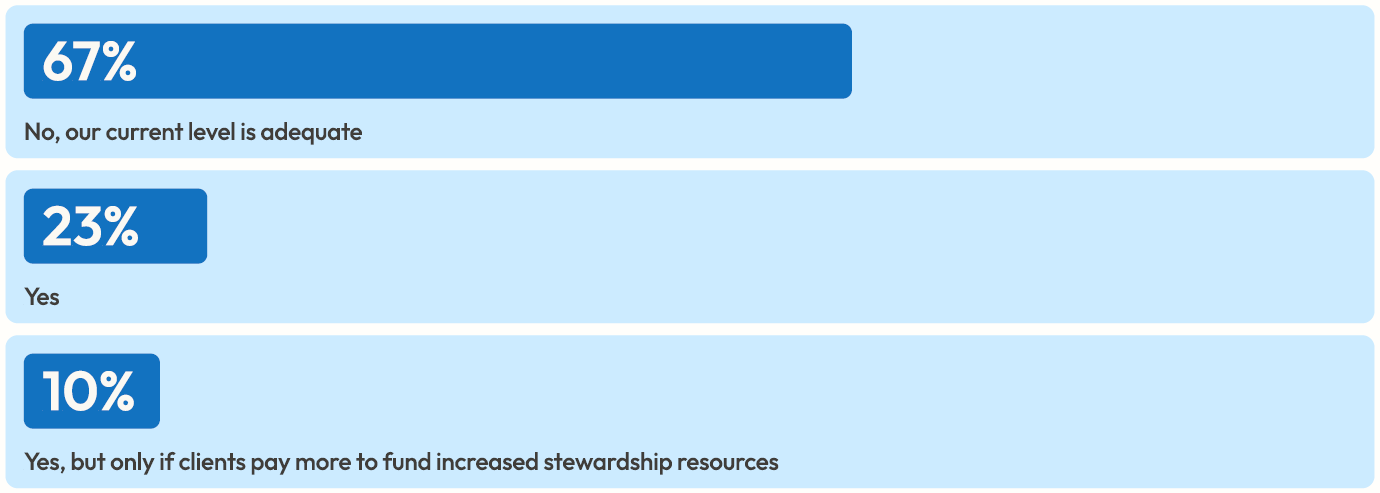
Stewardship teams most often comprise fewer than five professionals. Still, the majority of respondents believe current stewardship resourcing is adequate. Evidently, even with lean teams, most do not see “more headcount” as the answer. This points to operational improvements as important capacity levers.
Question: Are you looking to increase stewardship resources in the next 24 months?
Investors Seek to Strengthen Stewardship Via Accountability and Investment Integration
To strengthen the effectiveness of investment stewardship, many investors emphasize deeper integration with investment decision-making and the use of credible escalation. While both are widely viewed as high-impact strategies, broader industry research suggests that these approaches are not yet being implemented consistently or at scale, highlighting potential challenges in translating strategic intent into operational practice.

Stewardship Gains Are Expected Partly Where Admin Effort Is Highest
Stewardship admin time is primarily spent on prioritization, target research, and tracking engagement activity.
| Stewardship administrative tasks (time spent – most to least) | |
| 1 | Prioritization and target research |
| 2 | Recording and tracking of engagement activities and objectives |
| 3 | Analysis and reporting |
| 4 | Coordination, centralizing data and information sharing |
| 5 | Contact management (identifying and maintaining contact info) |
| 6 | Meeting coordination (scheduling, etc.) |
When asked how stewardship quality could be improved, many respondents pointed to strengthening those same areas, highlighting the focus on improving the workstreams that demand the most effort.

Investors Are Integrating Engagement and Voting – But Many Still Run Stewardship Ops on Spreadsheets
The vast majority of respondents say engagement and voting are either integrated or somewhat integrated, and three-quarters rate streamlining this as a medium to high priority. At the same time, engagement tracking is still mostly managed in siloed spreadsheets/general-purpose tools; if integration is the goal, then the operational model will need updating.*

* The table highlights results based on question alternatives from three separate questions.
Barriers to Tech Adoption: Cost Blocks Entry, While Integration Blocks Scale
Respondents cite cost considerations as the leading barrier to further stewardship technology adoption. While budget is a common hurdle, integration with existing systems grows in importance for larger stewardship and investment teams two different stories shaping market adoption.

Engagement Providers Function as Stewardship Capacity Multipliers
Most respondents do not use an external engagement provider. But among those who do, the top reasons are explicitly pragmatic: cost efficiency vs. adding headcount and scaling stewardship efforts. Increased utility therefore comes primarily from viewing these providers as ˝capacity multipliers,˛ leveraging external resources and expertise to pursue common goals.
| Reasons for using an external provider (ranked): | |
| 1 | More cost efficient than hiring additional internal resources |
| 2 | Desire to scale stewardship efforts |
| 3 | Gain access to more expertise or experience |
| 4 | To better meet client and stewardship objectives |
Asset Owners Want Greater Oversight of Outsourced Stewardship, but Data Plumbing Is the Bottleneck
Among asset owners with external management, a clear majority express interest in monitoring and reporting on stewardship performed on their behalf. When they try to operationalize this, the top ranked challenges are data collection and normalizing data across managers. Demand for oversight is evidently there; the constraint is interoperability and standardization.
| Process improvement areas (challenges most to least) | |
| 1 | Data collection process |
| 2 | Normalizing data across managers |
| 3 | Investment strategy / Asset class types |
| 4 | Investment Mandate Agreements (IMAs), power in relationship, and costs |
| 5 | Reporting (and possibly amalgamating data) to stakeholders |
| 6 | Centralizing data and suitable analysis capabilities |
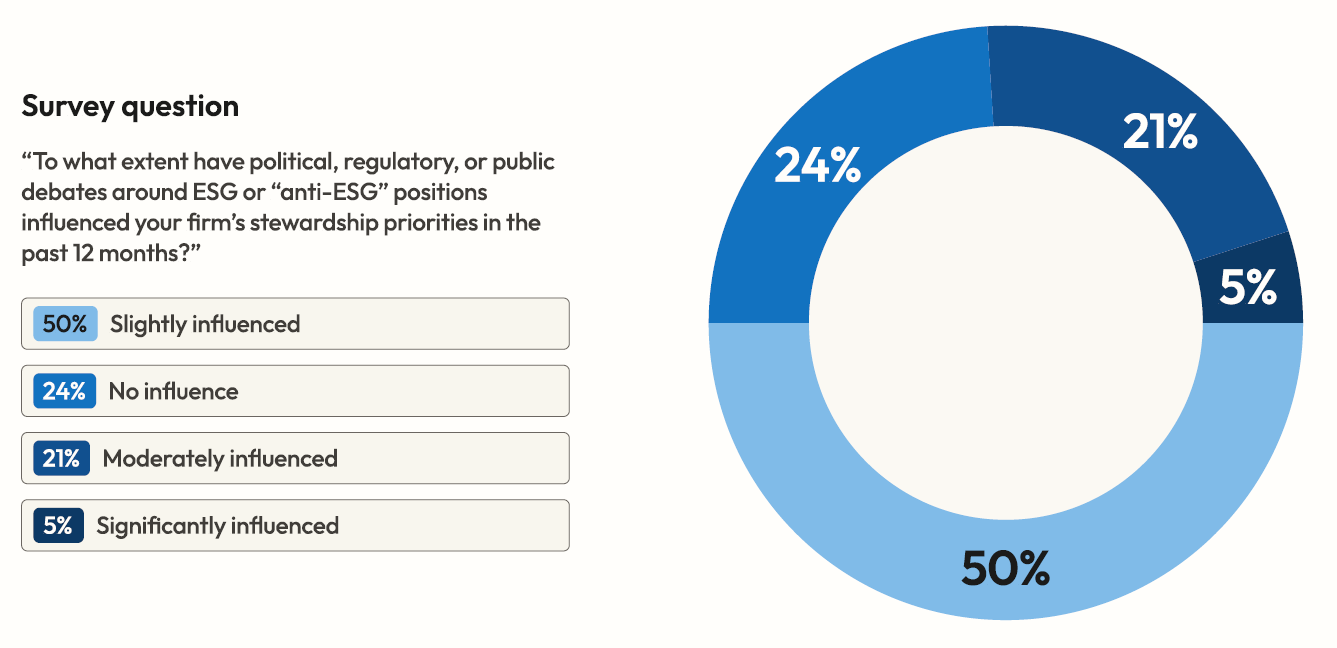
The ESG Debate Is Present, but Does Not Emerge as a Primary Influence
Most respondents report being slightly to moderately influenced by the external ESG discourse and regional developments, with only a few reporting major shifts in practices. Paired with the engagement topic insights, it reads as: we pay close attention, but core stewardship agendas remain fairly consistent. Notably, unlike with engagement priorities (see separate finding), responses to the ESG debate did not show significant regional variation.
The complete publication is available here.

