Print
Print E-Mail
Diana Lee is a Managing Director and Matt Filosa is a Senior Managing Director at Teneo. This post is based on a Teneo memorandum by Ms. Lee, Mr. Filosa, Rose James, Heidi Park, and Allie Ross, all at Teneo.
Introduction
It has been a year since we published our 2025 State of U.S. Sustainability Reports. The sustainability landscape remains marked by heightened scrutiny and uncertainty, as ongoing political conflicts and evolving global regulation continue to shape the expectations of key stakeholders.
For example, in the U.S., Republican state attorneys general continued to scrutinize company participation in climate initiatives, plastics and packaging and other sustainability-related activities. At the same time, California moved forward with mandatory climate disclosure requirements and Democratic states have scrutinized company rollbacks of diversity initiatives. Outside the U.S., the European Union continued efforts to simplify its sustainability reporting regime, while additional jurisdictions moved toward adopting disclosure requirements aligned with international frameworks (e.g., International Sustainability Standards Board (ISSB)). Amid this ongoing uncertainty and confusion globally, U.S. companies largely stayed the course on their sustainability reporting in 2026.
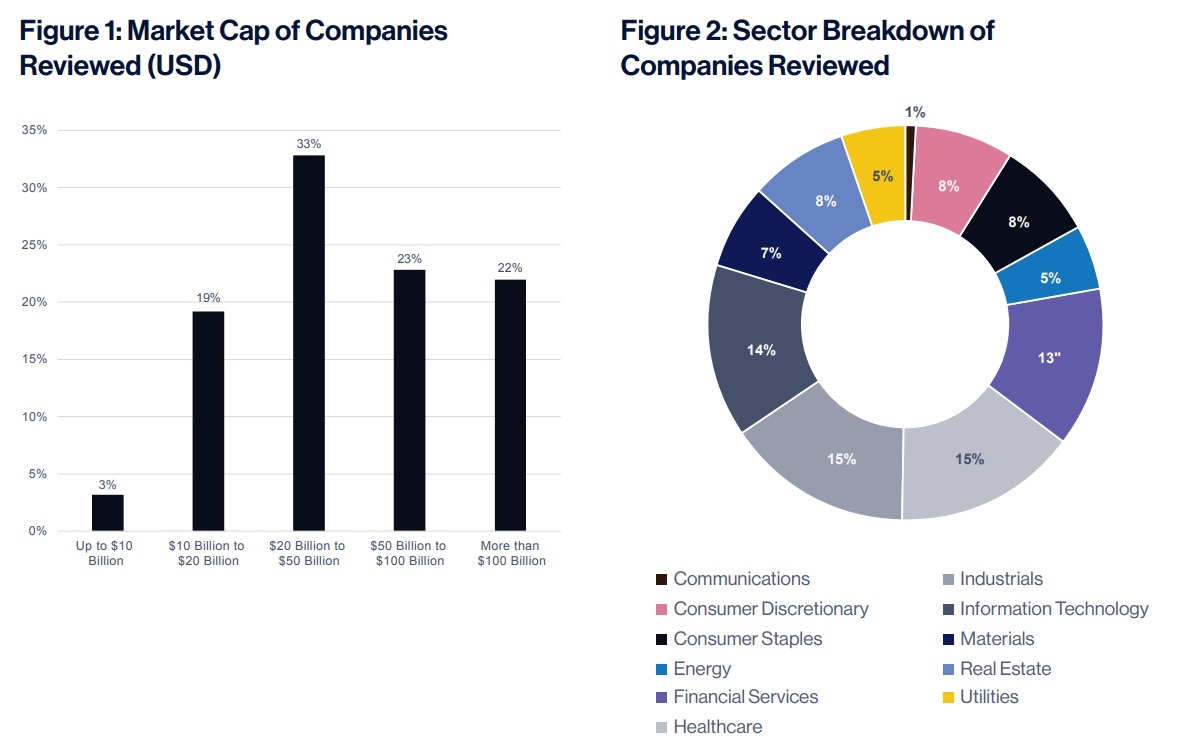
To help companies plan for reporting in 2027, we analyzed 250 sustainability reports from S&P 500 companies published in 2026. In this report, we provide (i) our study methodology; (ii) our top 10 takeaways from 2026 sustainability reports; and (iii) key statistics of 2026 sustainability reports.
Top 10 Takeaways From 2026 Sustainability Reports
01 Companies continue to publish sustainability reports but with less fanfare.
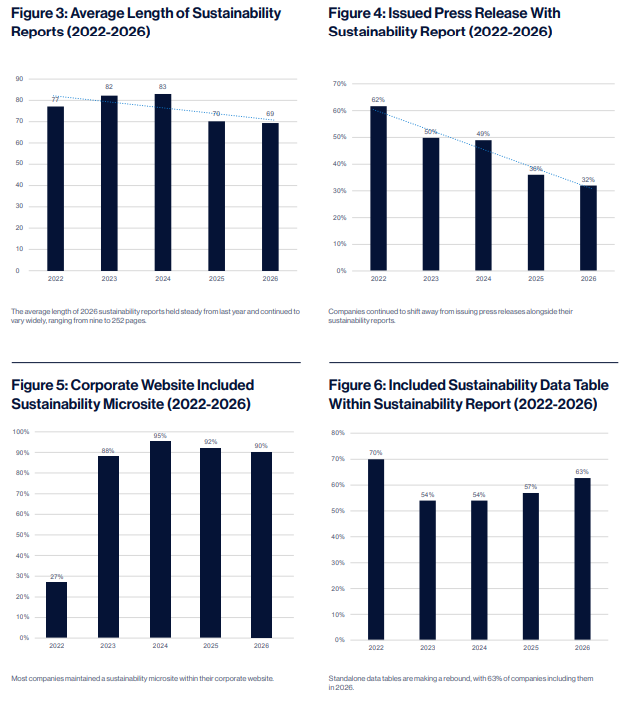
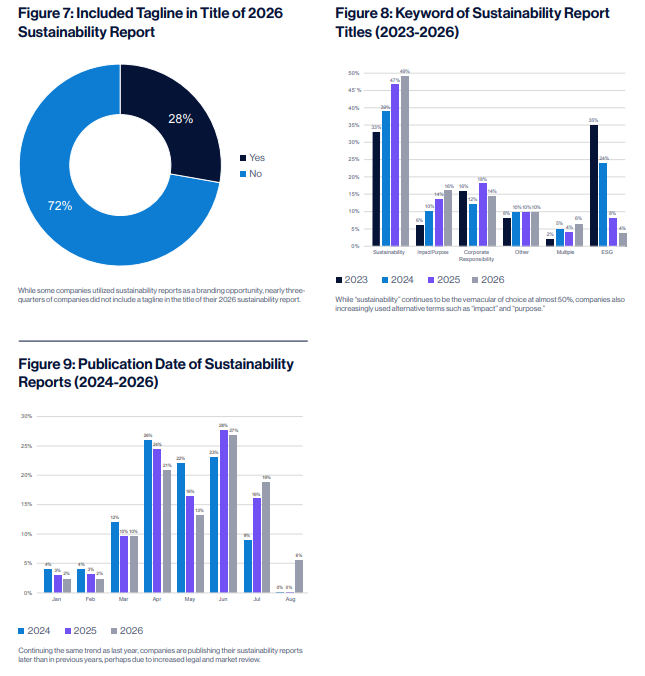
87% of companies that published a sustainability report by this time last year also published a sustainability report this year to date. Many of those sustainability reports were published later than last year, likely due to additional legal and market review. Report length held steady year over year, with the average length at 69 pages, while only 32% of companies issued a press release announcing publication of their sustainability report, down significantly from its peak of 62% in 2022.
02 Sustainability vernacular continues to evolve.
While “sustainability” maintains its dominance, “impact” and “purpose” emerged as increasingly popular choices for sustainability report titles. Meanwhile, the use of the acronym “ESG” almost disappeared from report titles, dropping to just 4% after peaking at 35% in 2022. Similarly, “ESG” appeared just 10 times within sustainability reports on average, representing a 50% decline from 2025.
03 Double materiality maintains momentum.
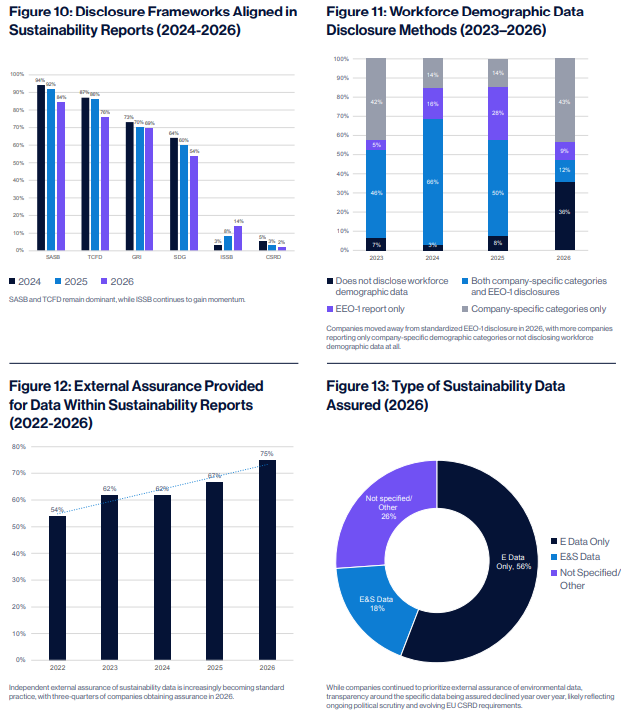
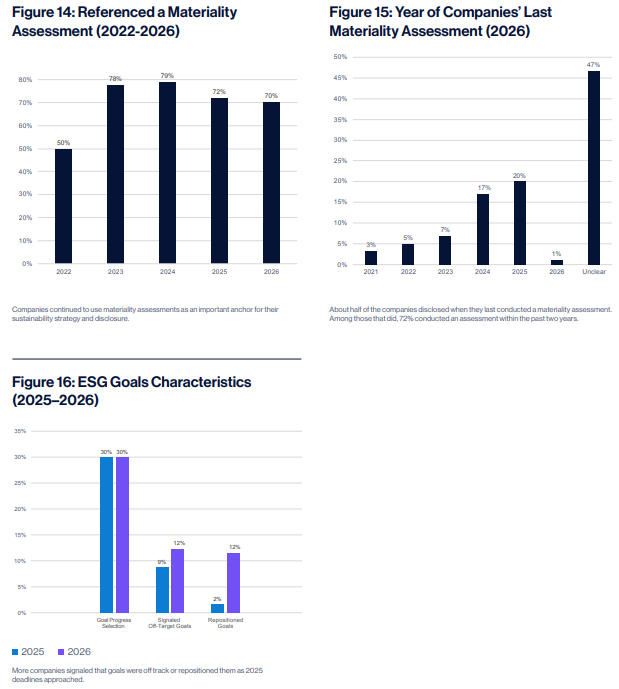
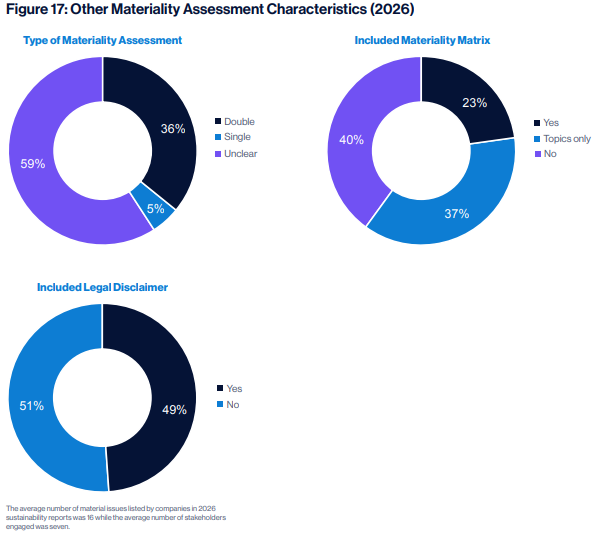
70% of companies disclosed that they had conducted a materiality assessment and the proportion that had completed (or were in the process of completing) a “double” materiality assessment increased to 51% (up from 41% in 2025). Of those companies, 44% referenced the European Union Corporate Sustainability Reporting Directive (EU CSRD) requirements, signaling continued attention to evolving EU compliance requirements.
04 International disclosure frameworks are still top of mind for U.S. companies with global operations.
14% of companies aligned their sustainability disclosures with the ISSB, almost double the number from last year. While most companies stopped short of confirming full alignment with the EU CSRD, 20% noted their ongoing monitoring of potential EU CSRD compliance requirements.
05 Companies continue to report on inclusion but with less supporting demographic data.
Most companies (72%) included dedicated inclusion- focused sections in their sustainability reports. Yet the share of companies disclosing workforce demographic data fell from 92% to 64%. Notably, standardized EEO-1 disclosure, which remained relatively resilient in 2025 despite broader changes to DE&I reporting, fell sharply from 78% to 21% in 2026.
06 Sustainability reports are now supported by more sustainability data overall.
While narratives remain an important part of reporting, companies are increasingly disclosing standalone sustainability data tables. Nearly two-thirds (63%) of companies included a sustainability data table in 2026, up from 57% in 2025. Commonly disclosed metrics included environmental data, such as greenhouse gas emissions, and metrics related to human capital management and employee health and safety. This shift has been accompanied by an increase in companies obtaining external assurance of their sustainability data.
07 External assurance is table stakes.
75% of companies obtained external assurance for data within sustainability reports, continuing a steady increase from 54% in 2022. Expected compliance requirements (e.g., EU CSRD) and political scrutiny have likely increased the focus on establishing the credibility of reported sustainability data.
08 General Counsels, Chief Sustainability Officers and Board Governance Committees are increasingly responsible for sustainability programs.
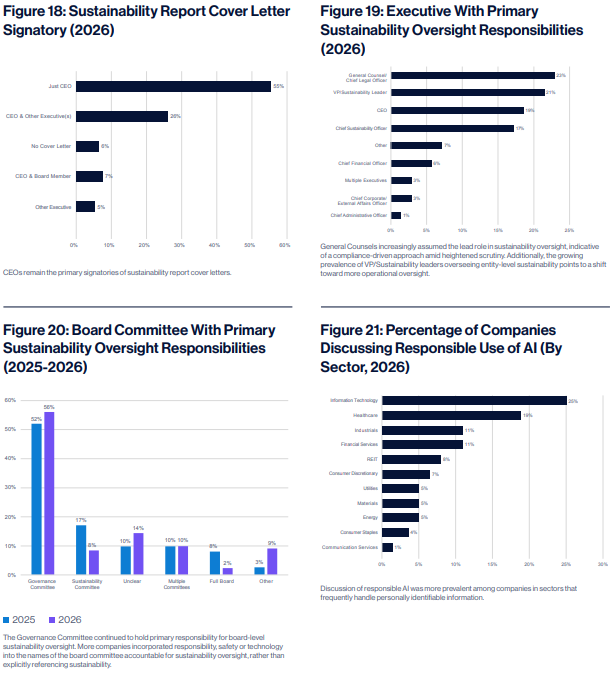
As sustainability programs become more operationalized and subject to varying compliance requirements across jurisdictions, management-level oversight is shifting accordingly. General Counsels now hold primary responsibility for sustainability oversight at 23% of companies. CEOs remain a leading choice at 19%, though their role as primary overseer declined notably from 28% in 2025. At the board level, sustainability committees are becoming less common, while more companies are assigning sustainability oversight to committees whose names include responsibility, safety or technology rather than sustainability.
09 While companies still disclosed goals, more companies signaled goals that were off track and/or repositioned them as deadlines approached.
The number of companies providing an ESG goals progress section remained steady at 30% year over year. However, the number signaling that at least one ESG goal was “off track” increased from 9% to 12%, while those reporting a repositioned goal increased from 2% to 12%. Two-thirds of off-track or repositioned goals were solely environmental, while 26% included both environmental and social goals.
10 A majority of companies mention their Al governance policy.
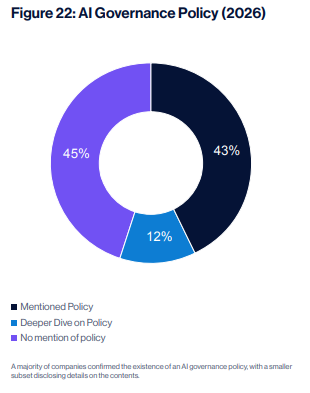
55% of companies referenced the existence of an Al governance policy in their sustainability reports, of which 12% providing specific details about their Al governance policies. Among companies that described their approach to responsible Al, information technology (25%) and healthcare (19%) companies were the most likely to provide such disclosures.
Key Statistics of 2026 Sustainability Reports
I. Sustainability Report Communications Characteristics
II. Sustainability Report Content Characteristics
III. Sustainability Report Governance Characteristics