Monthly Archives: January 2023

Climate Risk Factors Soar at Largest Public Companies

Dean Kingsley is a Principal and Matt Solomon is a Senior Manager at Deloitte & Touche LLP. Kristen Jaconi is an Associate Professor of the Practice in Accounting and Executive Director at Peter Arkley Institute for Risk Management at the USC Marshall School of Business. This post is based on their recent Deloitte report. Related research from the Program on Corporate Governance includes The Illusory Promise of Stakeholder Governance (discussed on the Forum here) and For Whom Corporate Leaders Bargain (discussed on the Forum here) both by Lucian A. Bebchuk and Roberto TallaritaRestoration: The Role Stakeholder Governance Must Play in Recreating a Fair and Sustainable American Economy—A Reply to Professor Rock (discussed on the Forum here) by Leo E. Strine, Jr.; and Stakeholder Capitalism in the Time of COVID (discussed on the Forum here) by Lucian Bebchuk, Kobi Kastiel, and Roberto Tallarita.

The past 12 months have continued to demonstrate the difficulty of effectively identifying and managing risk in the global business environment. Following the worst global pandemic in 100 years, U.S. companies have had to respond to the most significant armed conflict in Europe in over 80 years, the threat of use of nuclear weapons, a global trade and supply chain environment of unparalleled complexity, geopolitical tensions, the highest levels of inflation in 40 years, considerable global macro-economic uncertainty and volatility, and major tax, environmental, social, and governance (ESG) and cyber regulatory reforms.

In this highly dynamic environment, companies have had to continue to both manage and report publicly on their key risks in compliance with rules the Securities and Exchange Commission (SEC) finalized in 2020 to address the increasingly lengthy and generic risk factor disclosures of registrants. For a description of these rules, see Appendix: Summary of SEC’s Final Rule on Regulation S-K, Item 105. In order to understand the impact of these amended risk factor disclosure requirements, Deloitte and the Peter Arkley Institute for Risk Management at the USC Marshall School of Business are conducting a series of analyses on the risk factor disclosures filed by the Standard & Poor’s (S&P) 500 companies.
READ MORE »

Trends in Forum Selection Provisions, Merger Objection Class Actions and SPACs Continue To Shape Securities Litigation

Virginia Milstead is a Partner, and William J. O’Brien III is Counsel at Skadden, Arps, Slate, Meagher & Flom LLP. This post is based on their Skadden memorandum.

Key Points

  • State courts are enforcing federal forum provisions for cases under the Securities Act, encouraging companies to amend their charters or bylaws to add these clauses.
  • The previous boom in SPAC IPOs and subsequent mergers is likely to sustain a flow of class actions involving those transactions.
  • Suits challenging mergers have not declined, but most are now brought as individual suits rather than class actions.

In the first nine months of 2022, plaintiffs filed 157 securities class action lawsuits, according to Cornerstone Research — a figure only slightly lower than the 162 filings in the same period in 2021. Looking behind the numbers, class actions relating to SPACs and cryptocurrencies are expected to remain elevated in 2023 (see “Rise in Crypto Securities Filings Could Persist”), while state courts rulings on federal forum provisions and a shift in tactic for plaintiffs challenging mergers will continue to play out and shape securities litigation in the coming year.

READ MORE »

Investment Stewardship Proxy voting U.S. guidelines 2023

Sandy Boss is Global Head of Investment Stewardship, John Roe is Head of Investment Stewardship (BIS) in the Americas, and Jessica McDougall is a Director at BlackRock Inc. This post is based on their BlackRock memorandum.

These guidelines should be read in conjunction with the BlackRock Investment Stewardship Global Principles.

Introduction

As stewards of our clients’ investments, BlackRock believes it has a responsibility to engage with management teams and/or board members on material business issues and, for those clients who have given us authority, to vote proxies in the best long-term economic interests of their assets.

The following issue-specific proxy voting guidelines (the “Guidelines”) summarize BlackRock Investment Stewardship’s (“BIS”) philosophy and approach to engagement and voting, as well as our view of governance best practices and the roles and responsibilities of boards and directors for publicly listed U.S. companies. These Guidelines are not intended to limit the analysis of individual issues at specific companies or provide a guide to how BIS will engage and/or vote in every instance. They are to be applied with discretion, taking into consideration the range of issues and facts specific to the company, as well as individual ballot items at shareholder meetings.

READ MORE »

PwC’s Global Investor Survey 2022

James Chalmers is Global Assurance Leader, Nadja Picard is Global Reporting Leader, and Hilary Eastman is Head of Global Investor at PricewaterhouseCoopers LLP. This post is based on their PwC memorandum. Related research from the Program on Corporate Governance includes How Much Do Investors Care about Social Responsibility? (discussed on the Forum here) by Scott Hirst, Kobi Kastiel, and Tamar Kricheli-Katz; The Illusory Promise of Stakeholder Governance (discussed on the Forum here) and Does Enlightened Shareholder Value Add Value? (discussed on the Forum here) both by Lucian A. Bebchuk and Roberto Tallarita; and Companies Should Maximize Shareholder Welfare Not Market Value (discussed on the Forum here) by Oliver Hart and Luigi Zingales.

The role of high-quality information in building trust

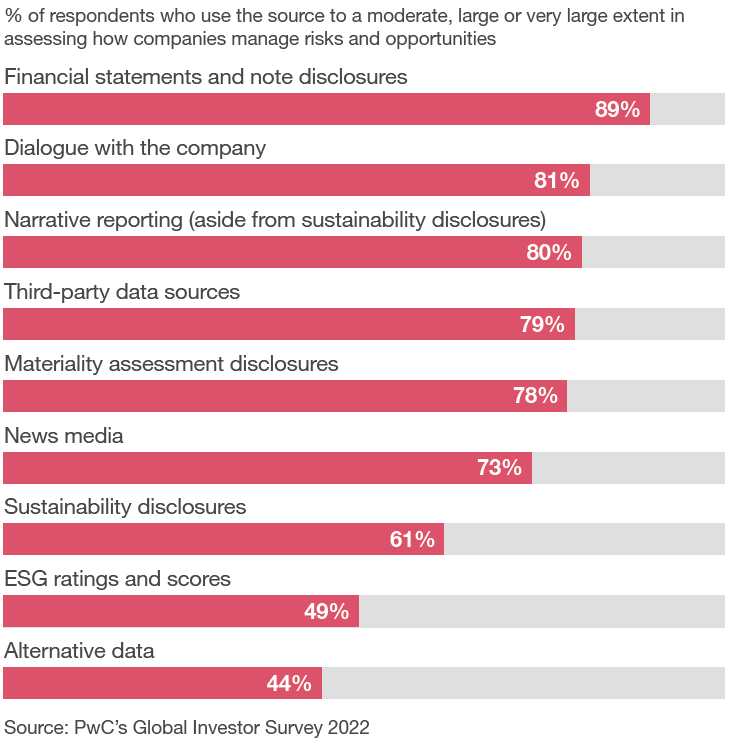
Investors use a wide array of sources to get information about how companies manage risks and opportunities, with financial reporting topping the list.

Investors’ concerns about greenwashing erode trust in what companies say about how they are addressing the sustainability risks and opportunities facing their business. These concerns also make it difficult for the investment profession to allocate capital to where it needs to go.

READ MORE »

SEC Continues Enforcement Scrutiny of ESG Claims by Investment Advisers

Mary Beth Houlihan, Diane Blizzard, and Scott A. Moehrke are Partners at Kirkland & Ellis LLP. This post is based on a Kirkland & Ellis memorandum by Ms. Houlihan, Ms. Blizzard, Mr. Moehrke, Norm Champ, Dan Kahl, and Alexandara Farmer. Related research from the Program on Corporate Governance includes How Much Do Investors Care about Social Responsibility? (discussed on the Forum here) by Scott Hirst, Kobi Kastiel, and Tamar Kricheli-Katz; The Illusory Promise of Stakeholder Governance (discussed on the Forum here) and Does Enlightened Shareholder Value Add Value? (discussed on the Forum here) both by Lucian A. Bebchuk and Roberto Tallarita; Reconciling Fiduciary Duty and Social Conscience: The Law and Economics of ESG Investing by a Trustee (discussed on the Forum here) by Robert H. Sitkoff and Max M. Schanzenbach.

In November 2022, the SEC announced a settlement with Goldman Sachs Asset Management, L.P. (GSAM), including a penalty in the amount of $4 million, in which the SEC alleged that GSAM initially failed to adopt procedures to ensure compliance with certain ESG claims made to GSAM clients/investors and then, once adopted, failed to follow such procedures. Like the BNY Mellon ESG order, which was settled last May for $1.5 million, the SEC focus was on statements made by the adviser regarding how it integrated ESG into its investment decision-making process. Notwithstanding the larger penalty in this GSAM order, the order only alleged an Advisers Act compliance rule violation while the BNY Mellon order included a compliance rule violation as well as additional allegations involving fraud/misstatements under the Advisers Act and the Investment Company Act. This order, the BNY order and the SEC proposed Advisers Act ESG rulemaking demonstrate the SEC’s focus on ESG claims by registered investments advisers.

READ MORE »

SEC Finalizes 10b5-1 Trading Plan Rule

Mike S. Kesner is a Partner at Pay Governance LLC. This post is based on his Pay Governance memorandum. Related research from the Program on Corporate Governance includes Insider Trading via the Corporation (discussed on the Forum here) by Jesse M. Fried.

Summary of Key Provisions

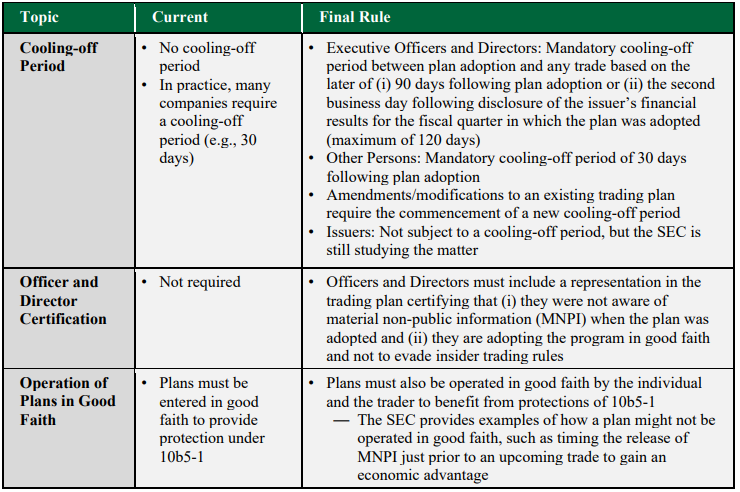
On December 14, 2022, the Securities and Exchange Commission (SEC) released the final Rule 10b5-1 requirements for preplanned trading plans for officers, other insiders, directors, and companies to qualify for the “affirmative defense” rule for such plans (i.e., the stock transaction was not entered into based on material nonpublic information).

The table below summarizes the impact on 10b5-1 plans and the related disclosure requirements.

SEC Rule 10b5-1 Implications and Considerations

Executives and directors who wish to avail themselves of the affirmative defense afforded trading plans under Rule 10b5-1 may need to consider whether to adopt such a plan prior to the effective date of the revised rule (60 days after the final rule is published in the Federal Register) as it would be subject to fewer restrictions and the new disclosure requirements.

Companies and their advisers may also want to revisit their policies regarding the use of 10b5-1 compliant trading plans to buy and sell company stock. Several companies encourage, but do not require, the use of 10b5-1 plans while other companies require they be used or do not have a formal policy. Given the additional restrictions to qualify, some companies may be reluctant to require the use of such plans.

It is also advisable that companies establish rigorous internal controls for collecting and reporting the adoption, modification, and cancellation of both qualified 10b5-1 and non-qualified pre-established trading plans, as both types of arrangements are subject to quarterly reporting requirements.

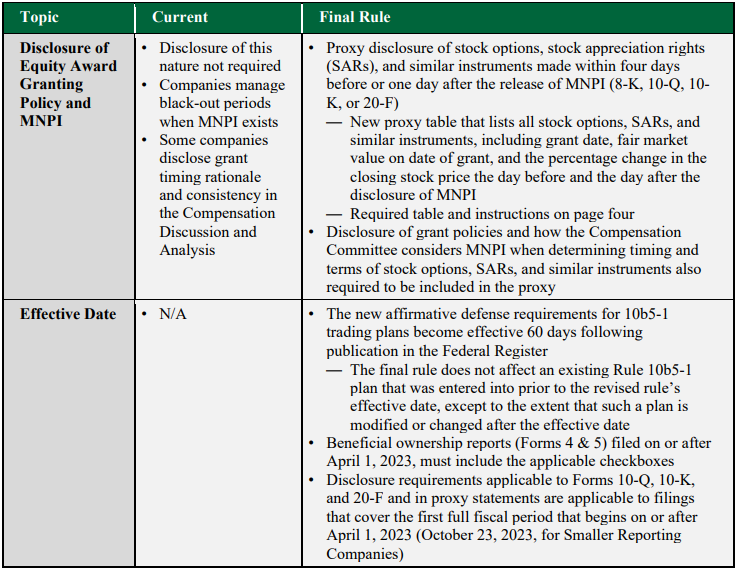
Finally, compensation committees will need to discuss and approve a policy regarding the granting of stock options (and other forms of equity compensation) when they are in possession of MNPI, as the policy must be disclosed in the company’s proxy.

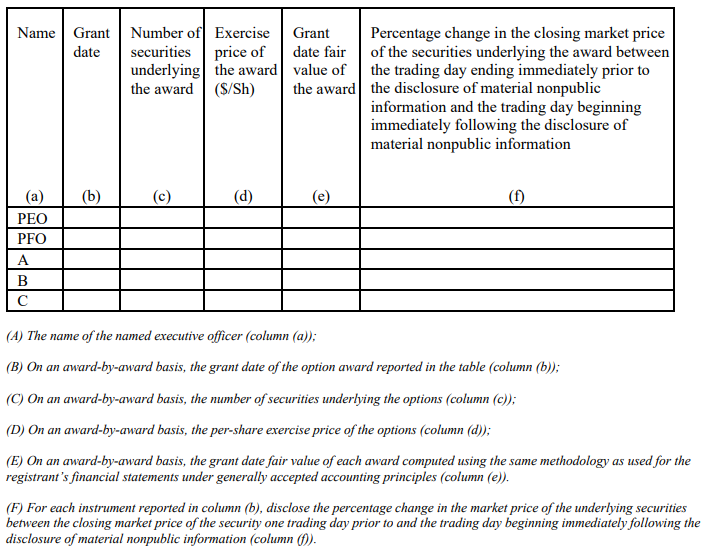
Stock Option Grant Table

As noted above, the following table is triggered by stock options, SARs, or similar instruments granted four days before or one day after the release of MNPI.


ESG Momentum Remains Strong but May Face Headwinds in 2023

Marc S. Gerber and Greg Norman are Partners and Kathryn Gamble is an Associate at Skadden, Arps, Slate, Meagher & Flom LLP. This post is based on a Skadden memorandum by Mr. Gerber, Mr. Norman, Ms. Gamble, Anita B. Bandy, Raquel Fox, and Simon Toms. Related research from the Program on Corporate Governance includes The Illusory Promise of Stakeholder Governance (discussed on the Forum here) and For Whom Corporate Leaders Bargain (discussed on the Forum here) both by Lucian A. Bebchuk and Roberto TallaritaRestoration: The Role Stakeholder Governance Must Play in Recreating a Fair and Sustainable American Economy—A Reply to Professor Rock (discussed on the Forum here) by Leo E. Strine, Jr.; and Stakeholder Capitalism in the Time of COVID (discussed on the Forum here) by Lucian Bebchuk, Kobi Kastiel, and Roberto Tallarita.

Key Points

  • ESG is expected to remain a priority in 2023, with investors, employees and other stakeholders continuing to press for climate change and diversity policies and disclosures.
  • Companies in the U.S., U.K. and EU will face new government ESG mandates and proposals in the new year.
  • Businesses should closely monitor developments in legal challenges to companies’ diversity, equity and inclusion programs. U.S. Supreme Court rulings on affirmative action cases also have the potential to impact corporate diversity efforts.

As companies grapple with the business challenges that rising interest rates and an uncertain economic outlook present, there are the inevitable questions about whether companies should worry less about environmental, social and governance (ESG) matters. While stakeholders and regulators in the U.S., Europe and elsewhere seemed to be moving in the same direction regarding ESG concerns in 2021 and 2022, it is possible that 2023 will see divergences. This is particularly the case in the U.S., where ESG has become highly politicized and is likely to remain so for at least the next two years, given a divided Congress.

Nevertheless, companies will still have plenty to grapple with in 2023: the plethora of regulations and other initiatives already in place or in the works, and investors, employees, customers, communities and other stakeholders continuing to push companies along in their “ESG journey.”

READ MORE »

The Angel’s in the Details: The Importance of Well-Drafted Board Minutes

Sonia K. Nijjar and Jenness E. Parker are Partners, and Lauren N. Rosenello is an Associate at Skadden, Arps, Slate, Meagher & Flom LLP. This post is based on their Skadden memorandum.

Takeaways

  • Boards should see minutes as a way to tell how they worked to fulfill their duties to stockholders, capturing a board’s deliberations and the reasoning behind its decisions.
  • Properly documenting the board’s deliberative process takes on heightened significance for “mission-critical matters” such as major deals, oversight of monoline businesses or significant revenue flows, or catastrophic events, where board actions may be the subject of stockholder litigation.
  • Well-drafted board minutes can help contain the scope of stockholders’ books and records requests and make it easier to win early dismissal of lawsuits.
  • To protect against claims that a company’s disclosures were misleading, a company’s public statements and filings should be consistent with the board minutes.

Board minutes are an essential part of a company’s internal record keeping. But they are more than a routine, formal exercise. They also play a pivotal role in stockholder litigation. As a contemporaneous record, plaintiff stockholders will scrutinize minutes when evaluating and pursuing claims against directors and officers, and judges will consider minutes at the pleadings stage. Boards should see minutes as a way to tell how they worked in fulfilling their duties to stockholders.

Minutes of important board meetings, and proxy statements describing them, have become increasingly important in recent years as a result of developments in Delaware law. Courts have sometimes granted stockholders early access to documents beyond formal board materials, such as directors’ emails and text messages, where they found that minutes offered too sparse an account of a board’s consideration of a particular issue. In addition, if a formal board record is lacking, stockholders may argue that a board breached its duty to oversee and address risk.

By contrast, a sufficiently clear record in the minutes of directors’ deliberations and the process by which they reached decisions can position the company to head off intrusive probes of internal records at the outset, help prevent complaints from being filed, and potentially aid in winning early dismissal of suits.

READ MORE »

Federal Reserve Proposes Climate Risk Guidance for Large Financial Institutions

Nicola Higgs, Betty M. Huber, and Arthur S. Long are Partners at Latham & Watkins LLP. This post is based on a Latham memorandum by Ms. Higgs, Ms. Huber, Mr. Long, Pia Naib, Anne Mainwaring, and Deric Behar.

On December 2, 2022, the Board of Governors of the Federal Reserve System (Federal Reserve) published proposed Principles for Climate-Related Financial Risk Management for Large Financial Institutions (the Proposal). The Proposal urges large financial institutions [1] to consider how best to identify, measure, monitor, and control the various risks associated with climate change over a variety of time horizons. It also specifies that large financial institutions should monitor microprudential risks, including credit, market, liquidity, operational, and legal and compliance risks, as well as other financial and nonfinancial risks that could arise from climate change.

The Proposal aims to support financial institution boards of directors and management in incorporating mitigation of climate-related financial risks into their broader risk management frameworks, consistent with safe and sound practices and the Federal Reserve’s rules and guidance on sound governance.

Large financial institutions are defined as those with over $100 billion in assets that are subject to Federal Reserve supervision, including the US operations of non-US banking organizations. The Federal Reserve’s guidance is founded on the premise that climate change poses an emerging risk to the safety and soundness of financial institutions and the financial stability of the United States.

READ MORE »

Investment Stewardship Global Principles 2023

Sandy Boss is Global Head of Investment Stewardship, John McKinley and Michelle Edkins are Managing Directors at BlackRock, Inc. This post is based on their BlackRock memorandum.

Introduction to BlackRock

BlackRock’s purpose is to help more and more people experience financial well-being. We manage assets on behalf of institutional and individual clients, across a full spectrum of investment strategies, asset classes, and regions. Our client base includes pension plans, endowments, foundations, charities, official institutions, insurers, and other financial institutions, as well as individuals around the world. As part of our fiduciary duty to our clients, we consider it one of our responsibilities to promote sound corporate governance, as an informed, engaged shareholder on their behalf. At BlackRock, this is the responsibility of the Investment Stewardship team.

Philosophy on investment stewardship

Companies are responsible for ensuring they have appropriate governance structures to serve the interests of shareholders and other key stakeholders. We believe that there are certain fundamental rights attached to shareholding. Companies and their boards should be accountable to shareholders and structured with appropriate checks and balances to ensure that they operate in shareholders’ best interests to create sustainable value. Shareholders should have the right to vote to elect, remove, and nominate directors, approve the appointment of the auditor, and amend the corporate charter or by-laws. Shareholders should be able to vote on key board decisions that are material to the protection of their investment, including but not limited to, changes to the purpose of the business, dilution levels and preemptive rights, and the distribution of income and capital structure. In order to make informed decisions, shareholders need sufficient and timely information. In addition, shareholder voting rights should be proportionate to their economic ownership—the principle of “one share, one vote” helps achieve this balance.

READ MORE »

Page 3 of 6
1 2 3 4 5 6