Monthly Archives: November 2025

Key Governance Considerations in PIPE Transactions

Uri Herzberg, Eric Juergens, and Gordon Moodie are Partners at Debevoise & Plimpton LLP. This post is based on a Debevoise memorandum by Mr. Herzberg, Mr. Juergens, Mr. Moodie, Christopher Anthony, and Amy Pereira.

Private investment in public equity (PIPE) transactions can be a fast and cost-effective way for companies to raise capital relative to other options—and can present an attractive investment opportunity for private equity funds. However, sponsor-backed PIPEs can raise a number of key governance issues that need to be carefully negotiated. The governance rights afforded to the sponsor typically reflect the anticipated length and nature of the relationship between the sponsor and the issuer, as well as the size of the sponsor’s investment in the issuer, and may implicate SEC regulations, stock exchange rules and state laws. Below are nine key governance issues that regularly arise in sponsor-backed PIPEs.

READ MORE »

Navigating Shareholder Engagement and Shareholder Activism: Essentials and Best Practices

Larry Sonsini and Doug Schnell are Partners at Wilson Sonsini Goodrich & Rosati. This post is based on their WSGR memorandum.

Engaging with shareholders and responding to shareholder activism continue to be top-of-mind for public companies. These situations present opportunities for management teams and boards of directors to work together to communicate the company’s strategy and reinforce the ways in which the company is positioned for lasting success. Our experience helping numerous clients engage with and respond to their shareholders has given us insight on the practices that stand out as the most effective.

READ MORE »

Remarks by Commissioner Uyeda on the Diversification Deficit: Opening 401(k)s to Private Markets

Mark T. Uyeda is a Commissioner of the U.S. Securities and Exchange Commission. This post is based on his recent remarks. The views expressed in this post are those of Commissioner Uyeda and do not necessarily reflect those of the Securities and Exchange Commission or its staff.

Good morning and thank you for the invitation to speak with you today.[1] Historically, this conference has been focused on closed-end funds, but it has been since re-branded to include retail alternatives. Today, my remarks will focus on the future use of private investments as part of diversified portfolios in defined contribution plans.

Before we discuss the future, however, let us turn to the past. By the early 2000s, it was clear that there had been a sizable shift in how workers were to provide for their retirement needs. Previously, many could rely on Social Security and company-sponsored defined benefit pension plans. Now, individuals are increasingly dependent on participant-directed vehicles, such as 401(k) plans, which moved the burden of accumulating sufficient assets for retirement to them. Accordingly, individual Americans are responsible for constructing and managing their own retirement portfolios, which can be challenging.

In 2006, Congress made this task a bit easier by enacting the Pension Protection Act, which amended the Employee Retirement Income Security Act (ERISA).[2] One provision addressed the practice of many defined contribution plans at the time to automatically default participants into money market funds, stable value funds, and similar vehicles, should the participant not actively select an investment choice. While these types of investment options present little risk of capital loss, they will not provide returns over time sufficient to generate adequate retirement savings. Thus, Section 624(a) of the Pension Protection Act required the adoption of regulations to provide guidance on designating default investments with a mix of asset classes consistent with capital preservation or long-term capital appreciation, or a blend of both.

READ MORE »

Weekly Roundup: November 14-20, 2025


More from:

This roundup contains a collection of the posts published on the Forum during the week of November 14-20, 2025

Dayforce Shareholders Say “Merger Price is Right” in Stinging Rebuke of T. Rowe Opposition Campaign


Securities Law Update


Shareholder Proposal Guide: A Playbook for CHROs and Total Rewards


A New Era in Antitrust


Financing Climate Change Adaptation: Turning Risk into Resilience


Navigating Shareholder Engagement and Shareholder Activism: Essentials and Best Practices


Court of Chancery Confirms Common Law Standards for Actual Control Regarding Challenged Transactions


Silicon Valley and S&P 100: A Comparison of 2025 Proxy Season Results


Attorneys’ Fee Awards in Delaware: Some Much-Needed Data to Calm the Waters


The SEC, Delaware and the High Stakes for Investors on Advisory Shareholder Proposals


The SEC, Delaware and the High Stakes for Investors on Advisory Shareholder Proposals

Sanford Lewis is Director and General Counsel, and Khadija Foda is an Associate Counsel at the Shareholder Rights Group. This post is based on their Shareholder Rights Group memorandum, and is part of the Delaware law series; links to other posts in the series are available here.

SEC Chairman Paul Atkins dropped a bombshell in a keynote speech on October 9, 2025, at the Delaware-based Weinberg Center for Corporate Governance. He endorsed a novel and disruptive legal theory which could eliminate about 98% of shareholder proposals, radically altering the landscape of corporate governance in US public markets. The theory supported by Atkins posits that advisory (i.e., non-binding) shareholder proposals do not constitute “proper business” for an annual meeting under Delaware law. The vast majority of shareholder proposals submitted to US corporations are written as advisory proposals, meaning that the board retains discretion over whether and how to act on them. The policy suggested by Atkins, taken to its conclusion, could eliminate all such advisory proposals. On November 17, 2025, the Division of Corporation Finance, in furtherance of the Chairman’s position, announced that it would not issue shareholder proposal no action decisions on the merits for the 2026 proxy season other than those that seek to advance a “proper business” theory for exclusion.⁠

The effective adoption of this new untested legal theory and suspension of the no action process creates extraordinary uncertainty for proponents and companies. In the absence of informal no action rulings, after receiving a notice of intent to exclude shareholders’ only legal recourse is to sue a company to force it to include the proposal in the proxy. The uncertainty for companies is compounded by the governance implications and potential repercussions of excluding proposals unilaterally in the absence of a substantive determination by the SEC, which may boost votes against directors and sour  relations with investors.

READ MORE »

Attorneys’ Fee Awards in Delaware: Some Much-Needed Data to Calm the Waters

Gilda Sophie Prestipino is a Law Clerk at the Delaware Court of Chancery and a former Academic Fellow of the Arthur & Toni Rembe Rock Center for Corporate Governance at Stanford University, and Michael Klausner is the Nancy and Charles Munger Professor of Business and Professor of Law at Stanford Law School. This post is based on a recent paper, and is part of the Delaware law series; links to other posts in the series are available here. The views expressed herein are solely the personal views of the authors and do not represent the views of the Delaware Court of Chancery.

Fees awarded to plaintiffs’ lawyers in Delaware derivative suits and class actions have recently become the subject of public controversy and policy debate. The $345 million fee award in Tornetta v. Musk has attracted the most attention and, together with a small number of other high-profile cases, has triggered the current debate. A draft paper by Joseph Grundfest and Gal Dor, which collected twenty cases of high fee awards over the past sixteen years, added fuel to the fire. A raft of press reports followed, with titles such as “Report Finds Delaware Court Jumbo Fees Rival Federal System.” Grundfest and Dor, and the press reports in their wake, focus on a small subset of cases in which fee awards were seven or more times the plaintiffs’ attorneys’ lodestar—that is, the hours lawyers devoted to a case multiplied by their hourly rate.

In a new paper, “Attorneys’ Fee Awards in Delaware: A Normative and Empirical Analysis,” we analyze ten years of comprehensive data to investigate whether such high fees are common or reflect a systematic problem with Delaware’s fee-award regime. Based on the data, we conclude that the awards the Court’s critics have highlighted are extreme outliers: among settled and tried cases, they account for about 1% of all fee awards. They are a byproduct of Delaware’s approach to fee awards, which is designed to give plaintiffs’ lawyers incentives to achieve the best possible outcomes for their clients (i.e., shareholders in a class action and the corporation in a derivative suit). We further find, contrary to the Court’s critics, that fees in Delaware cases are similar to those in federal securities class actions.

Delaware Supreme Court case law has long established that the Court of Chancery should award fees to plaintiffs’ lawyers based primarily on a percentage of the recovery or other benefit that the litigation confers on the corporation or the shareholder class. The percentage awarded increases for settlements that occur later in the litigation process and for cases that go to trial. The Supreme Court has further held that the Court of Chancery has discretion to adjust fees based on other factors, including the time plaintiffs’ attorneys devote to a case. This approach is consistent with economic analyses of incentive alignment between plaintiffs’ attorneys working on a contingency-fee basis and their clients.

Our central findings are summarized in Table 1 below. This table presents cases classified based on the stage of a case’s resolution (i.e., settled, tried, or voluntarily dismissed as moot), irrespective of whether they resulted in a monetary recovery or a non-monetary recovery (e.g., governance changes, deal amendments, etc.).

Table 1

Fee Award and Lodestar Multiple by Timing of Resolution (n=232)
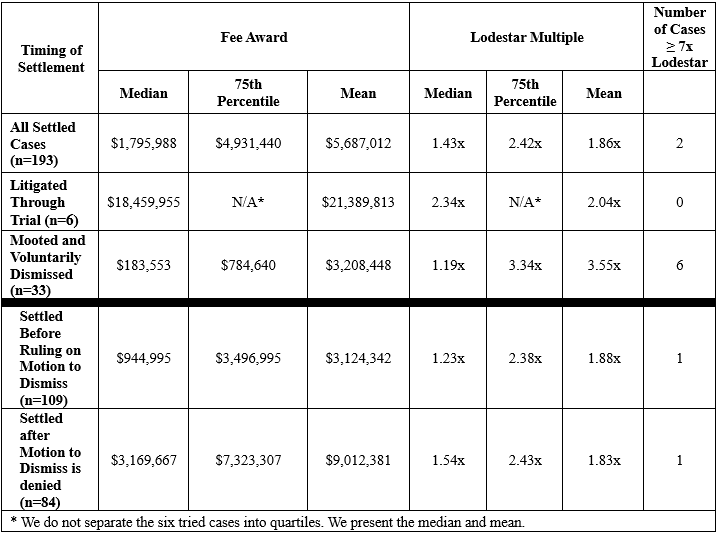
In settled cases, mean and median fees are 1.86 and 1.43 times the attorneys’ lodestar, respectively. Even at the 75th percentile, fees are 2.42 times the lodestar—far short of the 7x fees that have drawn critical attention. The lodestar multiples in the relatively small number of cases that went to trial are somewhat higher, but not dramatically so. Fees in those cases, and in cases that settled after a ruling on a motion to dismiss, are consistent with the Supreme Court’s guidance—and with economic analyses of incentive-compatible fee structures—according to which the percentage of the benefit awarded should be higher for cases that progress further into the litigation process. Among settled cases, only two of 193 resulted in fees seven times the lodestar. This pattern is similar to that observed in federal securities class actions.

Table 1 also includes cases that became moot once defendants met the plaintiffs’ demands and the plaintiffs voluntarily dismissed their case. In general, plaintiffs’ counsel and defendants negotiate fees in these mooted cases without the Court of Chancery’s involvement. As a result, there is typically no record of the lodestar. The mootness fees reported in Table 1 are those paid in cases for which lodestar data were available in the docket because the parties were unable to agree on a fee, and therefore triggered the Court’s review. As reflected by the median mootness fee, absolute fee levels in these cases are relatively low. Yet, because mootness tends to occur earlier than the other outcomes in the sample, the hours recorded are often lower, which can produce mean lodestar multiples higher than in settled or tried cases.

The Tornetta case and other high lodestar-multiple cases on which the Court’s critics focus are cases with very high shareholder recoveries. This is not surprising. Because fees are based primarily on a percentage of the plaintiffs’ monetary recovery or other benefit provided, one would expect some high-recovery cases to result in fees that are a high multiple of the lawyers’ lodestar. The hours a plaintiffs’ lawyer devotes to a case are not necessarily proportionate to the value of the potential recovery. Table 2 presents lodestar multiples by size of the recovery in cases with only monetary recoveries. We exclude cases with non-monetary remedies here because the value of such remedies is difficult to quantify and, therefore, subject to disagreement among the parties. As one would expect, mean, median, and 75th percentile lodestar multiples rise with the size of the plaintiffs’ recovery. The results, however, remain far below the levels that dominate the critical public discussion.

Table 2

Fee Award and Lodestar Multiple by Size of Recovery (n=87)
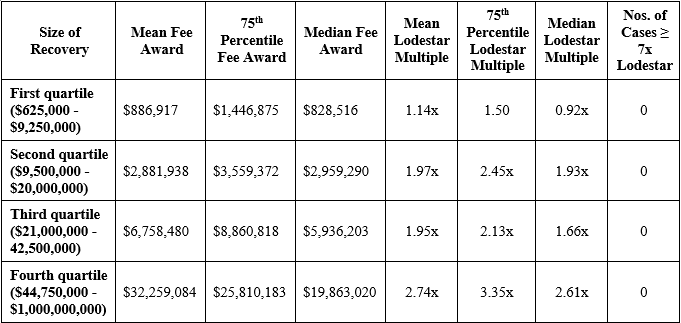
The bottom line is that the high fee awards on which the critics concentrate constitute a thin tail of the distribution of settled and tried cases. Among settled cases in Table 1, only two out of 193 provided 7x awards to plaintiffs’ counsel. (Those cases do not appear in Table 2 because the remedies were not solely monetary.) A small number of additional high-multiple awards arose in cases that plaintiffs voluntarily dismissed as moot. Among these, there is the case challenging Facebook’s effort to restructure its equity to allow Mark Zuckerberg to maintain control with a minority shareholding. Facebook abandoned that plan on the eve of trial, and the plaintiffs dropped their case. The plaintiffs’ lawyers received fees of $68.7 million, which amounted to a lodestar multiple of 8.15. Other cases were more typical of mootness cases, with fees ranging from under $1 million to about $2 million, but with high lodestar multiples because they were dropped with relatively little litigation effort.

The visibility of outliers makes them politically salient, and indeed a few outliers are what triggered the current discussion in Delaware about a possible legislative response. From a policy perspective, however, we question whether the statistical tail should wag the dog. Occasional high fees in high-recovery cases are a natural result of a regime that provides plaintiffs’ lawyers with an incentive to pursue the largest recovery they can obtain for shareholders—in high and low recovery cases alike.

Potential responses would include reducing percentage fees in high-recovery cases or capping fees—for example, at four times lodestar—as Texas does in class actions. These measures would address the 1% outliers at the expense of impairing incentives in other cases.

A lower percentage fee, even just for high recovery cases, would tend to reduce plaintiffs’ attorneys’ incentives to obtain the best recovery for their clients. In some cases, the expected fee may still be high enough to keep the attorneys’ incentives aligned. But in cases requiring the greatest amount of legal work, the incentive to press forward for the best recovery for shareholders could be impaired.

A lodestar-based cap on percentage-of-the-recovery fees would be worse, both from an incentive and judicial economy perspectives. Plaintiffs’ lawyers facing a lodestar-based cap would have no incentive to settle cases early for high amounts. Instead, they would have incentives to keep billing hours, in effect at a 4x rate. Then, toward the end of a case, rather than risking a loss, a plaintiffs’ attorney would have an incentive to accept a lower settlement so long as it yields a fee at the cap. This is not to say that plaintiffs’ lawyers would purposely act contrary to the interests of their clients as trial approaches. But they may have little choice. Defense counsel may act strategically by offering them a choice: a settlement that gets them a fee at the cap, or no settlement at all. Creating such a misalignment of lawyer and client interests is a high price to pay for reducing fees in 1% of cases.

Legislative intervention to address outliers is also unnecessary. The Court of Chancery is well-positioned to review fee requests and make adjustments in light of the Supreme Court’s guidance, and it regularly exercises that authority.


Silicon Valley and S&P 100: A Comparison of 2025 Proxy Season Results

David A. Bell is a Partner and Co-Chair of Corporate Governance, and Wendy Grasso is Corporate Governance Counsel at Fenwick & West LLP. This post is based on their Fenwick memorandum.

In the 2025 proxy season, all of the technology and life sciences companies included in the Fenwick – Bloomberg Law Silicon Valley 150 List (SV 150) and all of the companies in Standard & Poor’s (S&P 100) held annual meetings. Generally, such annual meetings will, at a minimum, include voting with respect to the election of directors and ratification of the selection of the auditors of the company’s financial statements. Fairly frequently, it will also include an advisory vote with respect to named executive officer compensation (say-on-pay).

Annual meetings also increasingly include voting on one or more of a variety of proposals that may have been put forth by the company’s board of directors or by a stockholder that has met the requirements of the company’s bylaws and applicable federal securities regulations.

This post summarizes key developments relating to stockholder voting at annual meetings in the 2025 proxy season among the SV 150 and S&P 100.[1]

Significant Findings

Our 2025 Proxy Season Results Survey shows:

  • Annual meeting participation was relatively consistent with 2024 participation. Stockholder support for directors remained high for both SV 150 and S&P 100 companies. SV 150 companies saw a slight increase in average stockholder “say-on-pay” support and S&P companies saw a slight decrease in support for these proposals.
  • The number of stockholder proposals saw a slight increase in 2025 for the SV 150, while the number of stockholder proposals decreased significantly for the S&P 100, primarily as a result of a significant decrease in governance-related and policy-related stockholder proposals. Both the SV 150 and S&P 100 saw an overall decrease in stockholder support for such proposals.
  • Even the smaller public companies in Silicon Valley are not immune to stockholder pressures. However, the majority of stockholder proposals in 2025 were aimed at the largest Silicon Valley companies. As companies grow larger, it is more likely they will come into the crosshairs of stockholder activists.

READ MORE »

Statement by Commissioner Crenshaw on Division of Corporation Finance’s Announcement on the 14a-8 Process

Caroline A. Crenshaw is a Commissioner at the U.S. Securities and Exchange Commission. This post is based on her recent statement. The views expressed in this post are those of Commissioner Crenshaw and do not necessarily reflect those of the Securities and Exchange Commission or its staff.

By Announcement today, the Division of Corporation Finance has apparently determined that, as a matter of “resource and timing considerations,” it will not respond to no-action requests for relief under Rule 14a-8. But, this Announcement is more of a giveaway to issuers than an exercise in resource allocation. And, more directly, it is an act of hostility toward shareholders.

For example, although the Announcement headlines that staff will not issue no-action relief to companies seeking to exclude shareholder proposals this proxy season—staff is purportedly being neutral and staying out of the mix—the Announcement later allows that, if a company really wants the SEC’s blessing and asks nicely (think, “pretty pretty please”), then all the company needs to do is cite to a rule provision and the Division will issue “no objection” relief. The Division will take the company’s request at face value—(“the Division will not evaluate the adequacy of the representation or express a view on the basis or bases the company intends to rely on in excluding the proposal”). And, notwithstanding that the Division will not do any substantive review of the company’s representations or interpretations, “the Division will respond with a letter indicating that, based solely on the company’s or counsel’s representation, the Division will not object if the company omits the proposal from its proxy materials.”

READ MORE »

Court of Chancery Confirms Common Law Standards for Actual Control Regarding Challenged Transactions

Yolanda C. Garcia is a Partner and Vincent J. Margiotta is a Senior Managing Associate at Sidley Austin LLP. This post is based on their Sidley memorandum, and is part of the Delaware law series; links to other posts in the series are available here.

Recently, in Witmer v. Armistice Capital, LLC, Delaware’s Court of Chancery dismissed a stockholder plaintiff’s derivative suit against Armistice Capital, LLC, a large investor in Aytu Biopharma, Inc., for, among other things, purported breaches of fiduciary duty and aiding and abetting fiduciary breaches, in connection with two transactions for which the plaintiff alleged Aytu overpaid, the investor improperly benefited, and the investor exercised control.

Our blog occasionally highlights developments in Delaware jurisprudence regarding alleged controller transactions (see, for example, our posts here and here).  It is important to note that, in March 2025, Section 144 of the Delaware General Corporation Law was amended to—among other things—create statutory definitions of “controlling stockholder” and “control group.”  See 8 Del. C. § 144.  It further provides that “[n]o person shall be deemed a controlling stockholder unless such person satisfies” this criteria (and provides similarly concerning a “control group”).  More broadly, Section 144 creates statutory safe harbors that, if satisfied, can eliminate the possibility of obtaining equitable relief or damages against fiduciaries for certain transactions (including controlling stockholder transactions).  But these amendments do not apply to litigation that was already pending on or before February 17, 2025.  Witmer (and this article) consequently address Delaware’s pre-amendment controlling stockholder jurisprudence.

READ MORE »

Speech by Chair Atkins on The Securities and Exchange Commission’s Approach to Digital Assets: Inside “Project Crypto”

Paul S. Atkins is the Chairman of the U.S. Securities and Exchange Commission. This post is based on his speech. The views expressed in the post are those of Chairman Atkins and do not necessarily reflect those of the Securities and Exchange Commission or its staff.

Good morning, ladies and gentlemen. Thank you for that kind introduction and for the invitation to join you today as we continue the conversation about how America will lead the next era of financial innovation.

When I spoke recently about American leadership in the digital finance revolution, I described “Project Crypto” as our effort to match the energy of American innovators with a regulatory framework worthy of them. Today, I would like to outline the next step in that journey. At its core, this next step is about basic fairness and common sense as it relates to the application of the federal securities laws to crypto assets and related transactions.

In the coming months, I anticipate that the Commission will consider establishing a token taxonomy that is anchored in the longstanding Howey investment contract securities analysis, recognizing that there are limiting principles to our laws and regulations.

Much of what I will describe builds upon the pioneering work of the Crypto Task Force that Commissioner Hester Peirce leads. Commissioner Peirce has laid out a framework for coherent, transparent treatment of crypto assets under the federal securities laws, grounded in economic reality rather than in slogans or fear. Let me reiterate that I share her vision. I value her leadership, her hard work, and her perseverance in championing these issues over the years. She and I have a long history of working together. I am very pleased that she agreed to take this task on.

READ MORE »

Page 2 of 6
1 2 3 4 5 6