
 Print
Print E-Mail
Yaron Nili is a Professor of Law at Duke University School of Law. This post is based on his recent article, forthcoming in the Harvard Business Law Review.
Over the last two decades, peer groups have become ubiquitous in executive compensation. Spurred by investor scrutiny and reinforced by SEC compensation-disclosure reforms, boards increasingly justify pay decisions by reference to a set of “peer” firms. Boards rely on metrics such as where compensation sits relative to a peer median, whether incentives are “market,” and whether outcomes are “competitive.” This benchmarking practice has drawn substantial attention from regulators, investors, proxy advisors, and scholars.
But peer groups are doing more than policing pay. In its 2024 proxy statement, American Tower defended its opposition to a change to a core shareholder-rights rule—the ownership threshold required to call a special meeting—by explicitly grounding it in peer practice: “The existing 25% special meeting ownership threshold … is aligned with those of our peers and of S&P 500 companies.” The company immediately doubled down on the peer logic, noting that “of our 23 proxy peers, more than 65%” either had thresholds at or above 25% or provided no special meeting right at all.
The governance-based use of peers—invoking peer firms to legitimate, or resist changing, governance architecture—is the core phenomenon I examine in Peer Group Governance. Existing scholarship has long identified key channels through which governance practices spread, including shareholder engagement, institutional investors, activist hedge funds, director interlocks, proxy advisors, and regulatory mandates. Yet corporate governance scholarship has largely treated peer groups as a technical compensation-benchmarking tool rather than as a broader channel through which governance practices diffuse. Although peer groups originated primarily as a compensation-benchmarking device, the Article shows that they have evolved into a broader governance channel, shaping policies ranging from governance to diversity to environmental protection.
The Article makes three key contributions. First, it provides the first detailed empirical account of the growing use, attributes, and composition of peer groups. Second, using governance data for S&P 1500 firms and interviews with directors and general counsel, it identifies peer groups as an important channel for the transfer of corporate governance policies and practices. Third, it outlines the implications of peer group governance for SEC disclosure rules, investor policies, and shareholder advocacy efforts.
The Article’s empirical foundation is a hand-collected dataset of peer group designations among S&P 1500 companies from 2005 to 2021. This dataset allows for the first systematic examination of how peer groups have grown, how companies construct them, and how those designated peers relate to subsequent governance choices. The descriptive account alone is revealing. Peer groups have become increasingly institutionalized in public company practice. Today, 93% of S&P 1500 firms benchmark to a peer group, and after increasing substantially from 2005, peer-group size has largely stabilized in the range of roughly fourteen to seventeen peers. At the same time, peer groups have become sticky: once established, they tend to remain relatively stable over time.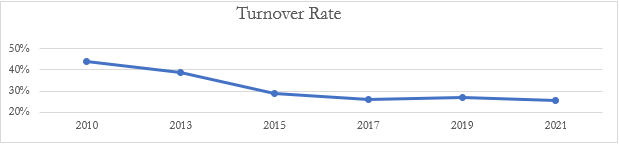
But the data also shows that peer designation is far from mechanical. Companies differ sharply in both the number and type of firms they designate as peers. Some identify only a handful of peers; others identify more than one hundred. Across the broader sample, peer group size ranges from as few as two firms to more than 700. The evidence also suggests that peer designation is often subjective, aspirational, and fluid. Although many firms keep relatively stable peer groups from year to year, there are notable deviations from that pattern, especially during periods of transition. This suggests that peer groups can be adjusted strategically. Peer groups, in other words, are not simply found; they are constructed.
The analysis then turns from peer group formation to peer group influence. Using governance data for S&P 1500 firms, the Article examines whether governance changes at peer companies are associated with later governance changes at the designating firm. The results show a statistically significant correlation between governance adoption by peer firms and subsequent adoption by the designating company. This relationship appears across multiple domains, including proxy access, board gender diversity, board independence, and classified boards. When a firm’s peers adopt governance changes in these areas, the designating company becomes more likely to move in the same direction.
While peer groups are not the sole driver of governance change, they seem to be a meaningful channel through which governance practices spread. The Article takes seriously the possibility that the observed relationship might simply reflect common industry trends, common shocks, or the fact that similar firms often move together for reasons unrelated to peer designation. The robustness section therefore pushes on the results from several angles.
First, it tests whether the peer effect strengthens in tighter peer networks. It does. When reciprocity is higher—when the peer relationship is more of a two-way street—the magnitude of the peer group governance effect increases. Firms in the top quartile of reciprocity are more likely to react to their peers on diversity, independence, and governance structure than firms in the bottom quartile. That finding is important because it suggests that the social force identified by the Article is stronger where the peer relationship is more mutual and salient.
Second, the Article constructs a set of randomly generated alternative peers—“hypothetical peers”—based on the ten closest companies by market capitalization within the same SIC industry and then re-runs the analysis using those counterfactual peer groups rather than the firm’s actual designated peers. If the results were driven simply by industry, size, or broad background similarity, those counterfactual peers should produce similar effects. They do not.
Third, the analysis uses matching techniques and alternative specifications to reduce the concern that the results are simply the product of observable firm similarities. The models include firm-level controls, industry and year fixed effects, and related robustness checks. Even so, the results do not prove causation. Rather, they identify a strong and persistent correlation that remains after a series of additional tests. Peer designation appears to be a meaningful governance channel and not merely a byproduct of firms sharing an industry or a compensation consultant.
Importantly, the interview evidence reinforces that account. Directors, CEOs, and general counsel consistently described peer groups as relevant to boardroom discussions not only in compensation, but also in governance more broadly. Some described peer groups as a source of ideas and a way to frame reforms as market standard rather than idiosyncratic. Others emphasized that once a peer group is established, it becomes sticky and difficult to ignore because both management and investors come to expect the company to benchmark itself against that set of firms. The qualitative evidence therefore strengthens the Article’s broader empirical claim: peer groups help shape what boards see as normal, defensible, and expected.
These findings carry implications well beyond academic debates. Companies are regularly judged by investors, proxy advisors, and regulators relative to their peers, yet they retain broad discretion in deciding who those peers are and often provide only generic explanations for how those choices were made. That gap matters all the more because the same flexibility that enables boards to tailor peer groups can also be used opportunistically.
For investors, the Article’s findings suggest that peer groups should be treated as a governance tool, not just a compensation disclosure item. Large institutional investors, in particular, can use peer group information to sharpen engagement strategies. The paper also points to a broader role for peer groups in shareholder engagement, especially at smaller firms that often receive less direct investor attention. One provocative implication it raises is that investors and companies may benefit from including a few “oranges” in the peer basket—such as select large-cap firms in the peer groups of smaller companies—to provide boards and investors with a clearer sense of how a firm compares not only to similarly situated companies, but also to governance leaders.
For academics, the implication is more conceptual. The Article identifies peer designation as a formalized social channel of governance diffusion. That opens a broader research agenda about how peer groups interact with other governance channels, including director interlocks, activist campaigns, proxy advisors, and regulatory mandates. It also invites scholars to rethink peer groups not as background controls or technical artifacts, but as governance infrastructure in their own right.
For proxy advisors, the paper suggests that peer groups deserve more scrutiny not only because they influence pay benchmarking, but because they may shape governance trajectories more broadly. Proxy advisors already compare companies against peer firms when evaluating governance practices. But if peer groups also help produce the very governance structures that proxy advisors later assess, then those groups are not merely a measuring stick; they are part of the mechanism. That, in turn, suggests that proxy advisors may want to pay closer attention to changes in peer composition and to the role peer groups play in legitimating or resisting governance reforms.
The Article also points toward more concrete reforms for stock exchanges and regulators. Because peers matter to investors and shape governance beyond executive compensation, exchanges could require listed companies to form and disclose a peer list even when it is not used for pay benchmarking. That would generate more consistent information for investors and better reflect the reality that boards often have a broader and richer sense of peers than the narrower set used for compensation. And because peer groups tend to be relatively stable, changes in peer composition may be especially consequential. Exchanges and regulators could therefore require more specific disclosure when peer groups change and more specific explanations for those decisions.
Taken together, these implications point in the same direction. The hidden power of peer-group governance should matter to investors, academics, proxy advisors, stock exchanges, and regulators alike. Peer groups are no longer just a compensation device. They are part of the architecture through which governance practices spread, become normalized, and ultimately harden into expectations. Understanding that role is important not only for explaining how contemporary corporate governance evolves, but also for shaping how governance change happens in the future.

