
 Print
Print E-Mail
Ray Garcia is a Partner, Paul DeNicola is a Principal, and Tracey-Lee Brown is a Director at PricewaterhouseCoopers LLP. This post is based on their PwC memorandum.
What the audit committee needs to know
On May 5, the SEC issued a rule proposal that would provide an optional semiannual reporting framework as an alternative to the existing quarterly reporting framework. The optional semiannual reporting framework would be available to any registrant currently required to file a quarterly report on Form 10-Q.
Form 10-S would replace Form 10-Q for semiannual filers
A company that elects the semiannual reporting framework (a semiannual filer) would forgo filing quarterly reports on Form 10-Q (for the first, second, and third quarters of its fiscal year) and would instead file one interim report covering the first half of the fiscal year on new Form 10-S. Form 10-S would require the same information that is currently required by Form 10-Q, except that the financial information (and related disclosures) would cover the fiscal six-month period instead of a quarter. Unlike Form 10-Q, which requires presentation of both quarter-to-date and year-to-date periods, Form 10-S would only require presentation of the year-to-date (i.e. semiannual) period, though voluntary presentation of quarterly information would be permitted. The financial statements in Form 10-S would be required to be (1) prepared under US GAAP, (2) reviewed by the auditor, and (3) data tagged using Inline XBRL.
The proposed deadline for a semiannual filer to file Form 10-S would be 40 days for accelerated and large accelerated filers (45 days for non-accelerated filers) after the fiscal year’s first semiannual period end, mirroring existing requirements for Form 10-Q.
A public company would make its reporting election (semiannual or quarterly) annually
Quarterly reporting would be the default frequency, but a public company would be able to elect to report semiannually via a new check box on the cover page of the Form 10-K. The semiannual option will also be available for a company pursuing an initial registration (e.g. an initial public offering [IPO]), and that election would be indicated via a check box on the registration statement cover page. Once made, the election would apply for the entirety of that fiscal year. For example, for a calendar year-end company, the election made on the cover page of Form 10-K for the year ended December 31, 2026, would apply for interim reporting for 2027. A company may change its filing election annually and those wishing to report semiannually must make that election (via the check box) each time it files a Form 10-K.
An error with respect to the check box election could be corrected by filing a Form 10-K/A on or before the date a company’s first quarter Form 10-Q would be due.
Earnings releases and Form 8-K reporting requirements would remain unchanged
The proposal does not modify existing requirements for information to be filed or furnished on Form 8-K, including earnings releases. A registrant that elects the semiannual reporting framework may continue to issue quarterly earnings releases based on its investor communication practices. Any such disclosures would continue to be furnished to the SEC on Form 8-K.
Proposal would revise age of financial statements requirements for registration or proxy statements
The existing requirements for determining the age of financial statements included in registration statements and other filings under Regulation S-X would also change. The changes are intended to generally (1) simplify existing rules by aligning the ‘staleness’ framework for registration statements more closely with the reporting deadlines for existing Exchange Act reports (e.g. Form 10-K, Form 10-Q) and (2) adapt the ‘staleness’ framework for the proposed semiannual reporting model.
Under current requirements, a registrant must evaluate whether financial statements are sufficiently current based on a fixed number of days (generally, 129 or 134 days depending on filer status). The proposal would replace this approach with a model that aligns the age of financial statements with the information that would be required to be filed in periodic reports for existing registrants. Specifically, under the proposal, as of the filing date for a registration statement, a registrant would be required to include interim financial statements that correspond to the most recent fiscal quarter (for quarterly filers) or semiannual period (for semiannual filers) that either has been filed, or would be required to be filed, on Form 10-Q or Form 10-S, as applicable. The proposed changes would not impact the requirements for updating financial statements after the end of a fiscal year.
What’s next?
The proposed rule will be subject to a public comment process that ends on July 6, with stakeholders invited to provide input. The proposal includes specific requests for feedback on accounting, financial reporting, and auditing matters as well as questions about potential cost savings for preparers and any impacts that less frequent financial reporting would have on a company’s access to the capital markets. The proposal does not address specific effective dates or transition considerations.
Following the comment period, the SEC will evaluate feedback and determine whether to proceed with final rulemaking, which may include revisions to what was proposed.
Why is this relevant to the audit committee?
A core responsibility of the audit committee is to assist the board in overseeing the integrity of the company’s financial statements, financial reporting processes, internal controls, and disclosure practices. A change in reporting cadence would directly affect how audit committees fulfill these responsibilities. The audit committee will need to evaluate management’s consideration of the potential shift.
Initial considerations
The audit committee should understand and evaluate management’s assessment of whether transitioning to semiannual reporting is appropriate for the company. Questions the audit committee may ask include:
- Beyond SEC requirements, what other obligations (e.g. debt covenants) may necessitate quarterly reporting? More broadly, how does the reporting cadence align with the company’s future strategy?
- How might investors and other key stakeholders view a move away from quarterly financial statements that are reviewed by an auditor?
- What are peers and competitors considering in terms of reporting cadence, and how might that influence expectations?
- Could reduced frequency of financial reporting create an information vacuum for the market, and if so, how might that impact stock price?
- What are the benefits to the company of transitioning to semiannual reporting?
Additional considerations
If, after considering the initial factors, management is further exploring a transition to semiannual reporting, the audit committee should understand and evaluate management’s assessment with the following additional considerations—aligned with the audit committee’s oversight responsibilities—in mind.
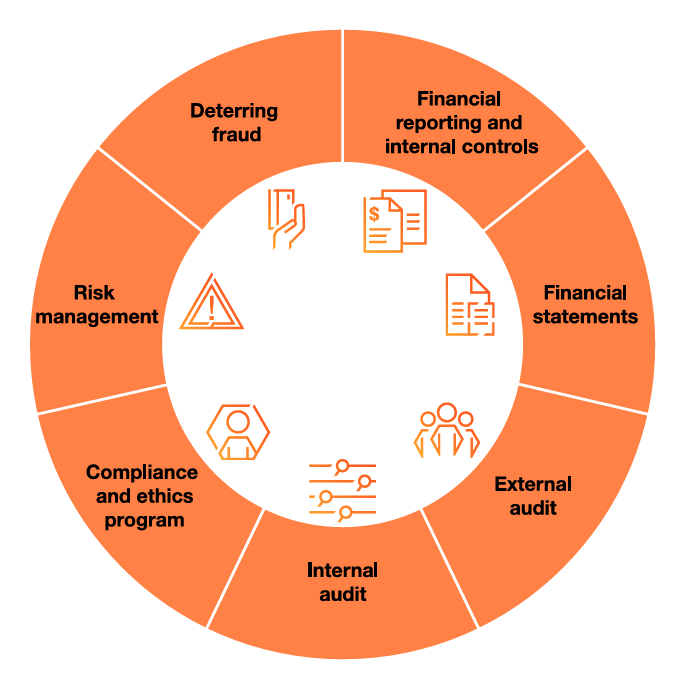
Financial statements, financial reporting, and internal controls
- What financial information will management provide in the ‘off quarters’?
- Will stakeholders rely more heavily on earnings releases, which are shorter and may lack the full context of a Form 10-Q, and how might that affect risk of misinterpretation and misstatement?
- How will quarterly control processes and procedures evolve to avoid degradation in the control environment?
- How has management considered the potential increase in Form 8-K filings for matters that might otherwise be disclosed in quarterly Form 10-Qs and any resulting changes needed to processes and controls?
- How might less frequent management certifications impact investors or other market participants?
- How might the role of the disclosure committee evolve?
- How will management maintain consistent information across various communication channels in the absence of the Form 10-Q in the ‘off quarters’?
External audit
- Will the company seek assurance on earnings releases and other public disclosures? How will communication cadence with the external auditor be maintained?
- Will the external auditor’s procedures change when reviewing semiannual information rather than quarterly information, and if so, what might be the impact on both interim and year-end audit procedures?
- Given that the proposal allows a company to elect quarterly reporting in a year subsequent to an election for semiannual reporting, how does this impact the company’s evaluation of the level of quarterly work by its auditor and the risk of misstatement?
- How might auditing standards evolve in response to a semiannual model?
Internal audit
- Will there be an increased need for internal audit coverage or real-time assurance?
- Will internal audit procedures or priorities shift under a new reporting cadence, and if so, how?
- How would internal audit evaluate the design and operating effectiveness of controls over voluntary quarterly earnings releases if no Form 10-Q is filed?
Compliance and deterring fraud
- How often will the audit committee receive updates from the compliance function?
- How has management considered the impact optional semiannual reporting could have on the company’s insider trading policies, including trading windows?
- How might reduced filings impact the control environment, which addresses risk of fraud or delayed detection, particularly if the control environment weakens due to less rigor around quarterly earnings releases and the absence of principal officer certifications?
Risk management
- How might a change in quarterly control processes and procedures impact the risk of error in financial reporting?
- How is the risk of errors in earnings releases impacted without concurrent Form 10-Q auditor review?
- How might the reduced cadence of reporting potentially impact cost of capital?
- How might reduced reporting frequency affect market perception and volatility, and how could it increase the risk of litigation or regulatory scrutiny?
Committee operations
- How might audit committee meeting frequency change under a semiannual reporting model?
- If meetings occur less frequently, how will the committee maintain effective oversight and engagement?
- If meetings occur less frequently, how might reduced interaction impact the strength of relationships with management and auditors?
- How might the audit committee charter be updated to reflect semiannual reporting?

