
 Print
Print E-Mail
Mike Kesner is a Partner and Annie Chen is a Consultant at Pay Governance LLC. This post is based on their Pay Governance memorandum.
KEY TAKEAWAYS
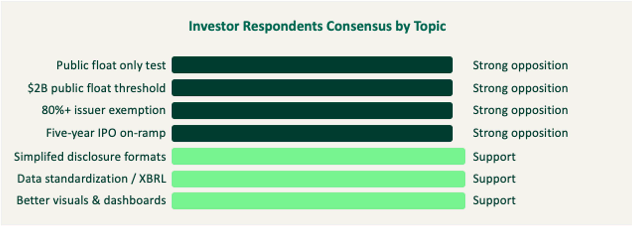
| 1. Large institutional investors have not directly weighed in The largest asset managers have not directly commented on the proposal; an association of these investors indicated support for reform, while suggesting many disclosures remain. | 2. Broad rollbacks face resistance The most consistent message was opposition to $2B NAF status, exemption of 80%+ of issuers, and a blanket five-year IPO on ramp. |
3. Investor respondents value transparency Investor respondents continue to use CD&A, Say-on-Pay, perquisite disclosure, and auditor attestation for governance and voting decisions. |
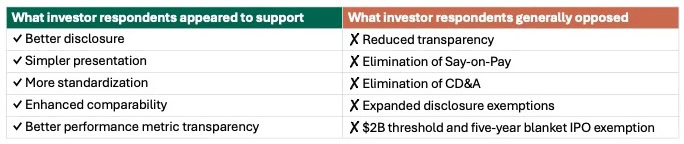
4. Reform should focus on usability Commenters supported better dashboards, standardization, XBRL tagging, improved visuals, clearer metrics, and comparability. |
Executive Summary
The SEC’s proposed amendments to expand Non-Accelerated Filer (NAF) status and broaden Emerging Growth Company (EGC) accommodations and SEC Executive Compensation Disclosure Roundtable (Roundtable) generated very few comment letters from investors. Notably absent from the comment process were many of the world’s largest index fund managers and institutional investors creating uncertainty regarding where some of the largest holders of U.S. equities ultimately stand on the SEC’s proposals. However, we note the Investment Company Institute (“ICI”), an association comprised of large funds and asset managers, indicated support for reform, while suggesting many current disclosure requirements continue to apply to both Large Accelerated Filers and some NAFs.
The comment letters that were provided by institutional investor respondents were generally consistent. Across both the EGC proposal comment letters and the Roundtable submissions investor respondents supported maintaining many of the existing executive compensation disclosure requirements, governance protections, and internal control standards.
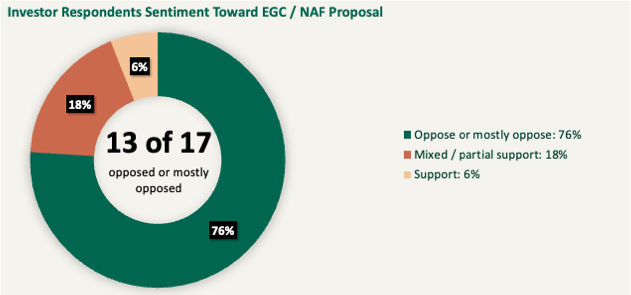
Opposition extended beyond traditional governance activists. Public pension funds, asset managers, labor-affiliated investors, faith-based investors, and international institutional investors largely converged around the view that transparency should be improved, not reduced.
Key Findings at a Glance
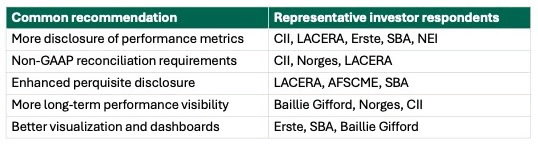
The key theme across both the EGC (n=17) and Roundtable (n=10) comment letters was not a rejection of simplification. Rather, participating investor respondents generally supported simplifying and modernizing disclosure while preserving the investor protections that underpin executive compensation oversight.
Theme 1: Investor Respondents Prefer Simplification, Not Deregulation
One of the clearest messages from both EGC and Roundtable letters was that investor respondents generally support simplifying executive compensation disclosure but not eliminating disclosure.
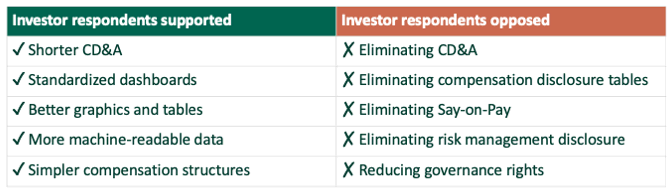
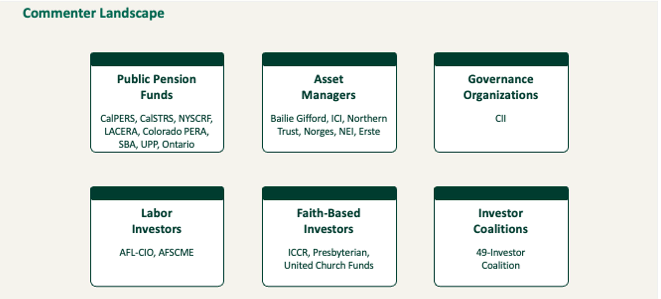
Representative investor respondents included Baillie Gifford, Norges Bank Investment Management, CII, ICI, SBA Florida, University Pension Plan, Ontario, and NEI Investments. These investor respondents repeatedly advocated for executive summaries, better graphics, standardized formats, Inline XBRL, and simpler compensation structures. For example, ICI stressed the importance of not eliminating the CD&A from all NAFs, as this information “provides transparency and enables investors to understand and evaluate the potential effects of executive compensation arrangements on a company’s stock price”.
Theme 2: Overwhelming Opposition to Exempting 80%+ of Public Companies
The most frequently raised concern was that the proposal would extend NAF treatment to approximately 80%-81% of public companies, significantly reducing executive compensation disclosure, say-on-pay voting, and SOX 404(b) auditor attestation requirements.
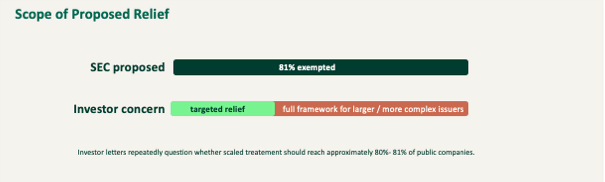
The prevailing view was that the proposal would increase information asymmetry, fraud risk, investor costs, and cost of capital, while weakening shareholders’ ability to monitor compensation and governance practices. Some commentors supported extending disclosure EGC disclosure accommodations broadly but also recommended retaining some of the existing disclosure requirements for NAFs, including the CD&A and certain of the executive compensation tables.
Theme 3: Public Float Alone Is Viewed as Inadequate
Many investor respondents broadly argued that public float is an incomplete and potentially manipulable measure because it may reflect capital structure choices rather than true issuer size, complexity, maturity, or risk profile.
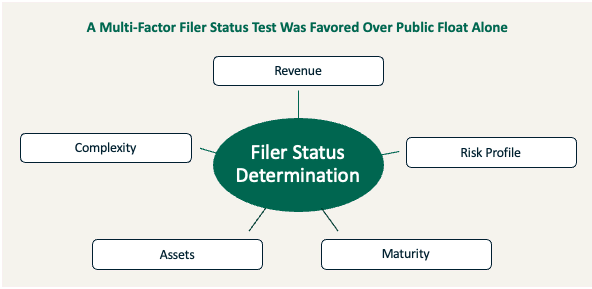
CalPERS suggested revenue and assets should be considered, CII recommended incorporating size, complexity and maturity, Baillie Gifford favored a broader assessment of company characteristics, and UPP supported relief targeted only to truly smaller and less complex issuers. ICI supported the use of the public float test.
Theme 4: Little Support for the $2 Billion Threshold
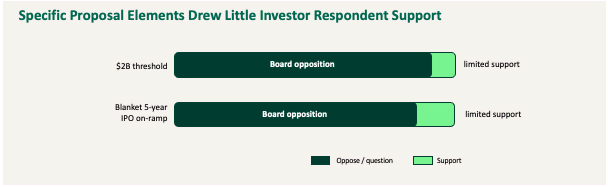
The proposed increase from approximately $700 million to $2 billion public float generated near-universal criticism. Many commenters argued that the threshold lacked analytical justification, was too broad, and would provide relief beyond firms that genuinely need accommodation. ICI did not object to the $2 billion public float threshold, but as noted above, recommended that some NAFs be required to prepare a CD&A and many of the existing compensation tables.
Theme 5: Five-Year IPO On-Ramp Viewed as Excessive
Investor respondents generally opposed a fixed five-year accommodation period for newly public companies regardless of size. Large and rapidly growing issuers were viewed as needing earlier entry into the full disclosure framework through size-based exit triggers.
Roundtable Letters: Investor Respondents Wanted More Disclosure, Not Less
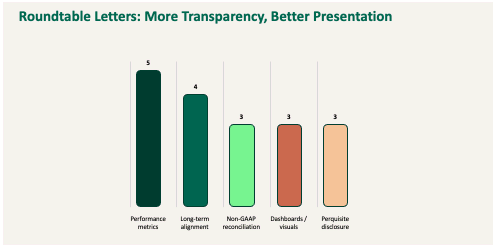
The Roundtable submissions were especially notable because they often sought incremental disclosure enhancements while also acknowledging the need for more concise presentation. The dominant theme was modernization, not deregulation.
Who Submitted Comments?
The comment files included public pension funds, asset managers, associations of asset managers, governance organizations, labor-affiliated investors, faith-based investors, and investor coalitions. Collectively, these groups represent tens of trillions of dollars in assets under management and stewardship. In some cases, organizations provided comments on both the EGC and Roundtable issues. Some of these same organizations also submitted comment letters to the SEC on its semi-annual reporting proposal.
Absence of the Largest Institutional Investor Respondents
Although the ICI submitted a comment letter on behalf of its members, the absence of individual comment letters from many of the largest passive and active managers creates an important caveat: the ICI comments may not necessarily represent the views of each of its members. These organizations may choose to provide policy updates that outline their disclosure preferences once the rules are finalized and encourage each portfolio company to develop a disclosure framework that preserves transparency and maintains investor confidence.
Pay Governance Perspective
The comment record, while limited, suggests a striking degree of alignment among participating investors: simplify presentation, improve comparability, and modernize disclosure, but preserve the underlying transparency framework that investors rely upon to assess executive compensation, governance quality, and board accountability.
BOTTOM LINE
Companies should plan for more extensive investor outreach and engagement to understand investor expectations about future compensation and other disclosures. If the SEC proceeds with broad scaled-disclosure relief, companies should consider how much disclosure to continue voluntarily to maintain investor confidence and minimize friction on Say-on-Pay, director elections, and broader governance engagement.

