
 Print
Print E-Mail
Subodh Mishra is the Global Head of Communications at ISS STOXX. This post is based on an ISS STOXX by Pranav Pradeep, Compensation & Governance Advisor; Tim Sessing, Compensation & Governance Advisor; & Chris Sayo, Data Analytics, at ISS-Corporate.
Key Takeaways
-
CEO pay continued to climb to record levels in fiscal 2025, with median S&P 500 CEO compensation reaching $17.5 million, while median pay among Russell 3000 companies (excluding the S&P 500) remained relatively stable;
-
Equity compensation remained the primary driver of CEO pay growth, as companies increased long-term incentive award values and expanded both the prevalence and magnitude of one-time equity grants;
-
The prevalence of CEO security perquisites in the S&P 500 continued to increase sharply, and the Russell 3000 has followed suit;
-
Say-on-Pay (SOP) support climbed to five-year highs across both the S&P 500 and Russell 3000, while SOP failures reached multi-year lows;
-
Potential changes in SEC rulings may fundamentally alter compensation disclosure and voting in years to come.
The 2026 proxy season was characterized by record CEO pay levels and a resurgence of one-time equity awards, but remarkably shareholder support for executive compensation remained strong. Equity compensation continued to drive pay growth through both higher values and increased use of special equity grants. At the same time, companies increasingly relied on security-related perquisites, reflecting a broader focus on executive safety and risk management.
Economic uncertainties impacted compensation designs and decisions, and increased market volatility has led to a spike in discretionary pay adjustments to levels not seen since the pandemic. Despite the scrutiny these pay decisions often invite, investors appeared largely supportive: median say-on-pay support reached five-year highs across both the S&P 500 and Russell 3000, while the number of failed say-on-pay votes fell to multi-year lows. These results suggest that investors generally viewed compensation outcomes and board designs as being aligned with company performance and business objectives, even as pay levels and pay discretion continued to increase.
However, the executive compensation landscape may be approaching another period of significant change. Proposed Securities and Exchange Commission (SEC) amendments could fundamentally alter compensation disclosure and shareholder voting requirements for a substantial portion of public companies. If adopted, these changes could have far-reaching implications for compensation governance and shareholder rights in the years ahead, reshaping how companies communicate executive pay decisions to investors and how investors express their views.
Chief Executive Officer Pay Trends
S&P 500 CEO Pay Outpaced the Broader Market
Median CEO pay remained relatively consistent among Russell 3000 companies (excluding the S&P 500) over the past two fiscal years, holding steady at approximately $5.5 million in both FY2024 and FY2025. By contrast, median S&P 500 CEO pay continued to increase, reaching $17.5 million in FY2025. Since 2021, median pay has risen 20% in the S&P 500, compared with just 5% among the rest of the Russell 3000.

At the industry level, most sectors experienced growth in median CEO pay between FY2021 and FY2025, though the magnitude of those increases varied considerably. Telecommunications Services led all industries with a 54% rise, well above the Russell 3000 median increase of 10%. Meanwhile, Real Estate Management & Development, Automobiles & Components, Banks, and Energy each reported declines in median CEO pay over the same period.

Incentive Compensation Driving CEO Pay Increase
While all major compensation elements increased between FY2024 and FY2025, the pattern of growth varied across market segments. Among Russell 3000 companies outside of the S&P 500, short-term incentives recorded the largest percentage increase, rising by 19%, followed by a 14% increase in All Other Compensation. Among S&P 500 companies, long-term incentives experienced the largest increase at 8%, while base salary and annual incentives each rose 3%.

Although annual incentives increased by the largest amount for Russell 3000 companies, equity compensation remained the primary driver of CEO pay growth when measured in absolute dollar terms. Median long-term incentive values increased by approximately $913,000 among S&P 500 CEOs and $121,000 among Russell 3000 CEOs outside the S&P 500, representing the largest rise of any compensation component in both groups. By comparison, annual incentive payouts increased by approximately $78,000 and $102,000, respectively. Among S&P 500 companies, the increase in long-term incentive values substantially exceeded the changes observed in any other compensation component, underscoring the continued importance of equity awards as the primary driver of CEO pay growth during FY2025.

Uptick in Median CEO Pay Reflected Increased Prevalence and Magnitude of One-Time Awards
The continued growth in equity compensation was not driven solely by annual long-term incentive programs, but also by off-cycle one-time grants. Following the onset of the pandemic, many companies relied more heavily on one-time equity awards to address executive retention concerns, leadership transitions and unprecedented business uncertainty. As a result, the percentage of Russell 3000 companies granting a special equity award increased to nearly 30% in 2021 and remained elevated in 2022. The use of these awards subsequently declined as markets stabilized. Fiscal 2025 marked the first year-over-year increase since the pandemic-era peak, with 27.3% of companies granting a one-time award to at least one NEO compared with 25.1% in fiscal 2024. The resurgence of these awards contributed to the broader growth in equity compensation observed during the year.

Although the prevalence of these grants remained below the levels observed during the pandemic and immediate post-pandemic period, the increase represents a notable shift in compensation practices. Companies commonly use one-time awards to recruit and retain executives, incentivize key strategic initiatives or support leadership transitions. The uptick in FY2025 may indicate that boards are seeking greater flexibility in compensation design as they respond to heightened market volatility, competitive pressure, and changing business conditions.

The growth in equity compensation is also driven by the changing size of one-time awards. While grants valued below $1 million continued to represent the majority of awards in FY2025, their share declined to 58.4%, compared to approximately 62% to 66% in each of the prior four years. Meanwhile, awards exceeding $20 million more than doubled from 1.5% in FY2024 to 3.3% in FY2025. The increase in these larger awards mirrors the rise in the percentage of Russell 3000 companies granting one-time equity awards in 2025, indicating that companies were not only more likely to utilize special equity grants, but also willing to grant them at higher values.
Usage of Longer-Term Awards is Uncommon Despite Growing Investor Emphasis
As the CEO pay continues to increase, pushed by growing magnitude of equity awards, some investors have begun questioning the structure and design of long-term incentives. The complexity of performance-based equity awards has faced criticism, and investors broadly support using time-based equity awards with extended time horizons in place of performance-based awards. [2] However, longer-term time-based awards (of at least five years) that combine a vesting period and post-vesting holding requirement, are relatively uncommon across the major indices. In the S&P 500, only 12.9% of companies grant equity that could be categorized as being long-term, while the Russell 3000 lags even further behind at just 10.2%. It remains unclear whether investor interest in these structures will drive broader adoption.

CEO Security Benefits Becoming Common Practice Across The S&P 500
The small uptick in “all other compensation” across both the S&P 500 and the Russell 3000 was driven largely by a record-high prevalence of CEO perquisites, including those focused on security perquisites. This underscores a trend that has been developing over the past few years with CEO security becoming an area of increased focus for boards. The number of companies disclosing CEO security benefits across both indices has more than doubled since 2021, though the practice remains relatively uncommon among smaller firms.
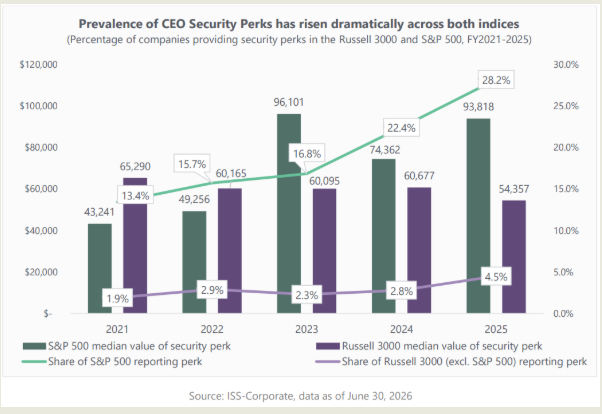
While the value of these benefits peaked for the S&P 500 in 2023, the number of companies reporting security benefits for their CEO spiked. Prevalence in the Russell 3000 increased by 61% from 2024, compared with a 26% increase in the S&P 500. For the Russell 3000, this increase in prevalence correlates with a decrease in the median value of the security perks, with the largest reporting value of the index occurring in 2021.
Say-On-Pay
Failures Drop To 5-Year Lows Despite Resurgence of One-Time Awards
Typically in prior years, median support for say-on-pay (SOP) generally decreased and failure rates consequently increased when there were spikes in one-time equity awards, significant rises in CEO pay, or other sudden changes in compensation practices. However, this year a large increase in one-time awards has been met with higher SOP support as well as significantly lower failure rates, bucking the earlier trend.
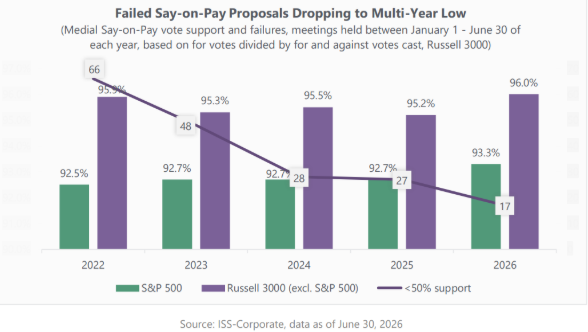
During the first half of 2026, the median SOP support for S&P 500 and Russell 3000 companies increased to five-year highs of 93.3% and 96%, respectively. The number of recorded SOP failures across indices also decreased from 2025 and continues to remain significantly below levels seen in 2022 and 2023.
This strong SOP support amid increases in CEO pay and resurgence of one-time awards indicates a broad investor endorsement of boards’ compensation decisions and underscores the successes many companies had in demonstrating alignment between pay and performance through thoughtful compensation design and robust disclosures.
Compensation Disclosure & Voting in Jeopardy?
While companies are enjoying increasing support from shareholders, significant rules changes proposed by the U.S Securities & Exchange Commission (SEC) could potentially upend this delicate balance.
Currently, public companies can fall under five different reporting categories, ranging from Large Accelerated Filers to Emerging Growth Companies correlating with their size. As companies grow, higher disclosure requirements are expected, while smaller companies receive disclosure and voting accommodations. The proposed changes to the rules would see the categories reduced to two: Large Accelerated Filers (LAF) and Non-Accelerated Filers (NAF). All companies with $2 billion in public capital float and a 60-month consecutive reporting history would be defined as LAFs, and all others would be NAFs.
The proposed new rules would also expand the exemptions that are available to NAFs and significantly reduce disclosure requirements. The rules specifically call for exempting NAFs from Say-On-Pay, Say-On-Frequency, and Golden Parachute votes. NAFs would be required to disclose fewer NEOs, and would not be required to report a compensation disclosure & analysis or narrative, certain compensation tables, or compensation committee interlocks disclosures and reports. While companies may choose to maintain their existing disclosure and voting practices, the proposed changes are likely to drastically change the reporting and voting landscapes surrounding executive compensation practices.
The timing and likelihood of these changes remain unknown. How investors would react to this change also remains unclear. Companies and investors alike have become accustomed to rigorous compensation disclosures that have been honed through years of refinement, and shareholder-issuer dialogues. For investors, significantly scaled down disclosures could obscure the alignment between executive incentives and shareholders’ interests, and a lack of SOP votes could limit their ability to voice their view on executive pay, potentially forcing them to consider other ways to express. For companies, limited shareholder input may result in divergence between investors’ expectations and the compensation designs. These divergences beget further questions about how executive behavior and corporate performance may be affected without shareholder feedback being easily received and incorporated.
While the future of compensation disclosure and SOP votes may be uncertain, the broadly held view that executive compensation is an important mechanism for accountability and alignment of interests between executives and shareholders is unlikely to change. Simply put, pay matters, whether disclosed in a transparent manner or whether shareholders can vote on it.
1For purposes of this analysis, one-time awards are classified based on the value of each individual award type. As a result, grants that contain multiple award types are categorized according to the value of each underlying award.(go back)
2In the 2025 ISS Policy Survey, investor respondents indicated general support for use of extended time-based awards with the extended time horizon achieved through a combination of vesting and addition share retention requirements.(go back)
3Proposed rule: Enhancement of Emerging Growth Company Accommodations and Simplification of Filer Status for Reporting Companies.(go back)

