
 Print
Print E-Mail
Haruyuki Yamashita is the Head of Policy Engagement at the Tokyo Stock Exchange New York Office.
Corporate governance codes have been adopted in jurisdictions around the world as frameworks that systematically set out governance disciplines for companies. The United Kingdom, which is generally regarded as having one of the longest histories in this area, developed its framework against the backdrop of a series of financial and corporate scandals in the late 1980s and early 1990s. The 1992 Cadbury Report, which made recommendations concerning the effectiveness and reporting responsibilities of boards and the role of external auditors, marked an important starting point. In 1998, the Financial Reporting Council (FRC) issued the Combined Code as a statement of best practices in corporate governance. The OECD Principles of Corporate Governance followed in 1999 and have since served as practical guidance for policymakers in both OECD member and non-member jurisdictions.
Japan moved in parallel. In 1999, Tokyo Stock Exchange (TSE) called on listed companies to strengthen their corporate governance. This was followed by the establishment of the Principles of Corporate Governance for Listed Companies in 2004 and the introduction of the Code of Corporate Conduct in 2007. In 2015, Japan adopted the first edition of its Corporate Governance Code (the “CG Code”). What distinguishes Japan’s CG Code from many overseas frameworks is that its starting point was the objective of enhancing companies’ earning power. At the time, the second administration of Japanese Prime Minister Shinzo Abe was seeking to break Japan out of the prolonged economic stagnation often described as the lost decades. The formulation of the CG Code was therefore positioned as one of the major initiatives under the 2014 revision of the Japan Revitalization Strategy. The Code was subsequently revised in 2018, including through expanded provisions on cross-shareholdings, and again in 2021 in conjunction with the TSE’s market restructuring. The 2021 revision introduced enhanced requirements for companies listed on the Prime Market, which was designed as a market segment for companies placing constructive dialogue with global investors at the center of their business. These requirements included appointing independent outside directors to at least one-third of the board, establishing nomination and compensation committees, and enhancing disclosure in English.
Five years later, in 2026, the CG Code was revised for a third time (the “Revised CG Code”). To encourage more substantive corporate action, the Revised CG Code has been streamlined and made more principles-based, reducing the number of provisions from 83 to 30. A new preamble was also added to reaffirm the purpose and underlying spirit of the original CG Code. The theme that best captures this revision is the “appropriate allocation of management resources for growth.” More broadly, the Revised CG Code seeks to take the original objective of strengthening corporate earning power to the next stage.
Overview of the Corporate Governance Code
The purpose of the Revised CG Code is to promote the “sustainable growth of listed companies and the enhancement of corporate value over the mid- to long-term.” This encompasses not only “defensive governance,” such as avoiding or containing risk and preventing misconduct, but also “growth-oriented governance”: governance that encourages sound entrepreneurship, strengthens companies’ earning power, and thereby supports sustainable growth and long-term value creation. Constructive dialogue with shareholders is also positioned as an important means of achieving these objectives. Therefore, Japan adopted a Stewardship Code for institutional investors in 2014. Constructive dialogue between companies and investors is also central to the concept of the Prime Market and can be regarded as a core element of Japan’s corporate governance reform (see Figure 1).
Figure 1. Overall Framework of Codes for Enhancing Corporate Value

The effectiveness of the CG Code is underpinned by TSE rules (Code of Corporate Conduct and Rule 436-3 of the Securities Listing Regulations) requiring listed companies to follow the Code. However, as with corporate governance codes in many other jurisdictions Japan’s CG Code has always followed a “comply or explain” approach: a company is expected either to comply with each principle or, if it does not, to explain why. Where a principle specifically requires disclosure, the company must provide the relevant disclosure in its Corporate Governance Report.
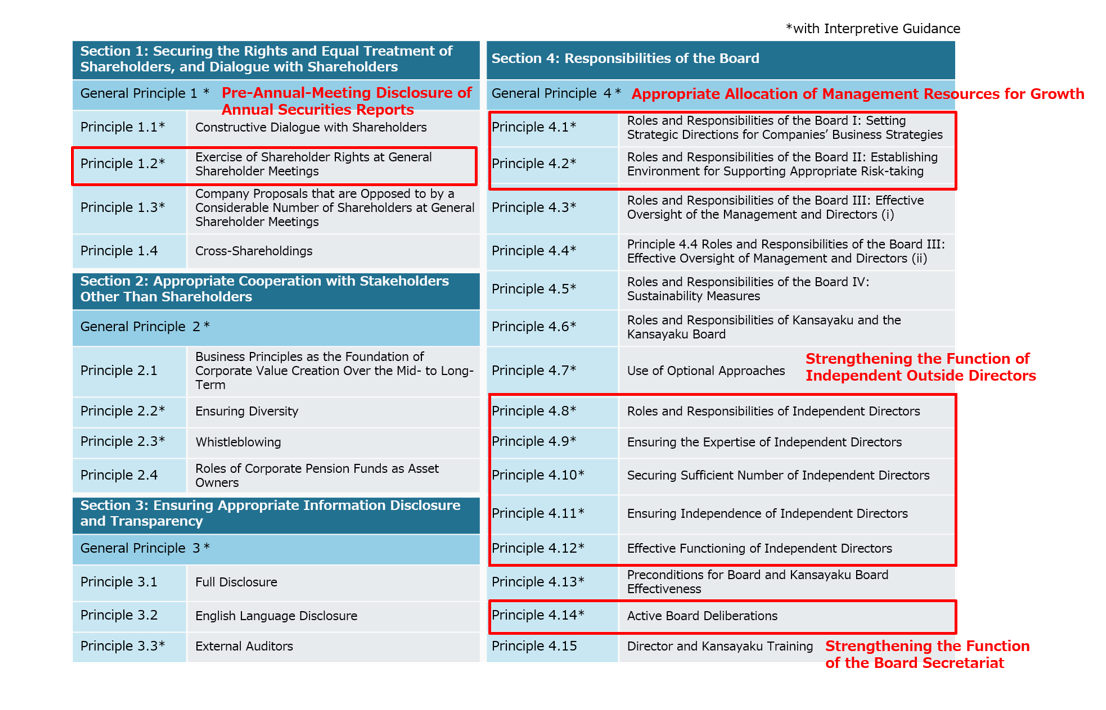
Figure 2 provides an overview of the structure of the Revised CG Code. The General Principles and Principles subject to comply-or-explain treatment vary by market segment, but Prime Market companies are subject to all of them. In addition, Interpretive Guidelines are provided for all General Principles and for certain Principles. The Interpretive Guidelines themselves are not subject to comply-or-explain requirements. Rather, they are intended to support substantive implementation by explaining the background and purpose of the relevant principles and, in some cases, by providing points that companies may refer to as forms of best practice. The areas highlighted in red in Figure 2 are those newly introduced or emphasized in the 2026 revision and illustrate the principal areas of focus in Japan’s current corporate governance agenda.
Figure 2. Overall Structure of the Corporate Governance Code
Revision of the Corporate Governance Code: Appropriate Allocation of Management Resources for Growth
Appropriate Allocation of Management Resources for Growth
As noted above, the defining feature of the Revised CG Code in 2026 is its explicit call for companies to allocate management resources appropriately in pursuit of growth. Appropriate allocation encompasses growth investment—such as capital expenditures, research and development, human capital, intellectual property and other intangible assets—as well as reviews of the business portfolio. These concepts are made explicit in Principle 4.1, which addresses the board’s role and responsibilities in setting the broad direction of corporate strategy, and Principle 4.2, which concerns establishing an environment that supports appropriate risk-taking.
In practical terms, these principles ask management and boards to engage continuously with a set of fundamental questions: Where is the company seeking to go, and along what path will it grow? How should limited management resources be allocated among people, facilities, R&D, intellectual property, M&A and other priorities? And is that allocation actually producing results? Many overseas investors have long pointed out that, during the deflationary environment that persisted through Japan’s lost decades, Japanese companies often placed insufficient emphasis on these questions.
Figure 3. Relevant Provisions of the Revised CG Code on the Appropriate Allocation of Management Resources for Growth
When formulating and disclosing business strategies and plans, companies should (Principle 4.1):
Companies should continuously verify whether their allocation of management resources is appropriate in light of the business strategies and plans formulated and disclosed with the aim of achieving growth (Principle 4.2). |
The substance of these requirements is not entirely new. It is aligned with the expectations TSE has communicated to listed companies since 2023 through its initiative to promote “management that is conscious of cost of capital and stock price” (the “TSE Initiative”). Partly as a result of the TSE Initiative, a steadily increasing number of Japanese companies are paying closer attention to their cost of capital and market valuation, and TSE frequently hears from overseas investors that the traditionally rigid mindset of Japanese companies has begun to change. Capital efficiency and market valuation among Japanese companies have indeed been improving overall. Even so, as Figure 4 illustrates, substantial room remains for further improvement when compared with other major markets. In particular, Japan continues to have many companies with relatively low ROE and, correspondingly, low PBR. The market also has comparatively few companies in the group sometimes characterized as “Aggressive Growth”—companies with both high ROE and high PBR, reflecting strong expectations for future growth. Increasing the number of companies for which investors can reasonably expect sustained growth will therefore remain an important theme in revitalizing Japan’s capital market.
Figure 4. International Comparison of ROE and PBR

What role, then, can the Revised CG Code play? In capital markets, the investors with the strongest interest in improvements in corporate governance and, ultimately, medium- to long-term growth are typically shareholders with a long-term investment horizon able to wait for governance reforms to bear fruit. Under the Revised CG Code, companies are expected to articulate an external pathway toward sustainable growth and to allocate management resources appropriately in line with that pathway. Doing so should help companies earn the support of shareholders with a long-term investment horizon. At a time when concerns about increasingly short-term investment behavior are frequently raised, such shareholders can be important partners for listed companies seeking long-term growth. Constructive dialogue with them can, in turn, create a virtuous cycle supporting corporate growth.
In addition to the Financial Services Agency and TSE, the Ministry of Economy, Trade and Industry (METI) has also sought to promote corporate growth. In July 2026, METI issued new Guidance for Growth Investment (“Guidance”) that refers to Principle 4.1 of the Revised CG Code. The Guidance is not part of the Revised CG Code and is not mandatory. Instead, building on the Revised GC Code’s underlying concepts, it is intended to help companies translate growth-investment principles into concrete actions and implementation. The Guidance identifies several structural challenges facing Japanese companies, including growth investment—wage increases included—that remains relatively low compared with U.S. and European companies; an insufficient balance between growth investment and shareholder returns across different stages of corporate growth; and capital remaining tied up in value-destructive business segments. Against this backdrop, the Guidance positions value creation, measured through Economic Profit (EP), as a common language. Used appropriately in light of a company’s stage of growth, this approach should encourage companies first to improve capital efficiency and then to allocate and expand capital strategically toward investment opportunities capable of generating returns above the cost of capital.
The Guidance also encourages business portfolio transformation based on the “best owner” principle as a means of expanding EP. Examples include selling businesses with low capital efficiency to another owner and redirecting resources toward growth investment in the company’s core business areas. In connection with this, METI’s tax reform request for fiscal 2027 proposes the creation of a “Business Portfolio Transformation and Strengthening Tax Regime,” under which corporate tax on gains from the sale of a business could be deferred when qualifying divestitures and acquisitions are carried out within a specified period.
Revision of the Corporate Governance Code: Other Measures to Improve Corporate Governance
The Revised CG Code also updates a number of other areas of corporate governance.
Strengthening the Function of the Board Secretariat
One notable area, which had received relatively little attention under previous versions of the CG Code, is the “strengthening of the function of the board secretariat.” A board secretariat should play an important role in setting an appropriate agenda for board discussions in light of changes in the external environment and the expectations of shareholders and investors. It should also provide outside directors—who may otherwise face information disadvantages—with the information needed to participate fully in board discussions. Some companies have treated the board secretariat’s principal role as little more than ensuring the smooth administration of board and committee meetings. The new Interpretive Guidelines therefore make clear the importance of establishing personnel and organizational arrangements capable of performing the broader substantive functions expected of the secretariat.
Strengthening the Function of Independent Outside Directors
The Revised CG Code also revisits the role of outside directors, who are important not only in supervising management but also as a point of contact for dialogue with investors, with particular emphasis on ensuring their quality. To support the quality of candidates, the Revised CG Code now clarifies that companies should select individuals with the attributes necessary to perform their roles and responsibilities in a manner that contributes to the company’s sustainable growth and enhancement of corporate value over the medium to long term. There is no formal change in the numerical requirement for independent outside directors because the 2021 revision had already raised the benchmark to at least one-third of the board. At the same time, some have argued that a majority of directors should eventually be independent outside directors at Prime Market companies with significant global operations. This remains an issue for future consideration.
Pre-Annual-Meeting Disclosure of Annual Securities Reports
The Revised CG Code also introduces a new requirement in Principle 1.2 concerning the exercise of shareholder rights at annual general meetings: companies should disclose their annual securities report before the annual meeting. The annual securities report is Japan’s statutory disclosure document broadly comparable, in function, to a Form 10-K filed with the U.S. Securities and Exchange Commission. It contains key information for investment decisions, including financial information, governance arrangements and management policy, in a statutory filing subject to a high degree of reliability. Historically, many Japanese companies have filed the report after the annual meeting, often on the following day. Overseas investors in particular have repeatedly called for disclosure before the meeting, and a growing number of companies have recently begun voluntarily accelerating their filings. The Revised CG Code formalizes this direction by introducing it as a new principle. The Interpretive Guidelines encourage companies to provide at least three weeks between disclosure and the annual meeting, although achieving such a period will be challenging under current corporate practice. In parallel, policymakers are considering institutional reforms aimed at reducing companies’ burdens, including eliminating duplication among filings, reducing audit-related burdens and reviewing disclosure items. Companies are expected to consider earlier disclosure as these related reforms progress.
Comply-or-Explain Disclosure and Dialogue with Investors
Listed companies will be required to update their Corporate Governance Reports by the end of July 2027 to disclose how they address the Revised CG Code. The Revised CG Code again emphasizes that, where a company chooses to explain rather than comply with a principle, the explanation should be sufficiently detailed to enable shareholders and other stakeholders to understand the company’s position. This includes explanations that reflect the company’s specific circumstances and, where the company adopts an alternative approach, why that alternative is appropriate for the company. The Revised CG Code further emphasizes that even where a company complies with a principle, explaining the reasons for and substance of its approach is desirable where doing so contributes to constructive dialogue with shareholders and other stakeholders. Such disclosure may include the status of implementation, the specific actions taken, and the reasons the company considers the principle to have been implemented. Ultimately, these disclosures should support investor dialogue, which is itself a central element of Japan’s corporate governance reform. To make that dialogue constructive and conducive to enhancing corporate value, companies are expected to consider capital allocation in light of their own stage of growth and business environment and to ensure that their boards engage in thorough discussion.

