Print
 E-Mail
George Anderson and Rebecca Thornton are both Partners and Co-Leaders of the Board practice at Spencer Stuart. This post is based on a Spencer Stuart memorandum by Mr. Anderson, Ms. Thornton, and Ann Yerger, all at Spencer Stuart.
Board turnover and refreshment: What’s changed?
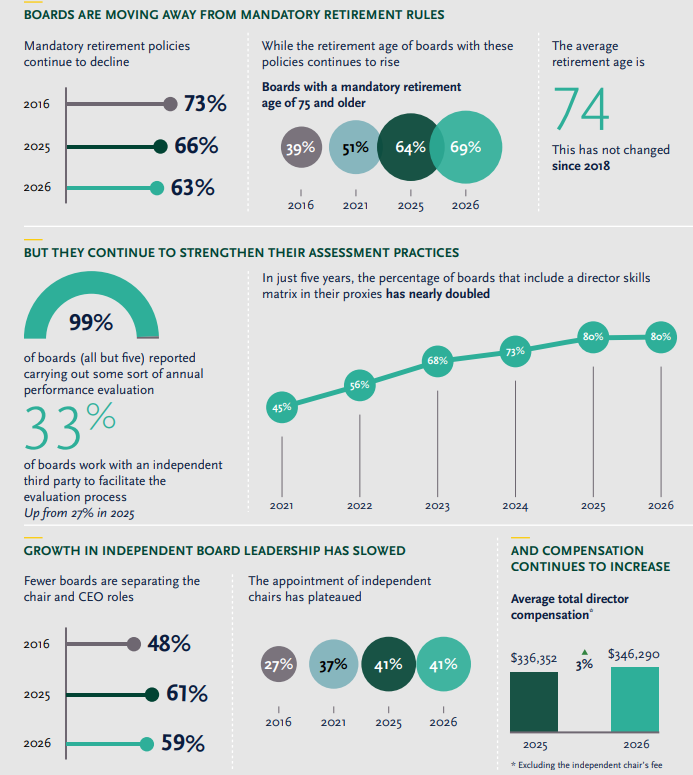
Refreshment continues to evolve gradually. While fewer boards rely on mandatory retirement policies, they are strengthening how they assess board effectiveness.
Our Perspective
Boards are operating in a more complex, politicized and tech-driven environment. How can they ensure their governance practices are equipped for today’s challenges and structured to adapt as those challenges evolve?
For decades, Spencer Stuart has researched changing board composition and governance practices among the largest U.S. companies and how they support effective governance. Given the challenges organizations face today, we see the need for a more dynamic model of governance and board-CEO engagement, one that equips boards with the independence, agility and trust needed to help the business move faster on both risk and opportunity. Drawing on our ongoing research and daily work with boards around the world, we believe the highest-performing boards take an “always-on” approach to strategy and risk oversight, CEO succession and board refreshment and embrace a continuous commitment to strengthening how the board governs, engages, learns and evolves.
Here is what these boards do differently.
1. Adopt always-on risk and strategy oversight
Whether it’s AI, cybersecurity, geopolitics or business model transformation, today’s risks emerge, and opportunities shift at a pace beyond what boards were traditionally built for. An annual strategy offsite or choreographed meetings that are long on reviews and short on discussion are insufficient. Instead, strategy should be an ongoing board conversation, informing every decision made and how every director shows up. The most effective boards seek out external perspectives on developments that could impact strategy, spend most of their meeting time on forward-looking discussion and view themselves as a thought partner to the CEO on strategy and risk.
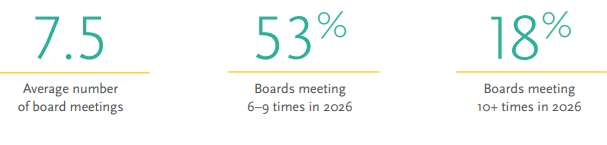
With boards already meeting seven to eight times a year on average — ranging from multi-day in-person meetings to ad hoc calls — it’s unlikely that many boards will opt to add more to their calendar to accommodate more future-focused discussions. Boards may be able to free up time by redesigning meeting structure to use time together more effectively, moving some oversight work to committees and leveraging AI and other technology for information sharing.
2. Make board refreshment a strategic discipline
Having the right people in place is the bedrock for board excellence and impact. And the right composition starts with strategy; boards should continually assess whether their collective experience, perspectives and leadership are aligned with the company’s future direction and evolve accordingly. The highest-performing boards treat board succession as an ongoing strategic priority.
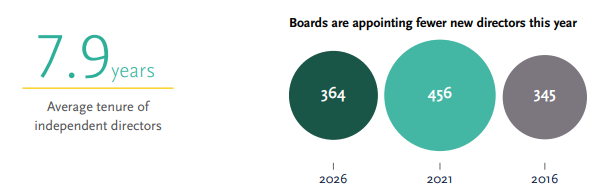
While boardroom continuity is valuable, many U.S. boards are still taking a too-cautious approach to refreshment. New S&P 500 director appointments in 2026 are at the lowest level since 2016, and director turnover declined year over year to 0.7 new directors per board. The number of appointments also lagged the number of director departures in 2025, suggesting that not all directors were replaced. Appointments of both first-time and next-generation (next-gen) directors (those aged 50 and younger) have also declined as boards favored experienced directors.

A director skills matrix is one tool for evaluating and disclosing the relevance of directors’ experience and backgrounds, and it’s one that more S&P 500 boards are employing; 80% of S&P 500 boards disclosed a director skills matrix in their most recent proxy. But a skills matrix is only as valuable as the information it includes. Rather than including a laundry list of perspectives and skills — and matching most directors with them — a skills matrix should be focused to reflect the boardroom’s most critical needs and directors’ current, most relevant expertise.
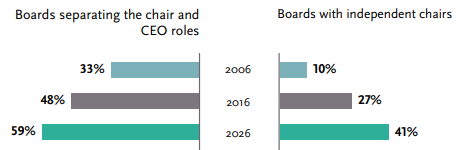
Board succession planning should also include board leadership. The independent board leader, whether a board chair or lead director, plays a critical role in setting the tone, culture and focus of the board. Our research underscores the impact of these leaders: Compared with lower-performing boards, members of top-performing boards are significantly more likely to say the board leader fosters high-quality discussions and that their boards make timely decisions.
3. Embrace board evaluation as a tool for continuous improvement
A continuous improvement mindset is more important than ever in a business environment defined by disruption, compressed decision cycles and mounting stakeholder expectations. Rigorous and regular board evaluations are an effective tool for ensuring directors’ skill sets remain relevant to company strategy, the board operates at a high level with a future focus and its work supports company performance.
Board evaluation has become a standard feature of governance, proxy reports show. All but five S&P 500 boards (99%) report conducting an annual evaluation. Nearly half (49%) disclose that they evaluate individual directors. One-third of boards now report working with an external partner to facilitate evaluations, up from only 3% a decade ago. An experienced adviser drawing on observations from hundreds of boards across industries and governance situations can help boards identify opportunities they may not otherwise recognize, introduce new ideas and proven practices and provide practical recommendations that strengthen board effectiveness.
For boards to capture the full value of an evaluation, however, they must translate insights from the findings into meaningful action — particularly when it comes to strategy oversight, director performance, board composition and renewal. Boards that treat evaluations as a continuous discipline — by translating feedback into specific actions, revisiting progress throughout the year and assigning ownership for agreed-upon priorities — will be in the best position to support and oversee the CEO, advise on risks and strategy and ensure the board remains fit for purpose.

4. Build CEO succession into the board’s strategic agenda
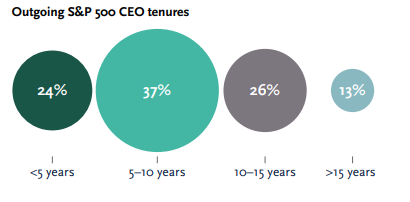
Amid greater market volatility and uncertainty, investors and boards have less patience for CEOs leading weak growth and for those slow to transform their organizations for a technology-centric future. As a result, the average tenure of departing S&P 500 CEOs has been trending downward in recent years — from 11.2 years in 2022 to 8.1 in 2025. While the trend seems to have reversed in 2026, with average tenure rising to 10.7 years, the rise was largely due to the departure of a number of “marathoner” CEOs with 10 years or more in the role. Median tenure is 7.8 years, and nearly one-quarter of CEOs left within the first five years in the job.
In this environment, high-performing boards treat CEO succession planning as a strategic discipline, not an occasional exercise. This starts with aligning on a holistic CEO performance dashboard, regularly evaluating CEO performance and taking prompt actions — which may include replacing the CEO — to address performance issues.
The most effective boards are ready when the time for transition comes, having both viable internal candidate options and an understanding of the external talent market. On an ongoing basis, these boards work with the CEO to develop a current view of the leadership pipeline and the capabilities the company will need next, anchored in future-looking business strategy. They make time for more structured discussion of potential successors, the external talent market, leadership development priorities and continuity risks, which can help the board move from reactive oversight to genuine foresight.
Every board, regardless of where it stands today, has an opportunity to achieve excellence by becoming more dynamic — by sharpening its focus, refreshing its expertise and creating more space for forwardlooking debate. The companies best positioned to compete will be those whose boards are not just well governed, but fully engaged, future-oriented and able to move at the speed the moment requires.
The full report can be accessed here.