
 Print
Print E-Mail
Subodh Mishra is the Global Head of Communications at ISS STOXX. This post is based on an ISS STOXX Research Institute by Joseph Hong, Associate with ISS STOXX Governance Specialty Research, at ISS-Corporate.
Different Approaches to AI Oversight
Growing corporate adoption of Artificial Intelligence (AI) has increased the importance of AI governance to both companies and shareholders. U.S. technology companies have been expanding their AI governance and disclosure frameworks. However, investor views on the adequacy of these practices continue to evolve, and AI-related shareholder proposals have increased over the past five years, despite a general decline in environmental and social proposals. Investors may well continue to engage on AI-related issues in the future, whether through proposals or other mechanisms.
Investment Stewardship in the AI Era is a publication series exploring the opportunities, risks, and responsibilities emerging from AI. Every edition focuses on a specific topic, offering concise analysis, proprietary insights, and practical observations for investors seeking to understand the opportunities and challenges ahead.
This report examines the different ways companies, shareholders, and others have been approaching AI oversight.
AI governance is moving from a specialist technology issue to a mainstream board, strategy, capital allocation, and stewardship topic.
Key Takeaways
- AI governance is increasingly a core investment and stewardship issue. As AI becomes increasingly embedded in corporate strategy, capital allocation, and infrastructure planning, investors are evaluating not only growth opportunities but also boards’ ability to oversee associated risks and externalities.
- AI-related investor concerns extend beyond technology execution. Shareholder engagement increasingly focuses on issues such as data privacy, misinformation, human rights, workforce impacts, energy consumption, water usage, emissions, and broader societal risks arising from AI deployment and infrastructure expansion.
- Large technology companies have expanded governance and disclosure frameworks around AI. The companies reviewed generally disclose board-level oversight mechanisms, AI-related risk factors, responsible AI commitments, and sustainability-related practices, suggesting that AI governance is becoming more formalized within existing corporate governance structures.
- Despite these developments, shareholder scrutiny remains elevated. The persistence of AI-related shareholder proposals indicates that some investors continue to question whether current oversight, disclosure, and risk-management practices are sufficient to address the long-term implications of AI.
- The debate is increasingly shifting from AI oversight to AI governance adequacy. With potential changes to Rule 14a-8 and growing discussion of alternative governance models, investors, policymakers, and companies are increasingly focused on whether existing governance frameworks are capable of managing AI-related risks and opportunities over the long term.
About This Report
This report examines various aspects of how shareholders and companies are addressing AI governance. These aspects include how shareholder proponents are framing AI-related risks, patterns of AI governance disclosures among certain U.S. technology companies, trends in AI-related shareholder proposals, and different alternative models of AI governance.
Ongoing investment in AI data centers is likely to continue, but investors are concerned not only with the potential returns on the massive investments but also with AI-related risks such as water and energy use, data privacy, and workforce impacts. The U.S. technology companies reviewed in the report respond to these concerns to some degree. They identify AI as a material risk factor and publicly disclose commitments to responsible AI principles, and many also disclose information on AI-relevant environmental and social risks.
AI-related shareholder proposals on U.S. ballots have grown in recent years, a trend that suggests a persistent investor focus on AI governance. However, evolving regulation may lead to investors pursuing other means of engaging on AI concerns, such as direct dialogue or proxy voting.
Amid heightened investor and company concern about AI, policymakers, academics, and others are considering alternative approaches to AI governance and accountability. Proposed options include closer public oversight of technology companies, federal equity stakes in technology companies, and mission-guardian structures, although some of these approaches have also attracted criticism. These discussions of alternatives relate to the larger question of whether conventional corporate governance is sufficient for AI-related risk.
Governing AI is likely to remain a concern in the future. For institutional investors, a major concern may be whether corporate AI governance frameworks can foster value creation while effectively managing risks.
ISS STOXX clients can download an expanded version of this report by logging into ProxyExchange, then selecting the Knowledge Center and its Library tab. The expanded report features additional detailed information on the selected technology companies and their AI governance profiles, along with a comprehensive listing of AI-related shareholder proposals, including the issuer, proposal description, proponent, and voting support levels.
Introduction
For institutional investors, the AI infrastructure buildout is increasingly viewed through two lenses:
- As a capital expenditure supercycle with the potential to support a broader secular shift in the global economy
- As an emerging governance and stewardship priority that may introduce material operational, financial, social, environmental, and policy risks.
The investment thesis remains compelling, but it is also being tested by questions around return on invested capital, free cash flow compression, financing requirements, energy and water constraints, and the durability of current spending levels.
This report examines how those issues surfaced during the 2026 U.S. proxy season. It focuses on four related areas.
First, the report assesses how shareholder proponents are framing AI-related risks, including privacy, misinformation, workforce impacts, discrimination, human rights, child safety, surveillance, water and energy use, and emissions.
Second, it reviews AI governance disclosures among a select group of large U.S. technology companies, including board and committee oversight, risk-factor disclosure, responsible AI commitments, sustainability reporting, and capital-structure considerations.
Third, it reviews AI-related shareholder proposal activity in the 2026 U.S. proxy season, including how proposal volume and support levels compare with the broader decline in environmental & social (E&S) proposals.
Finally, it considers alternative governance models being debated in policy and academic circles, including proposals for enhanced public oversight, government equity participation, frontier-model review pathways, and mission-guardian structures.
The central takeaway is that AI governance is moving from a specialist technology issue to a mainstream board, strategy, capital allocation, and stewardship topic. Large technology companies are expanding disclosures around AI oversight and responsible AI principles, but shareholder proponents continue to argue that disclosure alone does not resolve the underlying risks. As ongoing changes to Rule 14a-8 reshape the shareholder proposal process, institutional investors may increasingly rely on a broader engagement toolkit to assess whether boards are providing effective oversight of AI-related risks and opportunities.
AI governance is moving from a specialist technology issue to a mainstream board, strategy, capital allocation, and stewardship topic.
AI Infrastructure as an Investment and Governance Theme
The rapid expansion of AI infrastructure has intensified scrutiny from a wide range of stakeholders. Local opposition to data center development; competition for energy, water, and critical mineral resources; privacy concerns; misinformation; workforce disruption; and evolving local, state, federal, and geopolitical regulations are all becoming part of the investment debate. Some observers further contend that systemic risks associated with AI adoption, deployment, and infrastructure expansion may not yet be fully reflected in market valuations.
At the same time, geopolitical competition, national security considerations, and the strategic importance of resilient digital infrastructure are likely to continue supporting investment across primary, secondary, and tertiary industries linked to the AI data center buildout. For investors, the issue is therefore not simply whether AI infrastructure spending continues, but whether companies can demonstrate disciplined capital allocation, credible risk oversight, and governance frameworks that are proportionate to the scale of the opportunity and the risks. These governance questions have become increasingly prominent in investor stewardship discussions, with shareholder proponents arguing that a range of AI-related risks warrant greater corporate attention and oversight.
Shareholder Proponents and the Debate Over Material AI-Related Risks
One lens through which these governance concerns have become visible is the shareholder proposal process. Many environmental and social shareholder proposals have been submitted repeatedly at large U.S. technology companies over multiple proxy seasons. Before the current AI transformation, proponents were already raising issues such as emissions, water use, data privacy, discrimination, misinformation, child safety, workforce impacts, surveillance, and operations in conflict-affected and high-risk areas. Many of these longstanding digital-platform concerns are now being discussed through the lens of AI, but the underlying risk themes remain familiar.
For shareholder proponents, the persistence of these concerns suggests that material risks may remain insufficiently addressed, notwithstanding expanded governance and risk disclosures. Their argument is not that companies have failed to disclose governance structures altogether, but that their disclosures may not demonstrate sufficient remediation, accountability, or operational change when controversies recur. In that view, AI governance could become disclosure-heavy without necessarily becoming outcome-oriented.
Andrew Behar, CEO of As You Sow and a shareholder proposal proponent, has stated that shareholder proposals can serve as early warning systems that some companies ignore. Sanford Lewis, Director and General Counsel of the Shareholder Rights Group, has characterized issues raised in shareholder proposals as neglected material risks. In this framing, proponents argue that systemic risks and negative externalities may be material to long-term value yet are not fully captured in conventional financial statements or balance-sheet analysis.
At the same time, the shareholder proposal landscape has become more polarized. Support for environmental and social proposals has declined in recent years, reflecting broader shifts in investor voting behavior, changing interpretations of materiality, and political scrutiny of stewardship practices. AI-related proposals therefore sit at the intersection of two competing trends: rising investor attention to AI-related risks and falling support for many environmental and social shareholder proposals overall. As these debates continue, a key question is whether existing corporate governance frameworks are sufficient to address the risks and opportunities associated with AI, or whether boards are already putting appropriate oversight mechanisms in place.
AI Governance Disclosures among Select U.S. Technology Companies
To assess how companies are responding to these concerns, this report takes a closer look at selected U.S. technology companies[1] during the 2026 proxy season, with a focus on corporate governance disclosures relevant to AI oversight. The review considers proxy statement disclosures, board skills matrices, committee charters, Form 10-K risk factors, responsible AI statements, sustainability reporting, and capital-structure features.
As discussed in a December 2025 ISS STOXX article, a growing number of institutional investors view effective oversight of AI-related issues as relevant to fiduciary duty, investment stewardship, and corporate engagement. UNESCO and the Thomson Reuters Foundation’s Responsible AI in practice report, which leveraged data from the AI Company Data Initiative (AICDI) and was grounded in UNESCO’s Recommendation on the Ethics of AI, examined responsible AI disclosures from approximately 3,000 companies. The report identified significant gaps in responsible AI disclosure, particularly in board oversight and implementation due diligence mechanisms. AICDI data is also shared with an investor signatory group representing approximately USD 1.2 trillion in assets under management.
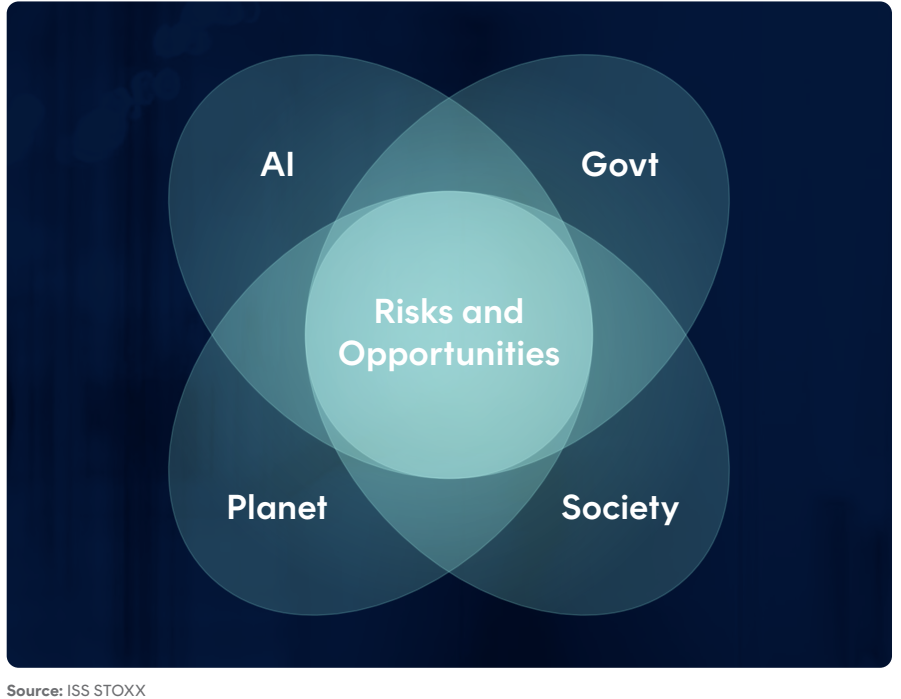
Against this evolving landscape, the governance disclosures of large technology companies provide one indication of how boards are approaching AI oversight, risk management, and accountability. For many asset owners and asset managers, the core governance question is whether companies and boards are aligning AI-related strategy with long-term financial value creation, responsible risk management, and sustainable capital allocation. AI governance effectiveness is, therefore, not limited to whether companies disclose responsible AI principles; it also depends on whether those principles are embedded in oversight structures, risk management processes, product governance, infrastructure planning, and stakeholder impact assessments.
Figure 1: Considerations in AI Long-Term Financial Value Creation
The U.S technology companies reviewed generally exhibit robust baseline governance practices, including board independence, committee independence, meeting attendance, and overboarding policies (the data is from Form DEF 14A proxy statement disclosures).
However, AI is not explicitly identified in most of the selected companies’ board skills disclosures, suggesting that boards may be treating AI as part of broader technology, cybersecurity, product, strategy, or risk oversight rather than as a standalone expertise category.
In Form 10-K Item 1A “Risk Factor” disclosures, all the companies reviewed explicitly identify AI as a material risk factor. These companies also identify climate change as a material risk factor and discuss material social risks and harms, including issues such as human rights, privacy, and employment, although the level of specificity varies by issuer.
Committee charters and other governance documents are generally available through company investor relations websites. In their committee charters, Meta and Microsoft explicitly include AI within a board committee’s oversight responsibilities. The other companies do not explicitly include AI in this way, perhaps because they reasonably view AI as warranting full-board oversight, particularly given its connection to corporate strategy, capital allocation, product development, enterprise risk management, cybersecurity, regulatory compliance, and reputation.
It is also common for audit committees, nominating and governance committees, and other standing committees to have overlapping responsibilities for enterprise risk management and corporate governance risk exposure. Because AI can expose companies to a wide range of environmental and social risks, the companies reviewed also delegate oversight of material environmental and social matters through formal committee charters.
All companies reviewed publicly disclose commitments to responsible AI principles on their corporate websites. Many also provide recurring updates on responsible AI initiatives, with Alphabet and Microsoft publishing formal reports on an annual cadence. The OECD has also published Due Diligence Guidance for Responsible AI, reflecting the growing focus on implementation mechanisms rather than principles alone.
In sustainability reporting, virtually all companies reviewed maintain Net Zero targets and disclose information on water management, waste management, and selected social risk topics. These disclosures are increasingly relevant to AI governance because the infrastructure supporting AI development and deployment can have significant implications for energy demand, water use, emissions trajectories, supply chains, data privacy, workforce impacts, and community relations.
Finally, only two companies in the selected peer group, Alphabet and Meta, have multi-class capital structures. For investors evaluating AI governance, capital structure remains relevant because it can affect shareholder influence, board accountability, and the practical impact of investor engagement or escalation.
While many companies have expanded their baseline governance and disclosure practices in recent years, they have not eliminated investor concerns. The 2026 proxy season illustrates the extent to which shareholders continue to seek greater AI-related oversight, accountability, transparency, and board engagement in AI-related risks and opportunities.
AI-Related Shareholder Proposals during the 2026 U.S. Proxy Season
Against this backdrop, AI-related shareholder proposals on U.S. ballots increased slightly in 1H2026 compared with the prior year, even as the total number of environmental and social (E&S) proposals declined sharply.[2] Overall U.S. E&S shareholder proposals reached an all-time high of almost 417 proposals on ballots in 1H2024, fell to approximately 253 in 1H2025, and declined further to approximately 162 in 1H2026, representing a decline of more than 60 percent compared with 1H2024. AI-related shareholder proposals at U.S. companies increased to 29 in 2026, up from 26 in 2025 and 24 in 2024.
This divergence suggests that AI-related social, environmental, and governance risks have been a focus of investor attention and engagement, even as broader E&S proposal activity continues to contract.
Figure 2. AI-Related Shareholder Proposal Volume at U.S. Companies (2022 to 2026)
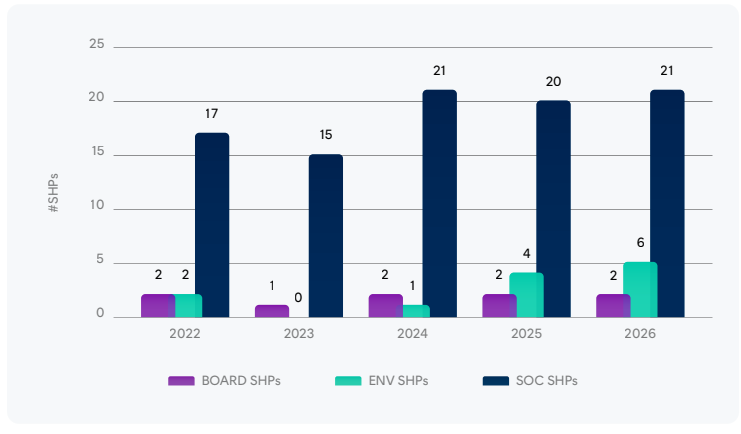
However, proposal volume and investor support tell different stories. While AI-related proposals continued to increase in number (Figure 2), support for AI-related proposals broadly mirrored the wider trend of declining support for the E&S proposal landscape.
As of June 30, 2026, U.S. E&S shareholder proposals received average support of 9.7 percent, down from 10.6 percent during the same period in 2025 and 15.5 percent in 2024. A similar pattern emerged among AI-related proposals, where average support declined to 10.3 percent, compared with 13 percent in 2025 and 19.2 percent in 2024 (Figure 3).
Figure 3. AI-Related Shareholder Proposal Support Levels at U.S. Companies (2022 to 2026)
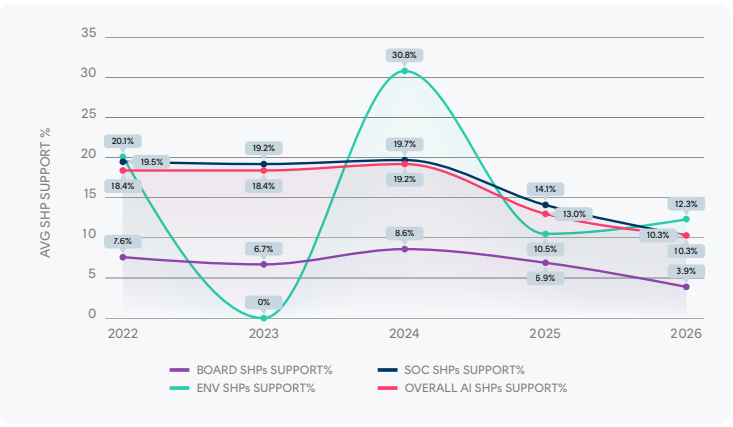
The persistence of AI-related shareholder proposals suggests that many investors continue to view AI governance as an important engagement topic. However, future engagement may not rely as heavily on the shareholder proposal process.
Regulatory developments may further reshape engagement channels. On November 17, 2025, the U.S. Securities and Exchange Commission (SEC) announced that it would no longer respond to no-action requests under Exchange Act Rule 14a-8. On August 14, 2026, the SEC announced that it had determined to discontinue responding to all Rule 14a-8 no-action requests and would no longer provide “no-objection” letters, effectively withdrawing from the shareholder proposal review process. The SEC has also indicated on several occasions that it may pursue rulemaking to rescind Rule 14a-8. Consistent with that position, on August 28, 2026, the SEC submitted a proposed rule to rescind Rule 14a-8 to the Office of Management and Budget.
If the shareholder proposal process becomes less available or less predictable, investors may need to rely more heavily on other engagement mechanisms, including direct dialogue, proxy voting, escalation strategies, investor coalitions, public policy engagement, and litigation-related or campaign-based approaches, where appropriate.
As investors continue to identify and engage on material AI-related risks, a related question is whether existing governance structures are sufficient to oversee a technology with potentially significant economic, social, and national security implications. This question has prompted growing discussion among policymakers, academics, and market participants about alternative approaches to AI governance and accountability.
The persistence of AI-related shareholder proposals suggests that many investors continue to view AI governance as an important engagement topic.
Emerging AI Governance Models
Proposed alternatives to current AI governance span a wide range of approaches. Some focus on increasing public oversight of private AI companies, while others contemplate a more direct government role in strategically important firms or the creation of governance mechanisms tailored specifically to frontier AI systems.
These debates have contributed to a broader discussion over whether conventional corporate governance arrangements remain adequate for AI-related risks. The speed and scale of AI development have prompted debate over whether prevailing corporate governance norms are sufficient for novel AI technologies. Some commentators have proposed alternative governance models intended to address risks that may extend beyond the traditional shareholder-company relationship.
Public Oversight Mechanisms
In a Financial Times opinion piece, Council on Foreign Relations (CFR) Senior Fellow Richard A. Falkenrath argued for a presidentially nominated, Senate-confirmed director to sit on certain technology company boards. Falkenrath contended that such a board seat would not amount to nationalization but would instead provide a mechanism for minimum accountability, given the national security and civilizational implications of AI.
Frontier-model review and vetting pathways also already exist in certain forms, including through the U.S. Department of Commerce’s Center for AI Standards and Innovation (CAISI), Executive Order 14409, and the Bureau of Industry and Security (BIS)’s export-control regime. These mechanisms reflect a policy environment in which AI governance is increasingly linked to national security, competitiveness, advanced computing infrastructure, and cross-border technology controls. Finally, some have proposed a FINRA-style self-regulatory organization that would report to the SEC on matters related to frontier AI governance.
Public Capital and Ownership Models
In addition to enhanced oversight, policy discussions have focused on industrial policy, federal government equity stakes, and the possibility of an AI sovereign wealth fund. The CFR and the Center for Strategic and International Studies (CSIS) have tracked recent federal equity stakes. CSIS commentary has highlighted the potential governance and political economy risks that can arise when public capital and strategic private-sector industries become closely intertwined.
Mission-Driven Governance Structures
Academic debate has also addressed mission-guardian structures. In AI Corporate Governance and Ben & Jerry’s Risk, Harvard Law School professor Jesse M. Fried and S.J.D. candidate Idan Reiter examined risks presented by ambitious mission guardians at Ben & Jerry’s and OpenAI. They argue that such structures can harm both investors and corporate missions. The authors suggested that many companies may follow Anthropic’s example by instituting a kill switch, under which a super-majority of investors can remove guardians.
Conclusion
AI governance has become an increasingly material issue for institutional investors because it connects large-scale capital deployment with a broad set of operational, financial, social, environmental, and policy risks. The 2026 U.S. proxy season suggests that large technology companies are expanding disclosures around AI oversight, responsible AI principles, risk factors, and related sustainability considerations. However, shareholder proponents continue to argue that disclosure alone may not adequately address the risks associated with AI development, deployment, and infrastructure expansion.
The modest increase in AI-related shareholder proposals during 1H2026, against a broader decline in environmental and social proposal activity, indicates that AI remains a meaningful stewardship topic. As the shareholder proposal process faces potential regulatory change, investors may increasingly rely on a broader toolkit, including direct engagement, proxy voting, escalation strategies, and policy dialogue, to evaluate whether companies are effectively governing AI-related risks and opportunities.
For boards and management teams, the governance challenge is likely to become more complex as AI becomes further embedded in long-term strategy, capital allocation, enterprise risk management, sustainability commitments, and public policy debates. For institutional investors, the key question is whether corporate AI governance frameworks are sufficiently specific, accountable, and operationally grounded to support durable value creation while managing the externalities that could affect both portfolio companies and the broader market.
1The sample was limited to select large U.S. technology companies, primarily hyperscale cloud and AI infrastructure providers and NVIDIA, and therefore did not include other AI-related companies such as SpaceX, Tesla, Palantir, Broadcom, AMD, or Intel.(go back)
2A number of utility companies have faced emissions-related proposals in recent years, including NextEra Energy in 2026. These proposals were determined to be outside the scope of this paper. According to a February 2026 Electric Power Research Institute (EPRI) report, data centers currently use approximately 4% to 5% of U.S. electricity, with AI workloads accounting for approximately 15% to 25% of data center electricity use. Data center power demand is projected to rise to roughly 9% to 17% of U.S. electricity by 2030. Although utility emissions proposals remain relevant to hyperscaler emissions profiles, they were excluded from the AI-related proposal universe for purposes of this analysis, particularly given the role of alternative energy sources. Affordability concerns were also treated as broader utility-sector issues because extreme weather events, aging infrastructure, energy market volatility, inflation, tariffs, and pass-through pricing are also important contributors to rising household utility costs.(go back)

