Print
 E-Mail
John Roe and Amra Balic are Global Co-Heads of Investment Stewardship (BIS) at BlackRock. This post is based on a BlackRock publication.
Executive Summary
Voting at a company’s shareholder meeting is a basic right of share ownership and a core principle of corporate governance. As a fiduciary, BlackRock is legally required to make proxy voting determinations in a manner that is consistent with the investment objectives of clients who have delegated voting authority to us.
BIS’ Benchmark Policies, and the vote decisions made consistent with those policies, take a financial materiality based approach and reflect our reasonable and independent judgment of what is in the long term financial interests of clients. We do not act collectively with other shareholders or organizations in voting shares or follow any proxy research firm’s voting recommendations.
This report provides a comprehensive overview of BlackRock Investment Stewardship’s (BIS) approach to voting on corporate governance matters and other material risks and opportunities under our Benchmark Policies in the 2025/26 proxy year.[1]
2025/26 Proxy Year Highlights
BIS voted on more than 154,000 management and shareholder proposals globally at more than 12,000 companies in 56 voting markets under the Benchmark Policies.[2] The substantial majority of proposals were on ordinary matters, including director elections and board related items.
Consistent with the past proxy year, BIS supported management on approximately 88% of total proposals voted, reflecting our continued assessment that boards and management teams generally acted in alignment with shareholders’ long term financial interests.[3]
BIS supported approximately 91% of the nearly 68,000 proposals categorized as director elections we voted on globally.[4][5] Director independence issues remained the primary reason we did not support these proposals globally.
Shareholder proposals represented less than 1% of total proposals BIS voted on, with BIS supporting approximately 9% globally. Investors, including BlackRock, most frequently supported governance related proposals, particularly those strengthening minority shareholder rights, while proposals concerning climate and natural capital and company impacts on people declined for a second consecutive year and continued to receive low median market support.[6][7]
The vast majority of BlackRock’s clients delegate voting authority to BIS under the Benchmark Policies, entrusting us to act on their behalf as their fiduciary. At the same time, BlackRock continues to expand choice in stewardship, including through BlackRock Voting Choice, which provides eligible clients with more opportunities to participate in the proxy voting process where legally and operationally viable.[8]
BlackRock Voting Choice, the industry’s largest pass through voting program, is available to client assets representing $3.96 trillion of BlackRock’s $8.79 trillion total index equity AUM, with clients representing approximately $923 billion in index equity AUM exercising this option.[9][10]
By the Numbers
Figure 1. Engaging with companies to build our understanding of material risks and opportunities and inform our voting decisions on behalf of our clients
| Region | Engagements | Companies engaged | Companies engaged multiple times | Markets engaged |
|---|---|---|---|---|
| Americas | 1,204 | 976 | 202 | 7 |
| APAC | 883 | 653 | 173 | 14 |
| EMEA | 555 | 389 | 100 | 24 |
| Total | 2,642 | 2,018 | 475 | 45 |
Source. BlackRock. Sourced on August 14, 2026, reflecting data from July 1, 2025, through June 30, 2026.
Figure 2. Engagements across five BIS priorities
| BIS priority | Engagements |
|---|---|
| Strategy, purpose, and financial resilience | 2,292 |
| Board quality and effectiveness | 1,629 |
| Incentives aligned with financial value creation | 1,074 |
| Climate and natural capital | 706 |
| Company impacts on people | 901 |
Source. BlackRock. Sourced on August 14, 2026, reflecting data from July 1, 2025, through June 30, 2026. Most engagement conversations cover multiple topics and therefore engagements across the five BIS priorities sub totals may not add up to the total 2,642 engagements held during the 2025/26 proxy year. Our engagement statistics reflect the primary topics discussed during the meeting.
Figure 3. Share of client equity assets engaged
~70% of the value of BlackRock’s clients’ equity assets engaged.
Source. BlackRock. Sourced on July 27, 2026, reflecting BlackRock index equity exposure as of June 30, 2026.
Figure 4. Voting on behalf of clients’ long term financial interests
| Region | Proposals voted | Meetings voted | Companies voted | Markets voted |
|---|---|---|---|---|
| Americas | 41,715 | 4,886 | 4,403 | 9 |
| APAC | 67,223 | 8,801 | 5,471 | 13 |
| EMEA | 45,172 | 2,987 | 2,422 | 34 |
| Total | 154,110 | 16,674 | 12,296 | 56 |
Source. BlackRock, ISS. Sourced on August 14, 2026, reflecting data from July 1, 2025, through June 30, 2026.
Figure 5. Proposals voted on at a glance
| Proposal category | Proposals voted | Share of total |
|---|---|---|
| Director elections and board related proposals[11] | 75,413 | ~49% |
| Executive compensation proposals[12] | 18,705 | ~12% |
| Shareholder proposals[13] | 982 | <1% |
| Total proposals voted | 154,110 |
Source. BlackRock, ISS. Sourced on August 14, 2026, reflecting data from July 1, 2025, through June 30, 2026. Numbers in parentheses reflect the percentage each category represents out of total proposals voted. Reflects BIS’ proposal taxonomy. To learn more about BIS’ proposal taxonomy and a full detail of total proposals voted, please refer to the Appendix section.
Figure 6. Voting on management proposals
| Measure | Share |
|---|---|
| Proposals voted consistent with management’s vote recommendation[14] | ~88% |
| Director elections voted consistent with management’s vote recommendation[15] | ~91% |
Source. BlackRock, ISS. Sourced on August 14, 2026, reflecting data from July 1, 2025, through June 30, 2026.
Figure 7. Number of companies where BIS did not support director elections for governance concerns[16][17]
| Concern | Americas | APAC | EMEA | Total |
|---|---|---|---|---|
| Board independence | 645 | 935 | 239 | 1,819 |
| Executive compensation | 152 | 3 | 441 | 596 |
| Board composition | 289 | 29 | 194 | 512 |
| Overcommitment[18] | 175 | 66 | 250 | 491 |
Source. BlackRock, ISS. Sourced on August 14, 2026, reflecting data from July 1, 2025, through June 30, 2026.
Figure 8. Voting on shareholder proposals, global shareholder proposals by proxy year

Source. BlackRock, ISS. Sourced on August 14, 2026, reflecting data by proxy year, i.e., running from July 1 through June 30 each year. Includes governance, climate and natural capital, and company impacts on people shareholder proposals voted globally per BIS’ proposal taxonomy.
Figure 9. Geographic distribution of shareholder proposals BIS voted on during the 2025/26 proxy year
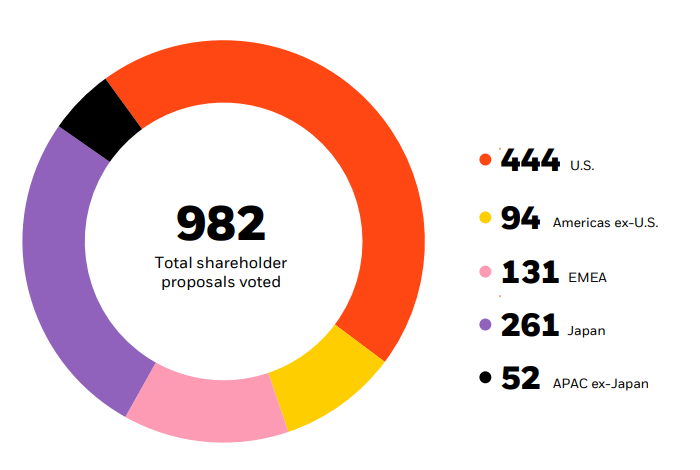
Source. BlackRock, ISS. Sourced on August 14, 2026, reflecting data from July 1, 2025, through June 30, 2026. Includes governance, climate and natural capital, and company impacts on people shareholder proposals voted globally per BIS’ proposal taxonomy.
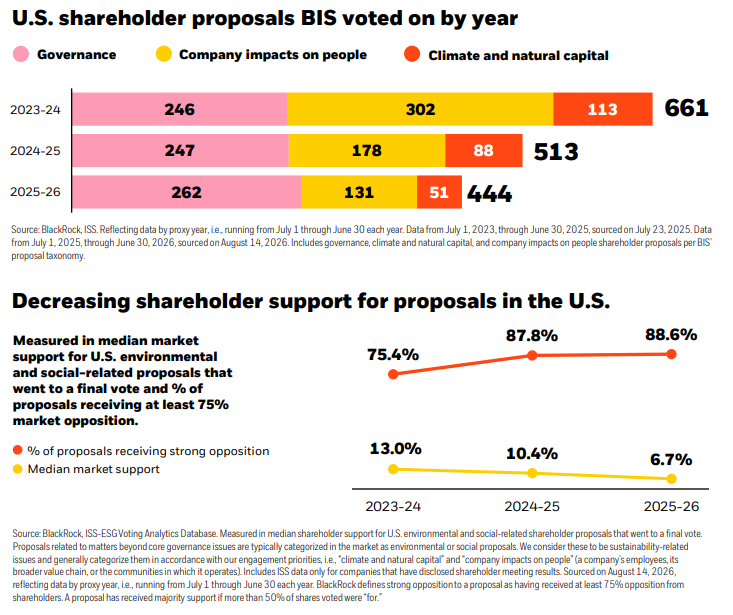
Figure 10. U.S. shareholder proposals BIS voted on by year
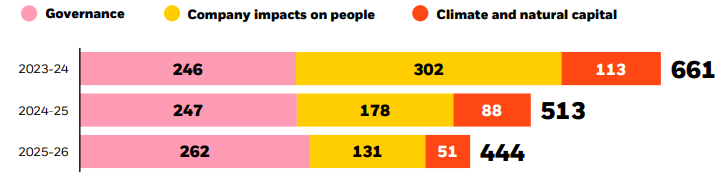
Source. BlackRock, ISS. Reflecting data by proxy year, i.e., running from July 1 through June 30 each year. Data from July 1, 2023, through June 30, 2025, sourced on July 23, 2025. Data from July 1, 2025, through June 30, 2026, sourced on August 14, 2026. Includes governance, climate and natural capital, and company impacts on people shareholder proposals per BIS’ proposal taxonomy.
Figure 11. Decreasing shareholder support for proposals in the U.S.
Measured in median market support for U.S. environmental and social related proposals that went to a final vote and the percentage of proposals receiving at least 75% market opposition.
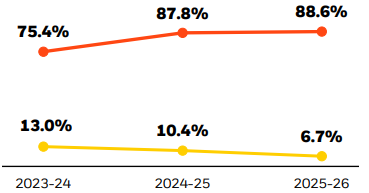
Source. BlackRock, ISS-ESG Voting Analytics Database. Measured in median shareholder support for U.S. environmental and social related shareholder proposals that went to a final vote. Proposals related to matters beyond core governance issues are typically categorized in the market as environmental or social proposals. We consider these to be sustainability related issues and generally categorize them in accordance with our engagement priorities, i.e., “climate and natural capital” and “company impacts on people” (a company’s employees, its broader value chain, or the communities in which it operates). Includes ISS data only for companies that have disclosed shareholder meeting results. Sourced on August 14, 2026, reflecting data by proxy year, i.e., running from July 1 through June 30 each year. BlackRock defines strong opposition to a proposal as having received at least 75% opposition from shareholders. A proposal has received majority support if more than 50% of shares voted were “for.”
Figure 12. BIS’ vote decisions on behalf of clients on shareholder proposals globally during the 2025/26 proxy year
| Proposal type | For | Against | Total |
|---|---|---|---|
| Governance | 87 | 577 | 664 |
| Company impacts on people and Climate and natural capital | 1 | 317 | 318 |
| Total | 88 | 894 | 982 |
Source. BlackRock, ISS. Sourced on August 14, 2026, reflecting data from July 1, 2025, through June 30, 2026. Reflects vote instructions on governance, climate and natural capital, and company impacts on people shareholder proposals per BIS’ proposal taxonomy. Votes “for” include abstentions. Includes the Japanese market.
Figure 13. Reasons BIS did not support climate and natural capital, and company impacts on people shareholder proposals globally
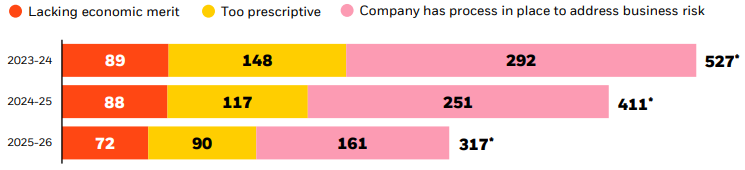
Source. BlackRock, ISS. Includes only climate and natural capital, and company impacts on people shareholder proposals per BIS’ proposal taxonomy. Sourced on August 14, 2026, reflecting data by proxy year, i.e., running from July 1 through June 30 each year. Includes the Japanese market.
* Totals for each row may not add up due to some proposals not being supported for more than one reason.
Voting in Our Clients’ Long Term Financial Interests
Voting at a company’s shareholder meeting is a right of share ownership and a core principle of corporate governance. As a fiduciary, BlackRock is legally required to make proxy voting determinations in a manner that is consistent with the investment objectives of clients who have delegated voting authority to us. The majority of our clients entrust BlackRock Investment Stewardship (BIS) to apply our Benchmark Policies when voting shares on their behalf.[19] The vote decisions made consistent with those policies reflect our reasonable and independent judgment of what is in the long term financial interests of clients.
The BIS Benchmark Policies, which are comprised of our Global Principles, regional voting guidelines, and Engagement Priorities, guide our approach to voting and are applied pragmatically, taking into consideration company specific factors, including a company’s sector, market, and business environment. Accordingly, our vote decisions are informed by in depth analysis of company disclosures, comparisons against industry peers, third party research, and, where appropriate, engagement with companies. In the 2025/26 proxy year, BIS held 2,600+ engagements with members of the boards and management teams of the companies our clients invest in.[20]
BIS applied the Benchmark Policies to vote decisions on more than 154,000 management and shareholder proposals at more than 12,000 companies across 56 markets.[21] Most of the proposals we voted on addressed ordinary matters, such as director elections and board related items. As in past years, shareholder proposals continued to represent less than 1% of the total proposals BIS voted on globally.[22]
As reflected in our voting each proxy year, BIS generally supported the recommendations of the board of directors and management at companies that have sound corporate governance and deliver strong financial returns over time. When we determine it is in our clients’ financial interests to convey concern to companies through voting, we may do so in two forms. We might not support the election of directors or other management proposals, or we might not support management’s voting recommendation on a shareholder proposal. BIS supported management’s recommendations in approximately 88% of total proposals voted globally.[23]
BIS’ voting activities during the reporting period are described in detail in the following pages, which include case studies that illustrate how we applied our Benchmark Policies. As these cases demonstrate, in executing our delegated voting authority, BIS does not prescribe actions for companies or direct business strategy. Responsibility for setting and executing strategy rests with company management, with the oversight of the board of directors. Vote decisions are one way BIS communicates our views on issues that may impact our clients’ interests as minority shareholders.
Consistent with this role, we conduct our voting and engagement activities independently. We do not discuss our voting intentions with or act collectively with other shareholders or organizations in voting shares.[24] Similarly, BIS does not publicly disclose our vote decisions in advance of shareholder meetings as we do not see it as our role to influence other investors’ proxy voting decisions. In addition, BlackRock does not file shareholder proposals or nominate directors for election to a company’s board.[25]
Management Proposals
Director Elections
Boards have the potential to enhance companies’ ability to deliver long term financial value when they are comprised of appropriately qualified, engaged directors with professional characteristics relevant to the businesses they oversee, and consider shareholders’ interests in board discussions. In our view, a strong board gives a company a competitive advantage, providing valuable oversight and contributing to the most important management decisions that support long term financial performance. For this reason, our investment stewardship efforts focus on the effectiveness of the board of directors.
Voting on the election of directors to the board is a fundamental right of shareholders globally. It is also an important signal of support for, or concern about, the performance of the board in overseeing and advising management. Some of the factors that speak to the board’s effectiveness as a group include the relevance of individual directors’ independence, qualifications, and skillsets, as well as directors’ capacity to serve among their other time commitments.
These factors may contribute to the company’s financial performance. We look to boards to establish formal and transparent processes for nominating directors that reflect the company’s long term strategy and business model.
During the 2025/26 proxy year, nearly 68,000 of the 154,000+ proposals BIS voted on were categorized as director elections, a category that includes votes on individual directors and director slates, as well as appointments to specific board positions.[26] BIS supported approximately 91% of these proposals, reflecting our assessment that boards and management teams generally acted in alignment with shareholders’ long term financial interests.[27] The four key reasons we did not support management recommendations were governance related and have been consistent over the years, namely director independence, executive compensation, board composition, and director overcommitment.[28]
Examples of BIS’ voting on behalf of clients on these matters are on the following pages.
Executive Compensation
Executive compensation is an important tool used by companies to support long term financial value creation. A well structured compensation policy rewards the successful delivery of strategic, operational, and/or financial goals; encourages an appropriate risk appetite; and aligns the interests of shareholders and executives through equity ownership. When assessing compensation proposals, BIS reviews companies’ disclosures to understand the connection among compensation policies and outcomes, strategic and operational priorities, and the financial interests of long term shareholders. BIS takes into account the company’s stated long term corporate strategy and specific circumstances, as well as local market and policy developments.[29] Where BIS finds apparent misalignment between executive pay and company performance, or has other concerns about a company’s compensation policies, we may engage to better understand the company’s approach.
When our analysis indicates that executive compensation is misaligned with company performance, BIS may not support compensation related management proposals, e.g., “Say on Pay,” remuneration policies and reports, equity compensation plans, or grant approvals, among others, which are common practice in markets such as Australia, the U.S., and the UK.[30]
During the 2025/26 proxy year, BIS supported ~84% (15,780 out of 18,705) of compensation related management proposals put to a shareholder vote globally.[31] Our support was largely driven by many companies’ clear articulation of how their policies align with shareholders’ long term financial interests, particularly around how short and long term incentive plans complement one another and are effective in rewarding executives who deliver long term financial value.
Where we have concerns about a company’s compensation practices or structures, we may also not support the election of members of the compensation committee or equivalent board members for misaligned compensation practices or structures. BIS did not support 1,063 proposals categorized as director elections at 596 companies due to concerns about the alignment of their approach to executive compensation with shareholders’ long term financial interests.[32]
Examples of how BIS voted on behalf of clients on executive compensation matters across regions are included below.
Case Studies
Americas
BIS supported ~90% of compensation related management proposals in the Americas.[33] In the U.S. market, which accounts for roughly 9 out of 10 compensation proposals voted in this region, we continued to vote against programs that either included large outside of program awards without a strong strategic rationale, limited linkages between pay outcomes and long term financial performance, or insufficient explanation of how compensation program design supported corporate strategy.[34] For example, BIS did not support a compensation related management proposal at the June 2026 AGM of Rivian Automotive Inc., where, in our assessment, executive compensation was misaligned with company performance. The Say on Pay proposal received shareholder support of approximately 67%.[35]
Voting on Strategic Transactions to Support Long Term Financial Value Creation
Companies continue to operate in a complex and dynamic global environment shaped by rapid technological change, geopolitical fragmentation, shifting trade dynamics, and evolving regulatory developments.
Against this backdrop, strategic transactions, including mergers, acquisitions, and spin offs, continued to feature prominently during the 2025/26 proxy year as companies sought to streamline portfolios, reposition businesses, strengthen balance sheets, and support long term growth prospects. In the first half of 2026, global M&A volume reached $3.2 trillion, up 44% against the same period in 2025.[36]
The circumstances driving this activity varied across markets and sectors. In the U.S., large healthcare companies pursued acquisitions to replenish product pipelines, while the industrials sector saw a year over year acceleration in deal activity, punctuated by several activist campaigns pressing for value unlocking transactions.
In technology and communications, strategic transactions increasingly centered on AI infrastructure, data, cybersecurity, and intelligent systems, while consumer companies pursued turnarounds, consolidation, portfolio repositioning, and strategic reviews amid weaker consumer demand and targeted activist activity.
In North American and European markets, portfolio restructuring and consolidation featured in sectors including aerospace and defense, financials, chemicals, and mining, reflecting efforts to secure access to critical minerals and strengthen energy security, among other factors. In APAC, market consolidation and takeover activity accelerated in Japan amid market initiatives to improve capital efficiency and heightened activist investor activity.
In this context, BIS assessed proposals related to strategic transactions through a company specific lens, evaluating the potential implications for clients’ long term financial interests. In North America, BIS supported the proposed combination of U.S. Class I railroads Union Pacific Corporation and Norfolk Southern Corporation, which, if approved by regulators, would create the first transcontinental rail network in the United States.[37][38][39] BIS also supported proposals related to the merger of UK headquartered mining company Anglo American plc and Canadian mining company Teck Resources Limited.[40][41] In APAC, BIS supported proposals related to Singapore based energy company Sembcorp Industries Ltd.’s acquisition of Australian integrated power utility company Alinta Energy, and Indonesian telecommunications company PT Telkom Indonesia (Persero) Tbk’s partial spin off of its wholesale fiber connectivity business and assets as part of a multi year restructuring.[42][43] Each proposal received majority shareholder support.
Shareholder Proposals
BIS takes a case by case approach to voting on shareholder proposals and maintains a singular focus on a proposal’s implications for long term financial value creation for shareholders.[44] Our analysis considers whether a shareholder proposal addresses a material risk that may impact a company’s long term financial performance. BIS does not support shareholder proposals that we view as being inconsistent with long term financial value or that seek to micromanage companies.
Several themes concerning shareholder proposals during the 2025/26 proxy year are described below.
Theme 1
Governance related shareholder proposals remained the most widely supported category and saw increased investor backing year over year
As in past proxy years, shareholder proposals related to governance matters received the highest levels of investor support, including from BlackRock. These proposals typically address matters affecting shareholder rights such as amendments to governance structures, as well as proposals on executive compensation or capital/share classification structures.[45] Median market support for these proposals increased to 23.6%, compared with 20.4% in 2024/25.[46] BIS most frequently supported proposals focused on strengthening the rights of minority shareholders, such as those requesting the adoption of simple majority voting.
Theme 2
Fewer environmental and social shareholder proposals went to a vote, while investor support continued to decline
Globally, shareholder proposals concerning climate and natural capital (environmental) and company impacts on people (social) matters declined for the second consecutive year, mainly driven by fewer proposals submitted to a vote at U.S. companies, where the majority of shareholder proposals are filed every year.[47]
We note that in the U.S., following the SEC staff’s decision to generally discontinue substantive review of company requests to exclude shareholder proposals from proxy materials, the percentage of submitted shareholder proposals on environmental and social issues that appeared on company ballots remained broadly unchanged.
Investor opposition to U.S. environmental and social proposals remained high. In each of the past two proxy years, nearly 9 out of 10 proposals received at least 75% market opposition, while median market support declined from 10.4% to 6.7%.[48]
Theme 3
Proposals seeking to roll back company efforts to address material sustainability related risks remained a feature of the proxy year, but received minimal investor backing
While overall environmental and social shareholder proposal volumes declined, those seeking to reverse or limit company efforts to address material sustainability related risks remained a feature of the proxy year. These proposals continued to receive minimal shareholder support, with median market support at approximately 1%.[49]
As in the prior proxy year, BIS did not support any of these proposals on which we voted (61 total compared to 69 last year).[50] In our analysis, BIS considered each company’s policies, practices, and disclosures, as well as the balance between the costs and benefits of addressing the relevant business risk, the merits of the proponent’s request, and long term financial value creation for BlackRock’s clients.
How We Voted on Shareholder Proposals Globally
BIS supported ~9% of shareholder proposals in the 2025/26 proxy year (88 out of 982). Consistent with last year, the greatest portion of shareholder proposals BIS supported addressed corporate governance matters, where we supported ~13% (87 out of 664).[51] As mentioned in the discussion of governance related proposals above, many of the proposals we supported focused on strengthening the rights of minority shareholders, such as those requesting the adoption of simple majority voting.
We again found that many shareholder proposals focused on topics related to climate and natural capital, and company impacts on people were overreaching, lacked economic merit, or sought outcomes that were unlikely to promote long term financial value. The majority also addressed business risks that companies already had processes in place to address, making them redundant. As a result, we supported one out of 318 of these proposals.[52]
Case Studies
Governance
During the 2025/26 proxy year, shareholder proposals seeking to strengthen the rights of minority shareholders were filed at several U.S. companies, including proposals requesting the adoption of a simple majority voting standard. Examples of these companies include value retailer Five Below, Inc. and coffee retailer Starbucks Corporation. BIS supported these shareholder proposals, which received approximately 90% and 98% support from shareholders, respectively.[53][54] In BIS’ view, supermajority voting requirements can act as an impediment to shareholders’ ability to express concerns, and their removal can strengthen the alignment between a company’s governance structure and the long term financial interests of shareholders.
BIS also voted on shareholder proposals seeking to strengthen other aspects of minority shareholder rights, such as through declassification of the board of directors. BIS looks to directors to be reelected annually. Staggered multi year terms for directors generally limit shareholders’ rights to regularly evaluate a board’s performance and elect directors. BIS supported a shareholder proposal concerning board declassification at cruise line company Norwegian Cruise Line Holdings Ltd., which received approximately 87% shareholder support.[55]
BIS considers shareholders having the well structured right to act outside company initiated shareholder meetings, either through a right to call special meetings or the ability to act by written consent, to be beneficial. At companies where no such right exists, BIS may support a well structured shareholder proposal requesting the company grant shareholders the ability to act outside company initiated meetings.
Providing Eligible Clients with More Choices
BlackRock Voting Choice
Launched in January 2022, BlackRock Voting Choice, sometimes referred to as pass through voting, provides eligible clients with more opportunities to participate in the proxy voting process, where legally and operationally viable. BlackRock Voting Choice is the industry’s largest pass through voting program.[56] Since launch, BlackRock has continued to expand Voting Choice by extending the pool of eligible client assets that can participate and expanding the range of voting policies clients can choose from.[57]
As of June 30, 2026, the program is available to client assets representing $3.96 trillion of BlackRock’s $8.79 trillion total index equity AUM, with clients representing approximately $923 billion in index equity AUM exercising this option.[58] Clients invested in certain institutional pooled funds that implement Systematic Active Equity strategies are also eligible for Voting Choice.
Stewardship for Funds with Explicit Climate and Decarbonization Objectives
In July 2024, BlackRock launched the Climate and Decarbonization Stewardship program, which applies only to funds with climate and decarbonization objectives across BlackRock’s index and active platform and where the funds’ respective governing body has explicitly approved the application of the program. Separately managed account (SMA) clients may also instruct BlackRock to apply the program to their holdings. Total funds and SMAs that have chosen to apply the BIS Climate and Decarbonization Guidelines represent $208 billion of clients’ index equity AUM, or approximately 2% of our clients’ total public equity AUM.[59]
Link to the full report can be found here.
1Every year, BlackRock discloses its global voting record through the filing of Form N-PX, the annual form that mutual funds and other registered investment companies are required to submit disclosing how they voted proxy ballots, and institutional investment managers are required to submit disclosing how they voted on certain executive compensation matters. Form N-PX is to be filed no later than August 31 of each year, containing the proxy voting record for the most recent 12 month period ending June 30. See “Form N-PX” to learn more.(go back)
2BlackRock, ISS. Sourced on August 14, 2026, reflecting data from July 1, 2025, through June 30, 2026.(go back)
3BlackRock, ISS. Sourced on August 14, 2026, reflecting data from July 1, 2025, through June 30, 2026.(go back)
4BlackRock, ISS. Sourced on August 14, 2026, reflecting data from July 1, 2025, through June 30, 2026.(go back)
5Refer to Appendix II, “Proposal terminology explained,” for detail on the proposal types included in this category.(go back)
6BlackRock, ISS. Sourced on August 14, 2026, reflecting data from July 1, 2025, through June 30, 2026.(go back)
7Proposals related to matters beyond core governance issues are typically categorized in the market as environmental or social proposals. We consider these to be sustainability related issues and generally categorize them in accordance with our engagement priorities, i.e., “climate and natural capital” and “company impacts on people” (a company’s employees, its broader value chain, or the communities in which it operates).(go back)
8BlackRock determines eligibility criteria under this program based upon, among other things, local market regulation and practice, cost considerations, operational risk and/or complexity, and financial considerations, including the decision to lend securities.(go back)
9BlackRock. Client funds participating in BlackRock Voting Choice are as of June 30, 2026. Assets include index equity assets held in multi asset fund of funds strategies.(go back)
10Based on total AUM eligible to participate in pass through voting programs across the industry, as of December 2025. Also see “The complete guide to pass through voting.” Accessed in June 2026.(go back)
11Includes management and shareholder director elections and board related proposals. Board related items include discharge proposals, the election of alternate and deputy members to the board, and internal matters, among others. For a full description of items included in each proposal category, please refer to the Appendix section.(go back)
12Includes management executive compensation proposals.(go back)
13Includes governance, climate and natural capital, and company impacts on people shareholder proposals voted globally per BIS’ proposal taxonomy.(go back)
14Votes to not support management recommendation include votes withheld and abstentions.(go back)
15Includes management and shareholder director elections and board related proposals. Board related items include discharge proposals, the election of alternate and deputy members to the board, and internal matters, among others. For a full description of items included in each proposal category, please refer to the Appendix section.(go back)
16Votes to not support management recommendation include votes withheld and abstentions.(go back)
17Includes management and shareholder director elections and board related proposals. Board related items include discharge proposals, the election of alternate and deputy members to the board, and internal matters, among others. For a full description of items included in each proposal category, please refer to the Appendix section.(go back)
18Includes voting action on regular overcommitment policy and overcommitment policy for executives per the BIS Global Principles.(go back)
19Clients representing more than three quarters of public equity AUM entrust BIS to apply the Benchmark Policies. Estimate based on balance of client AUM voted through BlackRock Voting Choice and the Climate and Decarbonization Stewardship program as of June 30, 2026.(go back)
20BlackRock. Sourced on August 14, 2026, reflecting data from July 1, 2025, through June 30, 2026.(go back)
21BlackRock, ISS. Sourced on August 14, 2026, reflecting data from July 1, 2025, through June 30, 2026.(go back)
22BlackRock, ISS. Sourced on August 14, 2026, reflecting data from July 1, 2025, through June 30, 2026. Includes governance, climate and natural capital, and company impacts on people shareholder proposals voted globally per BIS’ proposal taxonomy.(go back)
23BlackRock, ISS. Sourced on August 14, 2026, reflecting data from July 1, 2025, through June 30, 2026.(go back)
24In order to better serve our clients, BlackRock participates in multiple organizations and trade groups across different regions. We participate in dialogue on issues that may impact our clients’ portfolios. Participation in these groups helps us provide insights to clients who are interested in ways to mitigate certain risk and capture opportunities. This includes participating in organizations and trade groups related to corporate governance and stewardship. BlackRock conducts our stewardship activities independently. We do not coordinate our votes or investment decisions with any external group or organization. We do not make any commitments or pledges that would interfere with our independent determination on how to engage with issuers and vote proxies in the long term financial interests of our clients or in accordance with our clients’ instructions.(go back)
25BlackRock is subject to certain rules, regulations, and agency guidance that place restrictions and limitations on how BlackRock can interact with the companies in which we invest on behalf of our clients, including our ability to submit shareholder proposals or nominate directors for election to the board. Noncompliance with these requirements could adversely affect BlackRock’s ability to serve its clients’ interests.(go back)
26BlackRock, ISS. Sourced on August 14, 2026, reflecting data from July 1, 2025, through June 30, 2026.(go back)
27BlackRock, ISS. Sourced on August 14, 2026, reflecting data from July 1, 2025, through June 30, 2026.(go back)
28BlackRock, ISS. Sourced on August 14, 2026, reflecting data from July 1, 2025, through June 30, 2026.(go back)
29A compensation outcome generally relates to the payout of a performance conditioned pay component and reflects both the construction of the pay program as well as the performance of the company and executives against defined performance objectives.(go back)
30The terminology can vary across markets, but “Say on Pay” is the generic expression referring to the ability of shareholders to vote on a company’s compensation policy, plan, and/or practices. For select markets in EMEA, this term may also refer to shareholders’ ability to vote on the report companies publish on the implementation of its policies.(go back)
31BlackRock, ISS. Sourced on August 14, 2026, reflecting data from July 1, 2025, through June 30, 2026.(go back)
32BlackRock, ISS. Sourced on August 14, 2026, reflecting data from July 1, 2025, through June 30, 2026.(go back)
33BlackRock, ISS. Sourced on August 14, 2026, reflecting data from July 1, 2025, to June 30, 2026. Compensation related proposals include, but are not limited to, advisory proposals to ratify executive compensation (Say on Pay), reserve shares for equity compensation, and authorize employee stock purchase programs.(go back)
34BlackRock, ISS. Sourced on August 14, 2026, reflecting data from July 1, 2025, to June 30, 2026. Compensation related proposals include, but are not limited to, advisory proposals to ratify executive compensation (Say on Pay), reserve shares for equity compensation, and authorize employee stock purchase programs.(go back)
35Rivian Automotive, Inc. “Form 8-K.” June 26, 2026.(go back)
36J.P. Morgan. “2026 Global M&A Mid Year Outlook. Remarkable activity amid complexity.” 2026.(go back)
37As defined by the U.S. Surface Transportation Board, a “Class I” railroad is a railroad with annual operating revenues of at least $900 million, measured in 2019 dollars and adjusted annually for inflation. The inflation adjusted threshold applicable for 2025 was approximately $1.1 billion. See Surface Transportation Board, “Indexing the Annual Operating Revenues of the Railroads.” June 26, 2026.(go back)
38Union Pacific Corporation. “Form 8-K.” November 17, 2025.(go back)
39Norfolk Southern Corporation. “Form 8-K.” November 17, 2025.(go back)
40Anglo American plc. “Anglo American shareholders approve merger of equals with Teck.” December 9, 2025.(go back)
41Teck Resources Limited. “Teck Reports Voting Results from Special Meeting of Shareholders.” December 9, 2025.(go back)
42Sembcorp Industries Ltd. “Resolution Passed at the Extraordinary General Meeting.” January 30, 2026.(go back)
43PT Telkom Indonesia. “Announcement of Summary of Minutes of Extraordinary General Meeting of Shareholders Year 2025.” December 12, 2025.(go back)
44In most markets, shareholders can submit proposals to be voted on at a company’s shareholder meeting, as long as certain requirements are met. Shareholder proposals span a wide range of topics, including governance reforms, capital management, and changes in the management or disclosure of sustainability related risks. These proposals have a varying degree of relevance for companies across sectors, locations, and business models.(go back)
45Amendments to a company’s governance structures include changes to articles of incorporation (AOI), bylaws, constitution, or board committee charters.(go back)
46BlackRock, ISS-ESG Voting Analytics Database. Measured in median shareholder support for U.S. governance related shareholder proposals that went to a final vote. Includes ISS data only for companies that have disclosed shareholder meeting results. Sourced on August 14, 2026, reflecting data by proxy year, i.e., running from July 1 through June 30 each year. BlackRock defines strong opposition to a proposal as having received at least 75% opposition from shareholders. A proposal has received majority support if more than 50% of shares voted were “for.”(go back)
47BlackRock, ISS. Sourced on August 14, 2026, reflecting data by proxy year, i.e., running from July 1 through June 30 each year. Proposals related to matters beyond core governance issues are typically categorized in the market as environmental or social proposals. We consider these to be sustainability related issues and generally categorize them in accordance with our engagement priorities, i.e., “climate and natural capital” and “company impacts on people” (a company’s employees, its broader value chain, or the communities in which it operates).(go back)
48BlackRock, ISS. Sourced on August 14, 2026, reflecting data by proxy year, i.e., running from July 1 through June 30 each year. Proposals related to matters beyond core governance issues are typically categorized in the market as environmental or social proposals. We consider these to be sustainability related issues and generally categorize them in accordance with our engagement priorities, i.e., “climate and natural capital” and “company impacts on people” (a company’s employees, its broader value chain, or the communities in which it operates).(go back)
49BlackRock, ISS. Sourced on August 14, 2026, reflecting data by proxy year, i.e., running from July 1 through June 30 each year. Includes only governance, climate and natural capital, and company impacts on people shareholder proposals per BIS’ proposal taxonomy. Includes the Japanese market.(go back)
50BlackRock, ISS. Sourced on August 14, 2026, reflecting data by proxy year, i.e., running from July 1 through June 30 each year. Includes only governance, climate and natural capital, and company impacts on people shareholder proposals per BIS’ proposal taxonomy. Includes the Japanese market.(go back)
51BlackRock, ISS. Sourced on August 14, 2026, reflecting data by proxy year, i.e., running from July 1 through June 30 each year. Includes only governance, climate and natural capital, and company impacts on people shareholder proposals per BIS’ proposal taxonomy. Includes the Japanese market.(go back)
52BlackRock, ISS. Sourced on August 14, 2026, reflecting data by proxy year, i.e., running from July 1 through June 30 each year. Includes only governance, climate and natural capital, and company impacts on people shareholder proposals per BIS’ proposal taxonomy. Includes the Japanese market.(go back)
53Five Below Inc. “Form 8-K.” June 16, 2026.(go back)
54Starbucks Corporation. “Form 8-K.” March 30, 2026.(go back)
55Norwegian Cruise Line Holdings Ltd. “Form 8-K.” June 16, 2026.(go back)
56Based on total AUM eligible to participate in pass through voting programs across the industry, as of December 2025. Also see “The complete guide to pass through voting.” Accessed in June 2026.(go back)
57BlackRock determines eligibility criteria under this program based upon, among other things, local market regulation and practice, cost considerations, operational risk and/or complexity, and financial considerations, including the decision to lend securities.(go back)
58BlackRock. Client funds participating in BlackRock Voting Choice are as of June 30, 2026. Assets include index equity assets held in multi asset fund of funds strategies.(go back)
59AUM includes in scope index equity funds and SMAs where proxy voting is administered by BIS as of June 30, 2026. BAIS separately administers proxy voting activities for its respective in scope strategies. The total program represents $234 billion of client AUM, or approximately 2% of our clients’ total public equity AUM.(go back)