Monthly Archives: August 2024

Shareholder Proposal Developments During the 2024 Proxy Season

Elizabeth A. Ising and Ronald O. Mueller are Partners and Geoffrey Walter is an Associate at Gibson, Dunn & Crutcher LLP. This post is based on a Gibson Dunn memorandum by Mr. Mueller, Ms. Ising, Mr. Walter, Aaron Briggs, Julia Lapitskaya, and Lori Zyskowski.

This update provides an overview of shareholder proposals submitted to public companies during the 2024 proxy season,[1] including statistics and notable decisions from the staff (the “Staff”) of the Securities and Exchange Commission (the “SEC”) on no-action requests.[2] READ MORE »

Navigating ESG Collaborations Under Heightened Antitrust Scrutiny

Miriam Wrobel is a Senior Managing Director and Selvin Akkus-Clemens is a Managing Director at FTI Consulting. This post is based on their FTI Consulting memorandum.

As the world moves toward the end of the first quarter of the 21st century, companies around the globe find themselves under increased pressure from stakeholders and the communities in which these organizations operate to address major global challenges: climate change, sustainability, socioeconomic inequality among them. And what has become clear is that meeting these challenges will require collaboration that includes the public and private sector, not least to agree on principles and set measurable standards.[1] There have been efforts in some industries in the United States to seek common ground and work together. Yet increased scrutiny and vocal criticism by the U.S. federal and state legislators and regulators has, understandably, unsettled those passionately committed to moving forward on necessary and beneficial corporate ESG initiatives.

In 2019, for example, the U.S. Department of Justice (“DOJ”) conducted an investigation into a consortium of four automakers working together with the California Air Resources Board to reduce carbon emissions from automobiles.[2] Officials at the Justice Department sought to determine whether this agreement between competitors was collusive, and thus, would reduce available options and/or increase prices for consumers—a litmus test for most antitrust cases.[3] Importantly, the case was dropped in 2020, when the DOJ told the automakers they violated no laws.[4] More recently, in March, 2023, twenty one Republican states’ Attorneys General sent a strongly-worded letter to all major asset managers arguing that their ESG initiatives conflicted with their fiduciary duties to their clients and their compliance requirements under U.S. antitrust laws.[5]

READ MORE »

Say on Pay Laws and Insider Trading

Francois Brochet is a Professor of Accounting at Boston University. This post is based on a recent article, published in The Accounting Review, by Professor Brochet, Professor Thomas Bourveau, Professor Fabrizio Ferri, and Professor Chengzhu Sun

Our study, “Say on Pay Laws and Insider Trading,” published in The Accounting Review, examines whether the mandatory adoption of “say on pay” (SoP) laws—which require shareholder votes on executive compensation—leads executives to engage more in insider trading as a countermeasure to the increased compensation risk imposed by these regulations. This question is crucial because SoP laws, designed to enhance transparency and align executive compensation with performance, might inadvertently lead to increased insider trading activities, thus undermining their intended goals. Yet, the potential impact of SoP on implicit compensation, such as insider trading, has remained largely unexplored.

Over the past two decades, many countries have embraced SoP regimes. Previous studies, like those by Correa and Lel (2016), indicate that SoP boosts pay-for-performance sensitivity and slows the growth of pay rates, especially in firms with excessive pay and weak governance. Other single-country studies, including those by Ertimur, Ferri, and Oesch (2013) and Ferri and Maber (2013), show that SoP improves the quality of pay disclosures and prompts changes in pay practices following adverse votes. Collectively, the evidence suggests that SoP has had a direct impact on executive compensation. By increasing the performance sensitivity of top executive pay without a commensurate increase in levels, we argue that SoP increase executive pay risk.

READ MORE »
ESG in 2024: A Midyear Review

Raquel Fox and Simon Toms are Partners and Justin Lau is an Associate at Skadden, Arps, Slate, Meagher & Flom LLP. This post is based on their Skadden memorandum.

Environmental, social and governance (ESG) matters, and diverging opinions on approach, continued to dominate headlines across the globe in the first half of 2024. Companies and their stakeholders started the year navigating between proponents and detractors of ESG, and while it appears ESG momentum has slowed in recent months, the topic remains an important one for companies in both the European Union and U.S.

Key ESG trends and developments in 2024 so far, and which we will explore in more detail in this article, include:

  • The continued pressures of ESG litigation and activist pressure.
  • ESG backlash in the U.S. and EU.
  • Progress on ESG matters, despite the backlash.

We also look forward to what we expect to see in the second half of 2024, in particular focusing on incoming EU regulation and U.K. greenwashing rules, and how companies and their stakeholders can balance competing demands.

READ MORE »

Embracing disruption: The board’s role in championing innovation

Carey Oven is the National Managing Partner of the Center for Board Effectiveness and Deborah Golden is the US Chief Innovation Officer at Deloitte LLP. This post is based on a Deloitte memorandum by Ms. Oven, Ms. Golden, Caroline Schoenecker, Bo Baker, Jamie McCall, and Hallie Miller.

In today’s rapidly evolving business landscape, innovation powers the heartbeat of progress. As new technologies disrupt traditional industries and consumer preferences shift seemingly overnight, organizations that thrive are those that embrace change. Yet, corporate boards may underestimate their strategic role in fostering these crucial adaptations. Conversations on technology disruption are often initially focused on back-end operations (and efficiency), rather than proactive forces to drive seismic organizational shifts, catalyzing profound innovative transformation.

Imagine a once-dominant organization, known for its decades of success, now failing to adapt, facing the stark reality of dwindling demand and shrinking relevance. Visionary leaders, armed with bold ideas and the curiosity to understand the power of innovation are the driving force behind tomorrow’s marketplace, technological disruption, and engines of growth and resilience that are redefining supply and demand dynamics, while ultimately shaping the future of the boardroom.

Board members should consider strategies to champion and drive forward-thinking approaches that are essential to delivering marketplace outcomes in today’s economic landscape.

READ MORE »

Corporate Governance in an Era of Geoeconomics

Curtis J. Milhaupt is a Professor of Law at Stanford Law School. This post is based on his recent paper.

The “End of History” for corporate law and governance has come to a messy conclusion, marked by U.S.-China rivalry, techno-nationalism, economic sanctions, export controls, supply chain vulnerability, and resulting efforts by multinational enterprises and their governments to “de-risk” in a global environment that has upended many assumptions on which the post-Cold War economic order operated.

This new global environment has ushered in the era of geoeconomics – “the pursuit of power politics using economic means.” Because geoeconomics requires leveraging, curtailing or blocking the actions of profit-oriented commercial enterprises to increase governmental power vis-a-vis geopolitical rivals, it places corporations in a role for which they are unaccustomed and organizationally not well suited. As a result, the era of geoeconomics portends significant changes in the corporate governance environment.

In a recent paper, I explore the potential implications of geoeconomics for corporate governance of publicly listed U.S. firms. To frame the inquiry, I contrast the optimism about globalization and convergence that infused academic corporate governance debates around the turn of the twenty-first century with the darker vision of “weaponized interdependence” that fuels contemporary discussions of de-coupling. I trace the steps in one of the principal forces driving weaponized interdependence, the geopolitical chain reaction between China and the United States.

READ MORE »

One Year Later: The Implications of SFFA for Corporate America

Ishan K. Bhabha is a Partner, and Erica Turret and Peggy Xu are Associates at Jenner & Block LLP. This post is based on a Jenner & Block memorandum by Mr. Bhabha, Ms. Turret, Ms. Xu, Lauren J. Hartz, and Marcus A.R. Childress.

On June 29, 2024, one year passed since the Supreme Court’s landmark decision in Students for Fair Admissions (SFFA), which overturned fifty years of legal precedent in striking down the race-conscious admissions programs at Harvard College and University of North Carolina Chapel Hill. Although the actual legal applicability of the decision was largely confined to educational institutions and recipients of federal funds, the rationale behind the Court’s decision—and its very stringent application of the strict scrutiny standard in particular—casts doubt on the legality of race-conscious programs well beyond college admissions. The obvious question, which many have asked, is how SFFA might impact the myriad DEI programs that exist in corporate America, programs that are already the subject of political backlash. Now is a good time to take stock.

READ MORE »

Summary of Shareholder Voting on Rule 14a-8 Proposals

Neil McCarthy is Co-Founder and Chief Product Officer, James Palmiter is CEO and Co-Founder, and G. Michael Weiksner is Co-Founder and Chief Technology Officer at DragonGC. This post is based on a DragonGC memorandum by Mr. McCarthy, Mr. Palmiter, Mr. Weiksner, and Jennifer Carberry.

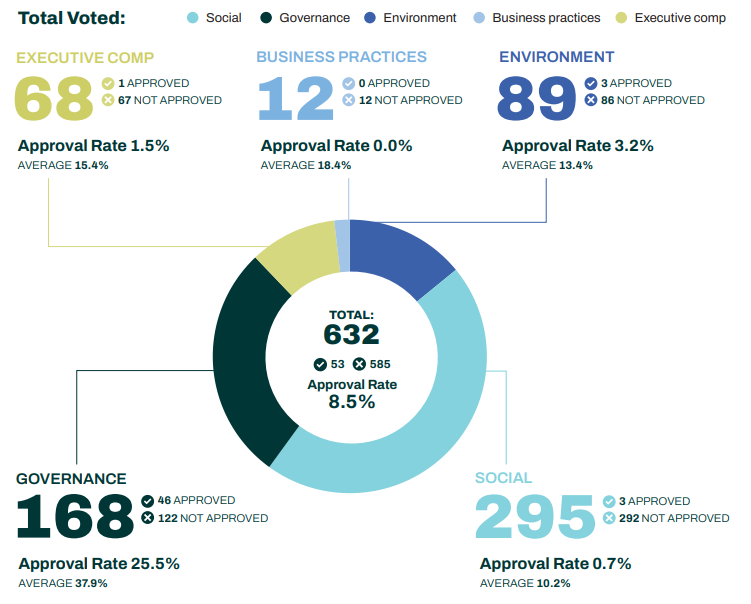
This summary is focused on 14a-8 proposals that were voted on by shareholders during the 2023-2024 season.[1]

We refer to the accompanying charts which have the supporting detail for what follows. As you’ll see, we divide proposals into five categories consistent with our team’s tracking of this data for several proxy seasons.

632 proposals were voted on in the 2023-2024 season compared with 617 in 2022-2023, an increase of 2.4%. 2

Voting Analytics 2023/2024

READ MORE »

Lessons from the Biggest Business Tax Cut in US History

Gabriel Chodorow-Reich is the George Fisher Baker Professor of Economics at Harvard University, Owen Zidar is a Professor of Economics and Public Affairs at Princeton University, and Eric Zwick is a Professor of Economics and Finance at the University of Chicago Booth School of Business. This post is based on their working paper.

The Tax Cuts and Jobs Act (TCJA) of 2017 significantly overhauled the U.S. tax code, primarily by reducing the corporate tax rate from 35% to 21% and lowering individual tax rates across most income brackets. It also increased the standard deduction while eliminating personal exemptions and limiting deductions for state and local taxes. Additionally, the TCJA introduced measures to encourage repatriation of overseas profits and included provisions aimed at simplifying the tax filing process for many taxpayers.

In our recent article, we assess the business provisions of the TCJA, which represented the largest corporate tax cut in U.S. history. There are five key lessons of our analysis:

READ MORE »

2024 Proxy Roundup: ESG Metrics in Incentive Compensation Plans

Simone Hicks and Eric Juergens are Partners, and Ulysses Smith is an ESG Senior Advisor at Debevoise & Plimpton LLP. This post is based on a Debevoise memorandum by Ms. Hicks, Mr. Juergens, Mr. Smith, Alison Buckley-Serfass, Tricia Sherno and Beatrice Techawatanasuk

In this year’s proxy roundup, we have analyzed the use of environmental, social and governance (“ESG”) metrics in cash and equity incentive plans among the largest 100 public companies.[1]

Incentive compensation plans, such as annual bonus and long-term equity awards, generally pay out on the basis of achievement of objective financial goals. However, incentive plans can also pay out in part or in full on the basis of nonfinancial metrics, including ESG metrics. In recent years, companies have increasingly linked ESG objectives to incentive compensation to support and advance their broader ESG strategies. Despite the growing politicization of ESG issues in the United States, ESG goals aimed at promoting environmental stewardship, social responsibility and robust governance frameworks remain important to many companies’ long-term strategic goals and value creation. By embedding ESG targets into compensation plans, companies reinforce their commitment to these goals and ensure that executive leadership remains accountable for achieving progress in these areas.

The proxy statements filed in 2024 by the companies in our sample generally disclose 2023 compensation plans and decisions. As discussed below, in light of the U.S. Supreme Court’s decision invalidating race-conscious admissions practices in higher education and the ongoing anti-ESG political backlash in the United States, the use of ESG metrics in incentive compensation plans in the 2024 compensation season may look quite different.

READ MORE »

Page 5 of 6
1 2 3 4 5 6

