Monthly Archives: July 2025

Voting for Value: Reforming Proxy Systems for Lasting Impact

Olivier Lebleu is a Managing Director at FCLTGlobal. This post is based on his FCLTGlobal memorandum.

The global proxy system is at a crossroads. Frustrations from investors and issuers in the proxy process are leading to frequent headlines from both camps calling for reform, but solutions have been elusive. Furthermore, frustrations with the proxy process are often cited as one of the reasons companies question the need to be publicly listed, especially given the rise of private markets investing in the last decade.

FCLTGlobal has conducted research on the topic since late 2024, looking for areas of common ground that could lead to a better system for the entire value chain – corporate issuers, asset managers, asset owners, and service providers.
Our research has yielded insights into initiatives, some more nascent than others, that offer compelling opportunities to enhance the proxy system. The first set of initiatives listed here are steps that companies and/or investors can take within the current regulatory environment in most countries, though some regulatory safe harbors or amendments to company bylaws may be necessary in some instances. The second set of initiatives would require policy or regulatory interventions in most countries. Together however, they would each contribute to restoring the proxy system to its most valuable intent: a mechanism for open and constructive investor-corporate dialogue, focused on the most salient issues for long-term, sustainable value creation in public markets.

READ MORE »

SEC Withdraws Gensler-Era Shareholder Proposal Rule

Craig Marcus is a Partner at Ropes & Gray LLP. This post is based on a Ropes & Gray memorandum by Mr. Marcus, Paul Tropp, Thomas FraserChristopher CapuzziMarc Rotter, and Kunle Deru.

In a broad reversal of course on proposed rules issued by the Securities and Exchange Commission (SEC) under the leadership of former SEC Chair Gary Gensler, on June 12, 2025, the SEC issued a notice withdrawing 14 of the proposed rules.

While most of the withdrawn proposals (13 of them) relate to investment management, and trading and markets matters, the SEC also withdrew its July 2022 rule proposal (the “rule proposal”). This had proposed amendments to certain substantive bases for excluding shareholder proposals from issuers’ proxy statements for annual or special shareholder meetings under the SEC’s shareholder proposal rule, Rule 14a-8 under the Securities Exchange Act of 1934.

The withdrawal of the rule proposal will be welcome news to issuers as the proposed amendments, which would have amended the substantial implementation, duplication, and resubmission exclusion bases, would have made it more difficult for issuers to exclude shareholder proposals from their proxy statements. The public comment period for the rule proposal had been closed since September 12, 2022, and based on the SEC’s fall 2024 regulatory flexibility agenda, final rules were planned for adoption in October this year.

READ MORE »

CEO Succession: 10 Pitfalls Boards Must Avoid— and the CHRO Practices That Help

Ani Huang is the Senior Executive Vice President and Chief Content Officer at the HR Policy Association, and Anthony Nyberg is the J. Henry Fellers Professor of Management and Faculty Director of the Center for Executive Succession at the University of South Carolina. This post is based on their HR Policy Association memorandum.

CEO succession is one of the board’s most sensitive, high-stakes responsibilities. It’s not just about selecting a new leader—it’s about safeguarding the company’s future, preserving the outgoing CEO’s legacy, aligning diverse stakeholders, and maintaining confidence across the organization and the market.

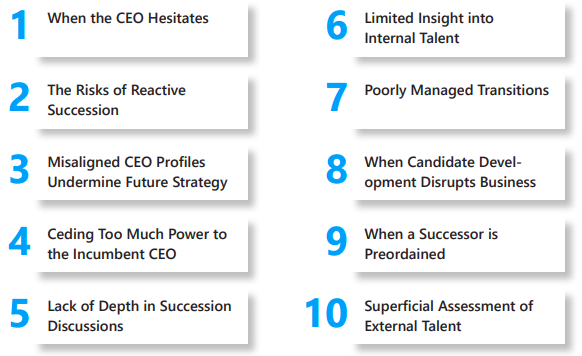
This report outlines 10 of the most common challenges boards face in CEO succession—and how a trusted CHRO can help avoid or resolve them. Based on in-depth interviews with board directors, investors, and succession experts, as well as findings from a national survey of corporate directors, we offer a practical board-centric perspective on strengthening CEO succession with critical CHRO support.

Top 10 CEO Succession Pitfalls

READ MORE »

Trends and Updates from the 2025 Proxy Season

Pamela Marcogliese is the Head of U.S. Transactions, Elizabeth Bieber is a Partner, and Shira Oyserman is Counsel at Freshfields Bruckhaus Deringer LLP. This post is based on a Freshfields memorandum by Ms. Marcogliese, Ms. Bieber, Ms. Oyserman, and Abbey MacDonald.

2025 Proxy Season Highlights

FEWER PROPOSALS, LESS SUPPORT

There has been a drastic reduction in the overall number of shareholder proposals, in part due to the SEC’s willingness to grant no-action relief after publication of SLB 14M, coupled with lower levels of shareholder support for environmental and social proposals

ZEROING IN

Following a multi-year trend of shareholder proposals reflecting issues of societal importance, proponents are increasingly tailoring proposals to specific company practices and industry

RETREAT TO COMFORT & SAFETY

As the regulatory and global environment becomes more uncertain for institutional investors and other shareholders, there has been a retreat to the relative safety of supporting traditional governance and compensation proposals

INVESTORS GO DARK

After SEC guidance changed, investors dramatically changed their engagement practices, leaving companies without feedback on topics of interest and raising the specter of an uncertain engagement season this fall

NEW ADMIN INFLUENCE OVER PROXY SEASON

A new administration led to significant mid-season changes to the SEC, recommendations from proxy advisory firms and policies and voting of institutional investors, although shareholder proposals generally were submitted before the administration change

ANTI-ESG IS ALL AROUND US

Despite limited support for proposals, anti-ESG considerations continue to be a significant topic for companies and their stakeholders and drive changes in the ecosystem

ACTIVISTS IN THE BOARDROOM? 

While large-scale proxy contests were won and lost in 2025, activists also focused their efforts outside of boardroom representation, demonstrating a willingness to wage vote-no campaigns, settle without boardroom representation or settle for unnamed future directors

READ MORE »

The Evolution of Overboarding Policies

Matteo Tonello is the Head of Benchmarking and Analytics at The Conference Board, Inc. This post is based on a Conference Board/ESGAUGE report by Ariane Marchis-Mouren, Senior Researcher, Governance & Sustainability Center, The Conference Board. 

This article explores how and why companies, proxy advisory firms, and large institutional investors have in recent years tightened their approach to overboarding policies, which limit the number of publicly listed boards on which directors can serve.

Trusted Insights for What’s Ahead

  • In the S&P 500, disclosure of overboarding policies jumped from 68% in 2020 to 86% in 2025, reflecting investor pressure for stronger board accountability and capacity oversight. This figure rose from 44% to 58% in the Russell 3000.
  • Companies are moving toward stricter thresholds to align with evolving best practices: in 2020, 51% of Russell 3000 companies with an overboarding policy allowed directors to serve on up to four or five additional boards. By 2025, that figure had dropped to 37%, with 55% of companies now limiting directors from serving on more than three additional boards.
  • While the number of directors serving on multiple boards has increased in recent years, the majority still serve on just one or two public company boards.
  • The adoption of an overboarding policy is directly linked to company size and sector, with larger companies being more likely to have a policy that applies to all directors.
  • Overboarding policies may promote board effectiveness and refreshment by helping ensure directors have sufficient capacity to fulfill their duties. However, since board service is a part-time role for nonemployee directors, overly rigid practices risk oversimplifying the factors that determine a director’s effectiveness and excluding highly qualified candidates with valuable experience.

READ MORE »

The Limited Corporate Response to DEI Controversies

David F. Larcker is the James Irvin Miller Professor of Accounting, Emeritus at Stanford Graduate School of Business, Charles G. McClure is an Associate Professor of Accounting at University of Chicago Booth School of Business, Shawn X. Shi is an Assistant Professor of Accounting at University of Washington Foster School of Business, and Edward M. Watts is an Assistant Professor of Accounting at Yale School of Management. This post is based on their recent paper.

Key Findings

  • Despite the heightened scrutiny firms face following DEI controversies, firms make only modest and largely superficial changes in their hiring. We estimate only a 0.8 percentage-point increase in hiring diversity, with this effect concentrated in junior and non-core roles.
  • Overall diversity is largely unchanged because the departures of diverse employees also rise.
  • Firms experience a –0.7% announcement return when these controversies are reported. This underperformance persists for up to four years afterwards, as we observe a 2–3% annual underperformance in stock returns. Firms that improve their diversity following these controversies offset the adverse stock-price effects.
  • Companies increase DEI-related disclosures and diversity targets, yet these signals are uncorrelated with real hiring, suggesting they engage in “diversity washing.”

Motivation

In recent years, one of the most contentious debates in corporate governance has been the advancement of firms’ diversity, equity, and inclusion (DEI) initiatives. Following the murder of George Floyd in 2020, firms dedicated considerable resources to this cause, with many of these investments intended to improve racial and gender issues. Almost as quickly, many of these same firms have scaled back or eliminated initiatives in response to anti-DEI backlash. Given the heightened focus and subsequent pullback, many have questioned whether DEI initiatives produce any tangible changes in firms.

To provide evidence for this debate, we examine DEI initiatives in arguably the most important group of firms—those with identified problems. These firms face public scrutiny, litigation, and stakeholder campaigns to redress their DEI issues and thus are under the most pressure to act. READ MORE »

Maintaining Motivation in 2025 Short-Term Incentive Programs

Blair Jones and Deborah Beckmann are Managing Directors at Semler Brossy LLC. This post is based on their Semler Brossy memorandum.

The ongoing macroeconomic uncertainty caused by tariffs, executive orders, and reductions in government contracts has upended short-term incentive programs. [1]

In our previous article on tariffs, we discussed how boards can create a proactive framework from which to judge the potential impact of tariffs on compensation plans and evaluate whether in-flight changes or discretionary adjustments might be warranted.

As uncertainty surrounding executive actions and legal rulings persists, the likelihood that short-term incentive programs may not pay out for many executives this year increases. In some cases, a lack of payout may be warranted. Boards, however, still desire a degree of flexibility in their compensation programs to incentivize good business management, especially for relative outperformance in difficult times. Year-end discretionary adjustments may, in limited cases, offer a solution.

Discretion can be something of a third rail in compensation discussions, and discretionary adjustments may be perceived to excuse management missteps or poor performance. Such instances have made shareholders, perhaps justifiably, wary. When used, communicated, and sized judiciously, however, discretionary adjustments can help rally the troops during periods of difficulty, align the organization towards the metrics that matter, and re-establish the link between pay and performance in a way that is fair to both executives and shareholders. In such cases, we’ve found that a well-designed discretionary scorecard may be a useful tool in the board’s arsenal.

READ MORE »

The Long and the Short of It: Institutional Investors’ Views on Activism

Ali Saribas is a Partner, and Andrew Brady is a Director at SquareWell Partners. This post is based on their SquareWell survey.

SquareWell Partners (“SquareWell”) conducted a survey of over 30 institutional investors collectively responsible for more than $35 trillion in AUM from North America, Europe, and Asia. The survey engaged both Stewardship Team professionals and Portfolio Managers from investors of a range of sizes, employing both active and passive strategies, ensuring a balance of perspectives.

Survey questions were organized around three key themes: (1) Views on Activism, (2) Evaluation Criteria, and (3) Engagement Dynamics.

READ MORE »

Why Financial Crises Recur

Gary B. Gorton is Frederick Frank Class of 1954 Professor Emeritus of Management & Finance at the Yale School of Management, and Jeffery Y. Zhang is an Assistant Professor of Law at the University of Michigan Law School. This post is based on their recent paper.

Why do financial crises recur with the proliferation of every new type of runnable short-term debt? In the 18th and 19th centuries, the short-term debt at issue were “banknotes” that circulated as a medium of exchange. Then came bank runs on account-based “demand deposits” during the 20th century. In this century, we have witnessed runs on “money market funds” and “repos” (and demand deposits still). And, during the past half decade, we have seen repeated runs on circulating digital short-term debt known as “stablecoins.”

We explore this question in our new article, “Why Financial Crises Recur.” To be sure, we are not the first to inquire. In the late 19th century, William Graham Sumner lamented that the literature on financial crises “for fifty years had repeated the same inferences, lessons, and warning; but all the doctrines of currency have to be learned over again apparently every ten or fifteen years, if indeed they are ever learned at all.” Over the past two decades, prominent legal scholars have offered explanations rooted in a flawed legislative process and a fragmented regulatory process. We do not disagree with these explanations but given what has occurred over the past few years—in the aftermath of runs on stablecoin issuers, crypto banks, and Silicon Valley Bank—we believe there is still a lack of substantive understanding with respect to the fundamentals of money creation and bank runs.

At a high level, we argue that generation after generation of lawmakers tend to make two (admittedly intuitive) errors when crafting financial regulation. The first error is overemphasizing the importance of transparency and underappreciating the role of opacity. Here, opacity refers to the difficulty of valuing assets, which then implies that liabilities cannot be easily valued. READ MORE »

Climate and Carbon Litigation Trends

Bill Tarantino and Krista deBoer are Partners, and Ashley Quinn is an Associate at Morrison & Foerster LLP. This post is based on a Morrison & Foerster memorandum by Mr. Tarantino, Ms. deBoer, Ms. Quinn, Cedar Hobbs, Erik Manukyan, and Alice Carli.

Introduction

Litigation involving climate-related claims and initiatives remains a source of exposure for companies across all sectors. As the Trump administration reshuffles federal priorities, we expect that consumer litigation and “blue state” attorney general (AG) enforcement may intensify to promote integrity around climate claims in the face of federal animosity toward climate mitigation, while the focus of shareholder derivative actions may shift to discourage climate disclosures following the death of the SEC climate disclosure rules. This document provides a brief overview of recent litigation trends in this space and key takeaways for companies navigating and seeking to mitigate risk in this rapidly evolving landscape.

READ MORE »

Page 5 of 7
1 2 3 4 5 6 7