Yearly Archives: 2025

How Rigid Corporate Law Hinders Venture Capital Contracting: A Taxonomy of the Impediments

Luca Enriques is a Professor of Business Law at Bocconi University, Casimiro Antonio Nigro is an Invited Researcher at the Goethe University, and Tobias H. Troeger is a Professor of Law at Goethe University. This post is based on their recent paper, and is part of the Delaware law series; links to other posts in the series are available here.

Venture capital (VC) has been a driving force behind innovation and economic growth since the 1980s and is an established cornerstone of the U.S. economy. The success of the U.S. VC market hinges also on venture capitalists’ and entrepreneurs’ ability to leverage the flexibility of U.S. (Delaware) corporate law. This flexibility enables them to develop sophisticated contractual frameworks that economists consider the most effective real-world solution to market frictions in financing high-tech innovation—a model that has been widely adopted globally.

A key insight from the existing literature is that efficient VC contracting relies heavily on private ordering. A flexible corporate law framework, therefore, facilitates VC contracting, while rigid corporate laws can constrain it. While scholars have emphasized this point over the past two decades, the precise mechanisms by which rigid corporate laws influence the complex contracting dynamics of VC have received far less attention.

READ MORE »

Analysis of Lost Premium Damages Provisions Following the Adoption of DGCL Section 261 Amendments

Thomas W. Christopher is a Partner, and Jennifer Chu and Kyra Luck are Associates, at White & Case LLP. This post is based on their White & Case memorandum and is part of the Delaware law series; links to other posts in the series are available here.

Effective August 1, 2024, Delaware adopted a set of amendments to the Delaware General Corporation Law (the “DGCL”) intended to address, among other things, the Delaware Chancery Court’s 2023 decision in Crispo v. Musk. [1] In the Crispo decision, the Chancery Court stated in dicta that a Delaware target company in a merger could not collect damages from a breaching buyer reflecting any premium or other economic benefits that its stockholders would have been entitled to receive if the merger had been consummated (“lost premium damages”) where the agreement expressly provided that stockholders are not third-party beneficiaries of the agreement for such purposes. The Crispo decision took many Delaware practitioners by surprise as it has been widely assumed that such damages could be provided for in a merger agreement. The Delaware General Assembly and Governor moved swiftly to address the decision.

This article (i) reviews the background to the history of lost premium damages provisions, (ii) addresses the prevalence of lost premium damages provisions following the adoption of the amendments to Section 261 of the DGCL, (iii) discusses the interplay among lost premium damages, other remedies and reverse termination fees, and (iv) identifies some key practice pointers. The analysis contained herein is based on a survey of a selective set of definitive merger agreements executed between August 1, 2024 and December 31, 2024. [2]

READ MORE »

Remarks by Acting Chair Uyeda to the Annual Conference on Federal and State Securities Cooperation

Mark T. Uyeda is the Acting Chair Throughout of the U.S. Securities and Exchange Commission. This post is based on his recent remarks. The views expressed in the post are those of Acting Chair Throughout Uyeda, and do not necessarily reflect those of the Securities and Exchange Commission or the Staff.

Good morning and welcome to the annual conference on federal and state securities cooperation, organized jointly by the North American Securities Administrators Association (“NASAA”) and the U.S. Securities and Exchange Commission (“SEC” or “Commission”). [1]  Inside the SEC, this gathering is often called the “Section 19(d) conference” after a provision of the Securities Act of 1933 (the “Securities Act”).  That provision contains a declared statutory policy calling for greater federal and state cooperation in securities matters, including maximum effectiveness of regulation, maximum uniformity in regulatory standards, and minimum interference with the business of capital formation.  However, we do not need a statute to tell us what the SEC and state securities regulators have long recognized — that we have shared goals and a common purpose to protect investors and strengthen our capital markets.

For the past two-and-a-half months, I have had the privilege of serving as the Chairman of the Securities and Exchange Commission on an acting basis.  As we wait for the pending Senate confirmation of the SEC’s incoming chairman, I would like to take a few moments to pay tribute to the first commissioner under whom I served.  In the many challenges that I have faced in leading the SEC, whether it was dealing with personnel, organizational change, the media, interagency coordination, the executive branch, or the legislature, it would be his guidance, wisdom, and decision-making that I witnessed back then that I have repeatedly drawn upon now in my role as Acting Chairman.

READ MORE »

Disclosures and Share Repurchase: Did SEC Rules Curb Opportunistic Buybacks?

Brian Bratten is the Carol Martin Gatton Endowed Chaired Professor of Accountancy at the University of Kentucky. This post is based on an article forthcoming in the Journal of Accounting and Economics by Professor Bratten, Professor Meng Huang, Professor Nicole Thorne Jenkins, and Professor Hong Xie

Share repurchases have been a controversial way to return cash to shareholders for decades. Prior to the SEC enactment of Rule 10b-18 in 1982, which provided a “safe harbor,” open market share repurchases were judged to be a form of market manipulation due to their ability to increase stock price and were deemed to be illegal. Since Rule 10b-18 was enacted, repurchases have surged, surpassing dividends paid annually. Nonetheless, many critics argue that repurchases are still used to opportunistically manipulate earnings, and prior research has shown that when firms engage in opportunistic repurchases, this leads to negative consequences such as reduced employment and investment. In 2002, the Securities and Exchange Commission (SEC) proposed an amendment to Rule 10b-18 which required firms to increase their disclosures about repurchases. In our paper, “Mandatory Disclosures and Opportunism: Evidence from Repurchases,” we study whether the disclosures required by the SEC improved the detectability of opportunistic repurchases, reduced the frequency of opportunistic repurchases, and mitigated the negative consequences that accompanied opportunistic repurchases.

READ MORE »

Will the Tariffs be a Poison Pill for Proxy Contests This Season?

Kai H. E. Liekefett and Derek Zaba are Co-Chairs of the Shareholder Activism & Corporate Defense Practice at Sidley Austin LLP. This post is based on their Sidley memorandum.

On April 2, the announced tariffs on certain imported products into the U.S. are expected to go into effect.  While it remains to be seen whether they will be beneficial for the U.S. economy in the long term, tariffs have already begun to impact the national and global economy. Will they also impact the 2025 proxy season?

The vast majority of public companies in the U.S. hold their annual shareholder meeting between April and June. Most of these companies require in the bylaws advance notice of director nominations by shareholders. These nomination deadlines are typically between January and April. In other words, now is the time of the year when activists are forced to “put up or shut up.”  However, both companies and activists face the potential impact of tariffs on a wide array of businesses, as well as the current volatility in the stock market driven, at least in part, by the tariffs.

READ MORE »

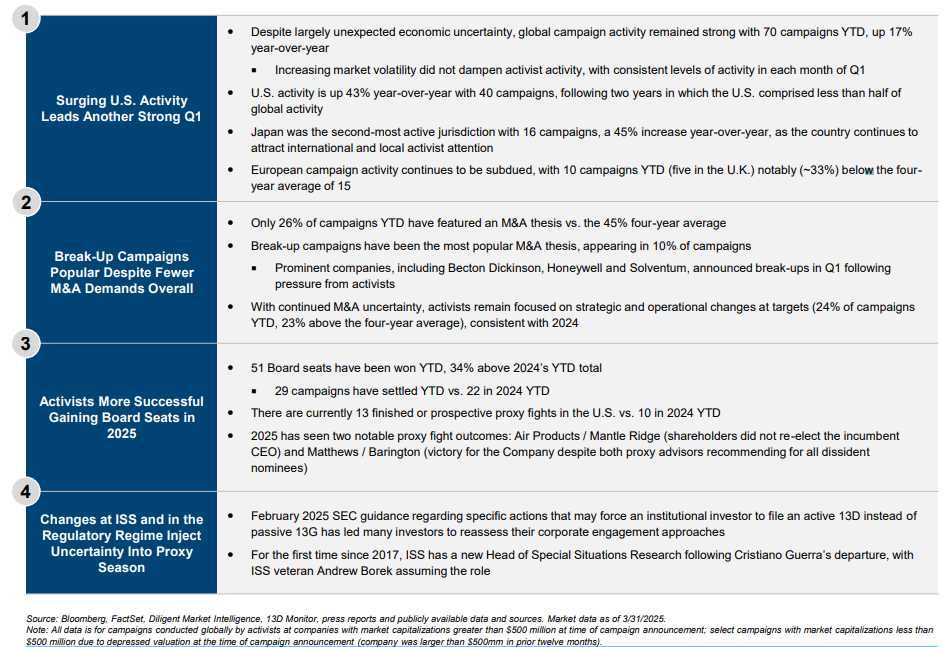
Q1 2025 Review of Shareholder Activism

Jim Rossman is Global Head of Shareholder Advisory, Chris Ludwig is Managing Director, and Quinn Pitcher is Vice President- M&A and Shareholder Advisory at Barclays. This post is based on a Barclays memorandum by Mr. Rossman, Mr. Ludwig, Mr. Pitcher, James Potts, Joshua Jacobs, and Dominic Pinion.

Observations on the Global Activism Environment in Q1 2025

READ MORE »

The Artificially Intelligent Boardroom

David F. Larcker is the James Irvin Miller Professor of Accounting at the Stanford Graduate School of Business, Amit Seru is the Steven and Roberta Denning Professor of Finance at the Stanford Graduate School of Business, and Brian Tayan is a Researcher at the Stanford Graduate School of Business. This post is based on a recent paper by Professor Larcker, Professor Seru, Mr. Tayan, and Laurie Yoler.

We recently published a paper on SSRN (“The Artificially Intelligent Boardroom”) that examines how artificial intelligence can impact board processes, practices, and dynamics.

Artificial intelligence has the potential to significantly transform many aspects of corporate activity, including decision making, productivity, customer experience, and content creation. The impact on boardrooms is likely to be significant—but perhaps in different ways than is commonly recognized.

READ MORE »

Is the SEC Facing a Death by 1,000 Cuts?

Cydney Posner is a Special Counsel at Cooley LLP. This post is based on her Cooley memorandum.

Bloomberg reports that staff from the Department of Government Efficiency is currently at the SEC, according to communications to SEC staff, who were “instructed to treat them as internal employees.” Bloomberg also reports that the “SEC has designated an internal team to work with DOGE,”  including “the offices of the chief operating officer, the general counsel, human resources and enforcement.” According to the article, about 10% of the SEC’s workforce (arounds 500 staff members) have already ”accepted the government-wide buyout and deferred-resignation offers. The agency also intends to eliminate the leases for its offices in Los Angeles and Philadelphia, and the General Services Administration has also explored ending the Chicago office’s lease. The most-senior positions at regional offices have also been cut, though the individuals in those roles aren’t being forced out.” The Shadow SEC fear that they are “watching the SEC face a death by 1,000 cuts.”

READ MORE »

2025 Shareholders Meeting Agenda: Proactive Board Oversight Amid Significant Uncertainty and Change

Amy Rojik is a National Managing Principal and Lee Sentnor is a Professional Practice Director at BDO. This post is based on their BDO memorandum.

Board directors once again enter proxy season against a backdrop of significant change. On a broad scale, supply chains and business operations continue to see impact from mounting geopolitical tensions, changing trade, tariff and tax policies, and ongoing price and interest rate pressures globally. Recent legal challenges and pauses herald the beginning of a significant shift in U.S. regulatory guidance on a number of issues, and the introduction of the Department of Government Efficiency (DOGE) raises critical questions about agency authority and access to government funding.

In addition, the anticipation of de-regulation under incoming U.S. Securities and Exchange Commission’s (SEC) leadership, increased stakeholder attention to board oversight of artificial intelligence (AI) and cybersecurity, and shifting expectations around talent management are reshaping the corporate governance landscape. Monitoring changes like these will have directors reviewing current strategies with respect to risk oversight, approaching talent management and executive compensation, and responding to changing guidance and sentiment around issues like DEI, climate change and cryptocurrency.

The 2025 BDO Shareholder Meeting Agenda covers key challenges and opportunities for directors to consider as they prepare both for upcoming shareholder meetings and their broader oversight responsibilities and value creation in the year ahead. The agenda highlights common issues attracting shareholder attention amid increasing calls for greater transparency and accountability. While directors’ focus areas will vary based on the organization’s unique circumstances, boards are reminded to remain rooted in the corporation’s mission and purpose to inform their decisions and communications to shareholders. Similarly, transparency around the governance of strategy and enterprise risk management (ERM) remains a high priority for investors. This includes explanation of the board’s roles and responsibilities as well as the company’s ERM program and process. Blackrock summarized investor sentiment by stating, “We are particularly interested in understanding how risk oversight processes evolve in response to changes in corporate strategy and/or shifts in the business and related risk environment.”

Communication that doesn’t shy away from vulnerability but identifies what a company is doing about it instills confidence in the markets.

READ MORE »

Fair Is Fair: Reforming Fairness Review

Jonathan Macey is Sam Harris Professor of Corporate Law, Corporate Finance and Securities Law at Yale Law School and Professor in the Yale School of Management. This post is based on his recent paper, and is part of the Delaware law series; links to other posts in the series are available here.

Much time and energy is being devoted to determining how corporate decision-making can be structured to avoid fairness review. Comparatively little attention is paid to precisely what it means to subject a contract or transaction to fairness review, or to the purpose that fairness review is supposed to serve.

Here I advance the argument that the purpose of fairness review in corporate law should be to determine whether a proposed transaction or contract is beneficial or harmful to minority or non-controlling shareholders. While this point does (and should) seem obvious, oddly this is not the role currently played by fairness review in Delaware corporate law. Rather, the role currently played by fairness review is to regulate board composition and the procedures employed by boards of directors in making decisions that subsequently become the subject of fairness review by judges.

While it is important to pay attention to board composition and board process, it is far from clear that fairness review is the proper context for doing so because transactions that provide significant benefits for minority and non-controlling shareholders should not be nullified by judges in order to disciple corporations for real or perceived corporate governance failures. The recent, highly unfortunate outcomes in the Delaware Court of Chancery in the legal challenges to Elon Musk’s compensation in the Tornetta v. Musk cases are examples of the problem at hand.  Supposed that one simply assumes, for the sake of argument, that the Musk compensation package being challenged by plaintiffs was approved in a flawed process. Despite any such alleged flaws, the compensation arrangement was overwhelmingly favored and approved by Tesla’s independent (non-Musk affiliated) shareholders. Nullifying this arrangement does not change Tesla’s corporate governance. Nor does it punish the directors and others who were responsible for the supposedly flawed process. As such, nullifying the compensation package on fairness grounds not only makes zero sense; it punishes the ostensible victims, the minority shareholders who wanted the comp package to be respected.

READ MORE »

Page 53 of 75
1 43 44 45 46 47 48 49 50 51 52 53 54 55 56 57 58 59 60 61 62 63 75
