Monthly Archives: January 2026

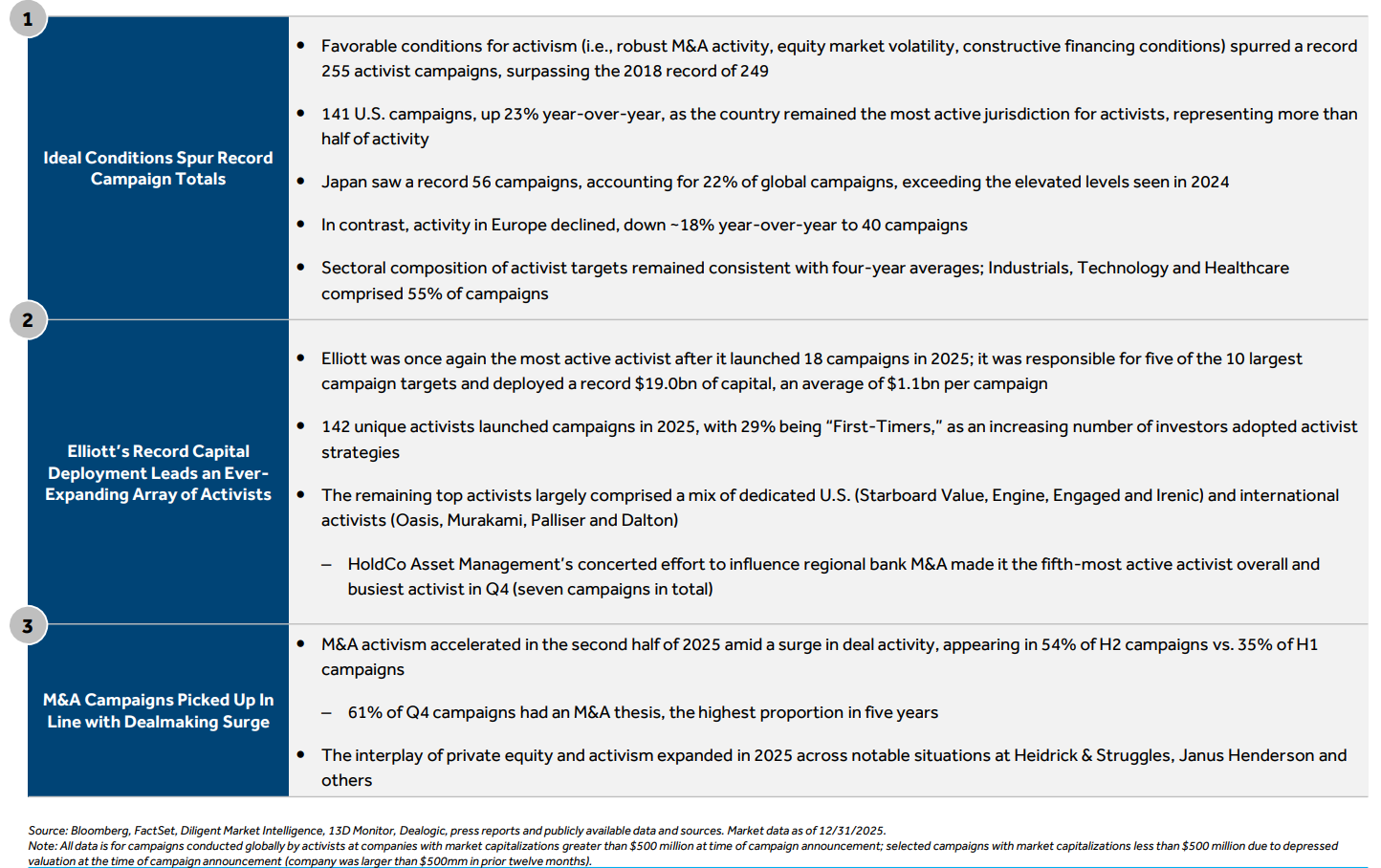
2025 Review of Shareholder Activism

Jim Rossman is Global Head of Shareholder Advisory, Ryan Ferguson is a Director, and Abraham Axler is a Vice President at Barclays. This post is based on a Barclays memorandum by Mr. Rossman, Mr. Ferguson, Mr. Axler, Josh Jacobs, Dominic Pinion, and Olakunle Akande.

Observations on the Global Activism Environment in 2025

READ MORE »

The Debate on Performance Shares—Who Has It Right

Ani Huang is the CEO and Dr. Charles G. Tharp is a Senior Advisor at CHRO Association. This post is based on their CHRO memorandum.

After a decade of complete primacy, performance-based share units (PSUs) are undergoing a moment of intense scrutiny.

Investors like CII and Norges Bank are questioning whether:

  • PSUs should be the prevailing form of long-term incentives for CEOs, and
  • whether they are in fact tied to better performance

In response to investor input, proxy advisors like ISS and Glass Lewis are softening their requirements around performance-based equity. It can be tough to sort through all the differing perspectives. Here is a resource we hope will help clarify how the varying findings compare to each other, which questions are being asked (and answered) and key considerations for you in your work with the Compensation Committee.

  • ISS recently made headlines by breaking with its historic preference for performance-based pay, and investors seem increasingly willing to support long-vesting RSUs.
  • While studies suggest that companies with innovative LTI design perform better than peers, companies should view these results with caution and undertake their own analysis to determine if their approach to long-term incentives is optimal in view of their business strategy, competitive landscape, company culture, and talent objectives.
  • The Center believes that “best fit” should guide the design of executive compensation and encourages companies to resist being overly swayed by either prevailing practice or the headlines generated by limited research on LTI design and company performance.

READ MORE »

Pulse on Pay: 12 Years of CEO Pay

Margaret Hylas is a Managing Director, Leah Sine is a Consultant, and Michelle Wu is a Senior Associate Consultant at Semler Brossy. This post is based on their Semler Brossy memorandum.

OVERVIEW

Most executive pay levels analysis focuses on target equity grant values—essentially the accounting value at grant—rather than value realized when equity is earned. Assessing the trends and data underlying take-home equity value can offer boards a fresh perspective on their pay-for-performance alignment and pay program liquidity versus what is communicated to participants in target grant value.

Realized equity outcomes can be found in the Option Exercises and Stock Vested Tables in the CD&A, which reflect the value of an executive’s equity the moment it is off the table or earned. This report contains analysis on “In-Role S&P 500 CEOs” who have served for at least three years (so there is enough time for equity vesting to build up), and “Take-Home” equity compensation, including full-value shares at vest and options at exercise. Importantly, this analysis is differentiated from a “realizable” equity look, which would include the trending value of unvested equity awards.

READ MORE »

Rulemaking Petition Pursuant to the Holding Foreign Insiders Accountable Act (HFIAA)

Robert J. Jackson, Jr. is the Nathalie P. Urry Professor of Law at New York University School of Law, Bradford Levy is an Assistant Professor at the University of Chicago Booth School of Business, and Daniel J. Taylor is the Arthur Andersen Chaired Professor at the Wharton School of the University of Pennsylvania. This post is based on their recent petition to the U.S. Securities and Exchange Commission.

We are scholars of securities law and financial economics whose research led to the development and passage of the Holding Foreign Insiders Accountable Act (HFIAA or the Act).[1] Our joint work, Holding Foreign Insiders Accountable, first identified risks that investors face from insider trading at foreign firms listed in the United States.[2] Using a unique dataset, we estimated that foreign-firm insiders traded to avoid losses of over $10 billion. The evidence shows that opportunistic trading has been concentrated in companies domiciled in nonextradition countries beyond the reach of U.S. law—especially China.

We respectfully submit this rulemaking petition pursuant to Rule 192(a) of the Securities and Exchange Commission (SEC) Rules of Practice to ask that the Commission develop rules to give investors the insider-trading transparency at foreign firms that Congress and the President have mandated under the Act.

While trading of corporate insiders at a U.S.-domiciled public company is subject to rapid disclosure under Section 16(a) of the Securities Exchange Act of 1934, the SEC exempted foreign private issuers (FPIs) from that requirement.[3]As highlighted in our testimony before the Senate and the SEC’s Investor Advisory Committee, the SEC exempted FPIs from Section 16 long before China-domiciled companies became prominent among U.S.-listed foreign issuers.[4]

The Act eliminates that exemption, shining light on opportunistic trading in foreign companies that can harm American investors. In response, the SEC’s Staff issued a press release suggesting that the Act leaves in place an exemption for large FPI shareholders from disclosures otherwise required under Section 16.[5] The result of the Staff Press Release’s interpretation would be that large shareholders of U.S.-listed, Chinese-domiciled firms could avoid disclosing their trades to the public, while such disclosures would be required for shareholders of U.S. companies. Our petition instead urges the Commission to proceed as follows: READ MORE »

When Does an Officer’s Sexual Harassment of Employees Constitute a Fiduciary Breach?

Gail Weinstein is a Senior Counsel, Philip Richter is a Partner, and Steven Epstein is the Managing Partner at Fried, Frank, Harris, Shriver & Jacobson LLP. This post is based on a Fried Frank memorandum by Ms. Weinstein, Mr. Richter, Mr. Epstein, and Erica Jaffe, and is part of the Delaware law series; links to other posts in the series are available here.

Editor’s Note (January 29, 2026): At the authors’ request, the following paragraph has been added to reflect recent developments in Delaware law:

On January 16, 2026, the Court of Chancery issued its decision in Los Angeles City Employees’ Retirement System v. Sanford (“eXp”), which pointedly rebukes the Credit Glory decision. In eXp, Chancellor Kathaleen St.J. McCormick held, at the pleading stage of litigation, that the defendant directors and officers of eXp World, a real estate company, may have breached both their duty of loyalty, and their Caremark duties of oversight, by permitting, allegedly, rampant drugging and raping of the company’s real estate agents by its other agents. Based on eXp, the court’s jurisprudence is in flux as to whether sexual misconduct in the workplace should be viewed as personal misconduct governed by employment laws or, instead, may implicate directors’ and officers’ fiduciary duties.

In Brola v. Lundgren (Dec. 1, 2025), the Delaware Court of Chancery held that a director-officer’s sexual harassment of employees, which resulted in fines and other damages to the corporation, constituted personal misconduct and not a breach of his fiduciary duties to the corporation and its shareholders. Accordingly, the director-officer was not personally liable to the corporation for its losses. The decision thus limits the reach of the court’s 2023 seminal McDonald’s decision.

Key Points

  • A corporate officer’s sexual harassment of employees will not constitute a breach of fiduciary duties except under limited circumstances. Based on Brola, unless the officer’s corporate duties specifically included responsibility for ensuring against sexual harassment of employees, it is unlikely that his or her sexual harassment of employees would constitute a fiduciary breach.
  • The decision limits the McDonald’s decision. In McDonald’s, the court had held that an officer’s sexual harassment of employees violated his fiduciary duty of loyalty, as it was “selfish” conduct in which he engaged for his own personal gratification. In Brola, the court expressed the need for a “limiting principle” on this logic, lest every workplace misdeed based on personal interests— whether “a breakroom fistfight, a defamatory social media post, or theft of office supplies”—would constitute a fiduciary breach.
  • The decision will make it more difficult for plaintiffs to bring derivative actions against corporate officers who commit sexual harassment. Corporate officers who commit sexual harassment may be liable for sexual harassment under employment-related statutes, laws of the jurisdiction where the injury occurred, and/or contractual obligations to the company, but, except where their corporate duties specifically include preventing sexual harassment of employees, they should not be liable to the corporation for a breach of fiduciary duties.

READ MORE »

26 Trends Affecting Capital Markets in 2026

Anna Pinedo is a Partner at Mayer Brown LLP. This post is based on her Mayer Brown memorandum.

On this blog, we have commented quite a number of times regarding a number of trends affecting our capital markets—many of which have been a factor since the early 2000s and which have become more pronounced since the adoption of the Sarbanes-Oxley Act and related reforms.  For example, we have noted the decline in the number of U.S. public companies, and the rising significance of the private markets.  A report earlier this fall in the New York Times DealBook (Oct. 25, 2025) notes that private assets have more than doubled over 12 years, to $22 trillion in 2024 from $9.7 trillion in 2012.  The article notes that companies are staying private longer, waiting an average of 16 years to go public, 33 percent longer than a decade ago.  Since the change in administration, enhanced retail access to the private markets, or to the perceived attractive returns associated with private market assets, has been a focus of policymaker attention.  Of course, this is but one of several important conversations that likely will continue to influence markets in this coming year—below, we expand on this, and share some additional perspectives (all from just one lawyer’s, not banker’s, vantage point) on other trends.

READ MORE »

2025 ESG Wrap-Up and 2026 Outlook

Simon Toms and Kate Jackson-McGill KC are Partners, and Justin Lau is an Associate at Skadden, Arps, Slate, Meagher & Flom LLP. This post is based on a Skadden memorandum by Mr. Toms, Ms. Jackson-McGill KC, Mr. Lau, Jonathan Benson, Abigail B. Reeves, and Leesha Curtis.

Executive Summary

  • What’s new: Key ESG developments in late 2025 include the EU’s final proposals regarding corporate sustainability due diligence, simplified European sustainability reporting, delayed timing for the EU Deforestation Regulation, a landmark liability ruling and new UK legislation governing carbon border adjustments.
  • Why it matters: The changes in the EU significantly reduce reporting burdens, narrow liability and compliance scope, and introduce new requirements, impacting EU and non-EU companies, financial institutions and businesses with global supply chains.
  • What to do next: Companies should (i) review updated thresholds, reporting exemptions and compliance timelines; (ii) assess applicability to their operations; and (iii) prepare for new or revised ESG reporting, due diligence and carbon border adjustment requirements.

READ MORE »

Letter in Response to SEC Changes to the Rule 14a-8 Shareholder Proposal Process

Jen Sisson is the CEO and Severine Neervoort is the Global Policy Director at ICGN. This post is based on their letter to the Chairman of the SEC, Paul Atkins.

The International Corporate Governance Network (ICGN) would like to offer its perspective on the SEC Division of Corporation Finance statement, published on November 17, 2025, regarding no-action requests under Rule 14a-8.1

Led by investors responsible for assets under management of over US$ 90 trillion, ICGN promotes high standards of corporate governance globally. Our members – both asset owners and asset managers – have significant exposure to the U.S. market. We are deeply concerned by the Division of Corporation Finance’s announcement that it will not substantively respond to most Rule 14a-8 no-action requests for the 2025–2026 proxy season.

We are concerned that the narrowing of shareholder proposal rights appears part of a broader shift that reduces the avenues through which investors can engage with portfolio companies – compounded by recent changes to interpretations of Section 13D and 13G. Taken together, these developments risk adding tensions between company owners and management, and diminish investor confidence in U.S. corporate governance standards and thereby weaken the appeal of U.S. capital markets globally.

READ MORE »

Weekly Roundup: January 16-22, 2026


More from:

This roundup contains a collection of the posts published on the Forum during the week of January 16-22, 2026

Executive Security: The Perk to Watch


Boards Enjoy Increased Investor Support as Markets Deliver and DEI Pressure Fades


Section 16(a) Insider Reporting: Legislation Ends Foreign Private Issuer Exemption


Harvard Corporate Faculty Excels in SSRN’s 2025 Citation Rankings


M&A Predictions and Guidance for 2026


ISS and Glass Lewis 2026 Policy Updates


SEC Enforcement: 2025 Year in Review


2026 Global Principles for Benchmark Policies


President Trump’s Executive Order on Proxy Advisors: The Potential Pros and Cons for Companies


Say-on-Pay 2025 Proxy Voting Review of Large Asset Managers


Say-on-Pay 2025 Proxy Voting Review of Large Asset Managers

Matthew Illian is the Director of Responsible Investing at United Church Funds. This post is based on a United Church Funds report.

The Interfaith Center on Corporate Responsibility (ICCR) and many of its members, including United Church Funds, have long championed the alignment of compensation incentives with long-term, sustainable value, well before the Dodd-Frank law mandated Say on Pay votes. The largest asset managers in the world also state the importance of designing executive compensation packages with long-term sustainable growth in mind. But new research commissioned by ICCR reveals that support for executive compensation varies widely between asset managers. These differences carry significant implications for asset owners and asset managers given the concentration of voting power in a small number of U.S. firms and the growing scrutiny of executive compensation design.

READ MORE »

Page 2 of 6
1 2 3 4 5 6