Yearly Archives: 2009

Back to the Good Times on Wall Street

This post is based on an op-ed piece by Lucian Bebchuk and Alma Cohen published today on Wall Street Journal online and available here.

New York State Attorney General Andrew Cuomo released yesterday a report on compensation and income at nine major banks during 2003-2009. An assessment of these figures raises serious concerns from the perspective of both investors and taxpayers.

The Cuomo report focuses on nine large financial institutions that received substantial TARP support from the government. Below we focus on the compensation decisions these firms made during the first half of 2009. Assuming that these decisions are a sign of things to come, the firms’ post-crisis pay policies appear to be, in the aggregate, even more lucrative to the firms’ employees than precrisis policies.

From shareholders’ perspective, it is useful to examine what may be labeled “Earnings before Compensation (“EBC”), which are equal to the sum of net income and compensation expenses. A financial firm’s ECB in any given year represents the total pie to be divided between the two groups crucial for the firm’s existence and operations — the firm’s employees and the shareholders providing the firm’s capital. Firms’ compensation decisions determine what fraction of ECB goes to employees rather than left in firms’ coffers (or distributed as dividends) to shareholders.

During the first half of 2009, with the exception of State Street, the banks in the group have enjoyed substantial ECB levels. The bar graph below displays the fraction of the banks’ aggregate EBC levels paid out as compensation to employees during the precrisis years as well as during the first half of 2009.
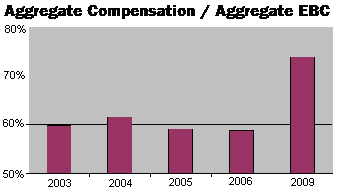
Aggregate Compensation/Aggregate EBC

As the bar graph shows, during each of the years 2003-2006, this fraction was in the 52%-62% range. In contrast, during the first half of 2009, this fraction was about 74%. To the extent that employees were not under-compensated during 2003-2006, investors have a reason to wonder: might financial firms be letting employees eat part of the investors’ lunch?

Defenders of firms’ compensation decisions argue that firms are paying what is necessary to retain able employees and to prevent the flight of talent. The aggregate figures of pay and compensation can also be useful in considering this argument.

In 2006, aggregate ECB for the banks in the group equaled (in 2009 dollars) $244 billion and the banks’ total compensation expenses were $143 billion. By contrast, assuming that ECB and compensation in the second half of 2009 will be the same as in the first half, the firms will pay an aggregate $156 billion even though they will generate an aggregate EBC of only $211. Assuming that the behavior of these firms is representative of the financial sector, investors might wonder why financial firms need in the aggregate to spend more on compensation even though they generate less value.

We now turn from the perspective of investors to that of the government (two perspectives that somewhat overlap as the government owns shares in some of these banks). We believe that government policy toward compensation in banks should focus on the incentives produced by pay structures, not on compensation amounts. But the above compensation figures should be of interest to public officials for two reasons.

First, during the financial crisis, taxpayers have expended substantial resources to shore up the firms’ capital, with the firms covered by the report receiving a total of $165 billions in TARP funding. The compensation amounts taken by employees out of the firms — $156 billion in 2009 alone assuming the second half of the year is the same as the first — are sufficiently large to have a meaningful impact on the firms’ capital.

Second, during the past two decades, compensation in finance has increased relative to other parts of the economy, and the financial sector has attracted an ever-increasing share of the country’s best and brightest. Following the financial crisis, there is widespread recognition that, in the post-crisis world, finance should command a smaller share of these best and brightest. To the extent that relative pay in the financial sector remains at or above its lofty precrisis levels, the desirable adjustment in the allocation of talent will be impeded or delayed.

Assessing the compensation figures for the first half of 2009 indicates that the good days of compensation are clearly rolling again. Investors and taxpayers should closely watch how these figures evolve during the remainder of 2009 and beyond.

Protecting Shareholders and Enhancing Public Confidence through Corporate Governance

Editor’s Note: This post is the written testimony (with footnotes and references omitted) submitted by Professor John Coates to the Senate Banking, Housing, and Urban Affairs Subcommittee on Securities, Insurance and Investment. Professor Coates testified on July 29, 2009 in the hearing on “Protecting Shareholders and Enhancing Public Confidence by Improving Corporate Governance.” Professor Coates’s complete written testimony can be found here.  Professor Coates’ testimony, and the research of other members of the Program on Corporate Governance, was discussed in this article published on July 29, 2009 in the Christian Science Monitor.

Introduction

Chairman Reed, Ranking Member Bunning, and members of the Subcommittee, I want to thank you for inviting me to testify. Effective corporate governance is a crucial foundation for economic growth, and I am honored to have been asked to participate.

A. Are There Any General Lessons for Corporate Governance from the Financial Crisis?

Some have described the ongoing financial crisis as reflecting poorly on US corporate governance, as with the accounting scandals and stock market bubbles of the late 1990s and early 2000s that led to the Sarbanes-Oxley Act. Unlike those episodes, however, the ongoing financial crisis has not exposed new and widespread problems with the basic governance of most US publicly held corporations. Outside the financial and automotive sectors, most companies have suffered only as a result of the crisis, and did not contribute to or cause it. Stock prices have fallen across the board, but most price declines have more to do with the challenges facing the real economy, and the spillovers from the financial sector on companies in need of new capital, and little to do with any general problem with corporate governance. As a result, we have learned relatively little about many long-standing concerns and debates surrounding the governance of publicly held corporations – and there are few if any easy lessons that can be drawn from the crisis for corporate governance generally.

I do not mean to minimize those concerns and debates, or suggest lawmakers should remain passive in the field of corporate governance. To the contrary, the crisis makes reform more important and urgent than ever, because well-governed companies recover and adapt more readily than poorly governed firms. But the best reform path will need to attend to differences between governance across industries, and ways that corporate governance interacts with industry-based regulation – and in particular, financial industry regulation – if legal changes are not to make things worse, rather than better. Governance flaws at Citigroup differed dramatically from governance flaws at GM, and attempts to fix the problems at firms like GM through laws directed at all public companies could make things worse at firms like Citigroup.

READ MORE »

Review Proposes Fundamental Changes to Strengthen UK Bank Governance

This post is by Sir David Walker of Morgan Stanley.


On July 16 the Walker review of corporate governance of UK banks and other financial institutions (BOFIs) released a consultation paper on the future of corporate governance in the UK financial services sector (the Review).
We have recommended substantial changes to the way the boards of BOFIs function in particular through boosting the role of non-executives in the risk and remuneration process.

We recommend strengthening bank boards, making rigorous challenge in the boardroom a key ingredient in decisions on risk and measures to encourage institutional shareholders to play a more active role as engaged owners of BOFIs.

Sir David said “These proposals are designed to improve the professionalism and diligence of bank boards, increasing the importance of challenge in the board environment. If this means that boards operate in a somewhat less collegial way than in the past, that will be a small price to pay for better governance.”

Five key themes of the Review are as follows:

First, the Combined Code of the Financial Reporting Council (FRC) remains fit for purpose. Combined with tougher capital and liquidity requirements and a tougher regulatory stance on the part of the Financial Services Authority (FSA), the “comply or explain” approach to guidance and provisions under the Combined Code provides the surest route to better corporate governance practice in BOFIs. The relevant guidance and provisions require amplification and better observance but there are no proposals for new primary legislation.

Second, principal deficiencies in BOFI boards related much more to patterns of behaviour than to organisation. The right sequence in board discussion on major issues should be presentation by the executive, a disciplined process of challenge, decision on the policy or strategy to be adopted and then full empowerment of the executive to implement. The essential challenge step in the sequence was missed in some board situations and must be unequivocally embedded in future. The most critical need is for an environment in which effective challenge of the executive is expected and achieved in the boardroom before decisions are taken on major risk and strategic issues. For this to be achieved will require close attention to board composition to ensure the right mix of both financial industry capability and critical perspective from high-level experience in other major business. It will also require a materially increased time commitment from non-executive directors (NEDs), from whom a combination of financial industry experience and independence of mind will be much more relevant than a combination of lesser experience and formal independence. In all of this, the role of the chairman is paramount, calling for both exceptional board leadership skills and ability to get confidently and competently to grips with major strategic issues. With so substantial an expectation and obligation, the chairman’s role will involve a priority of commitment that will leave little time for other business activity.

READ MORE »

U.S. Corporate Governance Today: A Reshaping of Capitalism

This post is by Peter Atkins of Skadden, Arps, Slate, Meagher & Flom LLP.

One way to sum up the “big picture” of corporate governance in the U.S. today is as follows:

We are in the midst of a true revolution in our private enterprise economic system, much of which is being driven in the name of “corporate governance” by multiple parties with an ever-expanding agenda.

This may sound like one of those deliberately extreme statements sometimes designed to stimulate debate—but I offer it simply as a description of where things are. In fact:

• The roster of participants in the U.S. corporate governance arena today is extraordinarily large and diverse, the collective agenda of these participants is very broad, and the level of dedication of these various participants to achieving their agendas is quite high.

• The common purpose or effect of their efforts is to redesign in significant ways the publicly traded business corporation, a central instrument of U.S. capitalism.

• This redesign involves sources of capital, the role of risk-taking, the fundamental purpose of business corporations and the role of directors.

The bottom line reality is that today’s corporate governance reform movement is reshaping materially our private enterprise economic system. Moreover, inadequate attention is being paid to assessing the scope and magnitude of the changes — and the risks they present to our economy. This inattention needs to be corrected promptly, before the law of unintended consequences produces considerable harm to our economic system in the name of “corporate governance.”

Participants in the Corporate Governance Universe Today

There is no question that the ranks of the participants in the corporate governance dialogue have been steadily expanding over the past decade, and as a result of the recent financial crisis and global recession, this has significantly accelerated in the past year or so. These participants now include: (1) the SEC; (2) the NYSE and Nasdaq; (3) shareholder governance activists; (4) hedge funds/other shareholders with shortterm or special economic interests; (5) public pension funds and other institutional investors; (6) corporate governance rating services; (7) proxy advisory firms; (8) academics in various disciplines; (9) labor unions; (10) the President/White House; (11) Congress; (12) the Treasury Department; (13) the Federal Reserve System; (14) the Federal Deposit Insurance Corporation; (15) the Department of Justice; (16) state Attorneys General; (17) the media; and (18) state corporate law (legislatures and courts).

Each of these parties or groups has become an active voice of corporate governance “reform.” The growth of this universe is a clear testament to the dramatically increased visibility and importance ascribed to “corporate governance” in today’s world.

READ MORE »

The Risk Burden of Entrepreneurship

This post comes to us from Robert E. Hall of Stanford University and the National Bureau of Economic Research, and Susan E. Woodward of Sand Hill Econometrics, Inc.

An entrepreneur’s primary incentive is ownership of a substantial share of the enterprise that commercializes the entrepreneur’s ideas. An inescapable consequence of this incentive is the entrepreneur’s exposure to the idiosyncratic risk of the enterprise. Diversification or insurance to ameliorate the risk would necessarily weaken the incentives for success. In our forthcoming American Economic Review paper, The Burden of the Nondiversifiable Risk of Entrepreneurship, we study this issue in the case of startup companies backed by venture capital.

We make use of a rich body of data, which we believe is not a sample, but close to the universe of companies receiving venture funding from 1987 to the present. Standard venture deals involve three parties: entrepreneurs, general partners, and limited partners. The entrepreneurs have leveraged positions; that is, they receive no payoff until other claimants have received prescribed payoffs. The general partners, who arrange financing and supervise the startup company by holding board seats, are compensated in proportion to the amount invested and the capital gains on the investment. The limited partners are passive investors who hold debt and equity claims on the startup. General partners are somewhat diversified across investments and the limited partners are highly diversified. The burden of specialization falls mainly on the entrepreneurs.

We focus on the joint distribution of the duration of the entrepreneur’s involvement in a startup what we call the venture lifetime and the value that the entrepreneur receives when the company exits the venture portfolio. Exits take three forms: (1) an initial public offering, in which the entrepreneur receives liquid publicly-traded shares or cash (if she sells her own shares at the IPO or soon after) and has the opportunity to diversify; (2) the sale of the company to an acquirer, in which the entrepreneur receives cash or publicly-traded shares in the acquiring company and has the opportunity to diversify; and (3) shutdown or other determination that the entrepreneur’s equity interest has essentially no value. Most IPOs return substantial value to an entrepreneur. Some acquisitions also return substantial value, while others may deliver a meager or zero value to the entrepreneur. The joint distribution shows a distinct negative correlation between exit value and venture lifetime. Highly successful products tend to result in IPOs or acquisitions at high values relatively quickly.

In addition, we develop a unified analysis of the factors affecting the entrepreneur’s risk-adjusted payoff, based on a dynamic program. The analysis takes account of the joint distribution of exit value and venture lifetime and of salary and compensation income. We use it to calculate the certainty-equivalent value of the entrepreneurial opportunity the amount that a prospective entrepreneur would be willing to pay to become a founder of a venture-backed startup. For a risk-neutral individual, the certainty-equivalent is $3.6 million. With mild risk aversion and savings of $100,000, however, the amount is only $0.7 million and with normal risk aversion and that amount of savings, the certainty-equivalent is slightly negative.

Our most important finding is that the reward to the entrepreneurs who provide the ideas and long hours of hard work in these startups is zero in almost three quarters of the outcomes, and small on average once idiosyncratic risk is taken into consideration.

The full paper is available for download here.

Populist Wish Lists Offer Legislative Parade of Horribles

This post is based on a client memo by David Katz and Laura McIntosh of Wachtell, Lipton, Rosen & Katz.

In recent weeks, regulators and lawmakers have proposed a dizzying array of reforms that, if implemented, would exacerbate short-termism, undercut directorial discretion, further empower shareholder activists, and impose unnecessary and potentially costly burdens on public companies. Few of the proposed reforms are truly new and nearly all are ill-conceived. They appear to proceed in part from a misguided impulse on the part of regulators and lawmakers to be seen as “doing something” about the current recession—though hardly any of the proposed reforms have even a remote connection to the origins of the credit crisis that precipitated the economic downturn—and in part from an opportunistic desire to use the financial crisis as an excuse to enact an activist “wish list” of reforms.

Overview

Members of Congress, the Department of the Treasury and the Securities and Exchange Commission (SEC) are all currently engaged in putting forth corporate governance initiatives. The proposed reforms include shareholder proxy access rules, corporate governance proxy disclosure requirements, executive compensation proxy disclosure requirements, requirements as to the structure, composition and election of the board of directors, executive compensation clawbacks, say-on-pay and independence requirements for compensation committees and their outside consultants, and mandatory majority voting. Pending federal legislation includes the Shareholder Bill of Rights Act of 2009 (Bill of Rights Act), sponsored by Senators Charles Schumer and Maria Cantwell, the Shareholder Empowerment Act of 2009 (Empowerment Act), sponsored by a group of Representatives, the Excessive Pay Shareholder Approval Act (Excessive Pay Approval Act), sponsored by Senator Richard Durbin, and the Treasury’s Investor Protection Act of 2009 (Investor Protection Act).

Amidst this veritable avalanche of reform, the SEC has already approved the New York Stock Exchange’s (NYSE) proposal to eliminate broker discretionary voting in uncontested elections beginning next year. The key features of the proposed initiatives are discussed below.

Shareholder Proxy Access

The latest chapter in the continuing saga of proxy access began in June 2009 as the SEC released proposed proxy access rules for the third time this decade. The first proposal, in 2003, was the subject of fierce debate—the SEC received a record number of comment letters on the proposal—and was shelved in 2004. The prevailing sentiment at that time was that the issue of proxy access was highly complex and carried many hidden consequences. For a time, it appeared that the issue had been largely superseded by the widespread adoption of a majority voting standard for the election of directors. In 2007, in response to a court ruling that unsettled the SEC’s long-held position that shareholder proposals on proxy access could be excluded from the proxy statement, the SEC took the unusual step of issuing two conflicting alternative proposals on shareholder access, each approved by votes of 3-2 among the SEC Commissioners. Later that year, the SEC voted to continue its policy of permitting companies to exclude shareholder proposals relating to board nominations or director elections from the company proxy statement. Now comes the latest installment, and, under the new leadership of SEC Chair Mary Schapiro, the SEC seems poised to take definitive action. The SEC comment period ends August 17, 2009, and the SEC has announced its intention to adopt final rules by November 2009 so that they will be in place for the 2010 proxy season. As part of its proposal, the SEC raised more than 500 questions that it asked be addressed in the comment process.

READ MORE »

NYTimes Editorial Refers Favorably to Bebchuk-Spamann Proposal

In an editorial titled “Of Banks and Bonuses,” The New York Times today expresses support for reforming pay in banks. Among possible reforms, the editorial describes as an “insightful reform” a proposal put forward recently in a discussion paper by Lucian Bebchuk and Holger Spamann that the Harvard Program on Corporate Governance issued recently. The New York Times describes the proposal and the rationale for it as follows:

“An insightful reform recommended by Lucian Bebchuk, a Harvard Law professor and director of the law school’s Program on Corporate Governance, would require that executive compensation be tied not only to the company’s stock performance, but also to the long-term value of the firm’s other securities, like bonds. That would encourage executives to be more conservative about using borrowed money to juice returns to capital, because it would expose them to the losses that leverage can exert on all the firm’s investors.”

The New York Times editorial can be found here. The Bebchuk-Spamann discussion paper, “Regulating Bankers’ Pay”, can be found here. The proposed reform is also discussed in Lucian Bebchuk’s testimony before the Financial Services Committee of the House of Representatives, which is available here.

Does Skin in the Game Matter?

This post comes to us from Martijn Cremers of Yale University, Joost Driessen of the University of Amsterdam, Pascal Maenhout of INSEAD and David Weinbaum of Syracuse University.

In our forthcoming Journal of Financial and Quantitative Analysis paper, Does Skin in the Game Matter? Director Incentives and Governance in the Mutual Fund Industry, we investigate whether effective governance, particularly director ownership, is associated with superior mutual fund performance, and if so, what economic mechanism could explain that.

We assemble a unique database on the fund holdings of the members of the largest equity mutual fund boards of directors, and investigate whether mutual fund performance is related to the ownership stakes of the directors overseeing those same funds. Specifically, for all actively managed equity funds that belong to the top 25 equity mutual fund families as of January 1996, we collect information on the ownership stakes of all independent and non-independent directors.

We find that directors’ ownership stakes in the funds they oversee are related to the subsequent performance of the funds: funds with low director ownership perform poorly. This underperformance has sizeable statistical significance and is economically large. This is true for ownership both at the fund family level and at the individual fund level. Funds in mutual fund families in which ownership by independent directors is low generate average annual abnormal returns of -2.54%. Similarly, funds with low ownership by non-independent directors generate average annual abnormal returns of -2.48%, and funds with low ownership by independent directors generate annual abnormal returns of -2.01%. The relation between ownership and performance is not linear, rather it is driven by the significant underperformance of low (and often zero) ownership funds. We do not find significant underperformance for funds with intermediate or high ownership.

In order to interpret our results, we distinguish between the monitoring and private information hypotheses by considering the performance of directors’ investments in the funds they oversee. In contrast to the results at the fund level, we find no link between lack of ownership and underperformance at the director level, which is evidence against the private information hypothesis. Further, we use various proxies for the importance of monitoring to show that the relation between director ownership and fund performance is driven by the underperformance of funds where monitoring is important, but ownership by directors is low. Third, we investigate the extent to which our results are driven by fees. We find that while fees are indeed higher in low director-ownership funds, and this does explain part of our results, it in fact explains a surprisingly small fraction of the results. This suggests that the role of mutual fund boards of directors extends well beyond fee negotiations.

The full paper is available for download here.

Delaware Supreme Court Establishes Equitable Relief in Short Form Mergers

This post is by Andrew J. Nussbaum, William Savitt, and Ryan A. McLeod of Wachtell, Lipton, Rosen & Katz. This post is part of the Delaware law series, which is cosponsored by the Forum and Corporation Service Company; links to other posts in the series are available here.

In a decision that could increase the litigation risk associated with short-form mergers under 8 Del. C. § 253, the Delaware Supreme Court has ruled that where there is a breach of the duty of disclosure in connection with a short-form merger, the appropriate remedy is an automatic “quasi appraisal” action in which the minority shareholders may adopt an “opt-out” class approach and need not escrow any of the merger consideration they have already received. Berger v. Pubco Corp., No. 509, 2008 (Del. July 9, 2009).

Under Delaware’s short-form merger statute, a parent corporation that owns at least
90% of its subsidiary’s outstanding stock may summarily cash out the minority holders by the unilateral adoption of a resolution setting forth the consideration to be given. In 2001, the Supreme Court ruled that controlling stockholders owed no duty to pay a fair price in a short-form merger, and a minority stockholder’s only recourse is to seek appraisal. Consequently, the only obligation of a company effecting a short-form merger is to provide minority shareholders with all information material to the decision of whether or not to seek appraisal. Glassman v. Unocal Exploration Corp., 777 A.2d 242, 248 (Del. 2001).

The Court of Chancery in Berger found several inadequacies in the parent’s disclosure notice, including that it had failed to provide any information about the method used to determine the consideration offered. Because the merger had already been effected and consideration had already been paid, the Court of Chancery ordered a “quasi appraisal,” which would replicate a statutory appraisal action by requiring minority shareholders to “opt-in” to the proceeding and place in escrow a portion of the consideration they had already received.

Reversing, the Supreme Court held that principles of “fairness” dictated that “majority stockholders that deprive their minority shareholders of material information should forfeit their statutory right to retain the merger proceeds payable to shareholder who, if fully informed, would have elected appraisal.” Consequently, the Court held that the proper remedy for disclosure violations in a short-form merger is a quasi appraisal action on behalf of an automatic class of all minority stockholders with no escrow requirement.

Because the Supreme Court’s remedy removes the ordinary downside risks of an appraisal action and facilitates class action-style proceedings, this decision may encourage increased litigation following short-form mergers. At the same time, however, Berger reemphasizes the limited fiduciary remedies available to minority stockholders in a short-form merger, and its holding applies only in circumstances where the merger was accompanied by material disclosure violations. The decision thus serves as a useful reminder to Boards and controlling shareholders pursuing shortform mergers that appropriately complete disclosure is critical to obtaining the statutory benefits to acquirors of the Delaware short-form merger and appraisal provisions.

D.C. Circuit Adopts Expansive Meaning of Underwriter

This post is by Annette L. Nazareth’s colleagues James T. Rothwell, Mark M. Mendez, and Katia Brener.


In Zacharias v. SEC, the U.S. Court of Appeals for the District of Columbia Circuit affirmed an SEC order finding that two officers and directors of a public company and an unaffiliated third party engaged in a “scheme” to sell securities in violation of the registration requirement of Section 5 of the Securities Act, despite the fact that the only shares sold to the public were freely tradable shares owned by the third party. The Court’s praise of the SEC decision as “a triumph of substance over form” [1] and the reasoning of the case (as well as the result) stand in contrast to the recent decisions of three U.S. District Courts that rejected the SEC’s claims of Section 5 violations in the hedging of “PIPEs” securities. [2]

The “Swap” Transactions

Christopher Zacharias and John Carley (the “Option Holders”) were officers and directors of Starnet Communications International, Inc. (“Starnet”) and held options to purchase Starnet shares. Starnet registered the exercise of the options on Form S-8, but the registration statement did not cover resales of underlying shares. Thus, the Court stated that “[s]ales to the public of shares acquired by exercise of their options would have been illegal unless a registration statement under § 5 had been in effect” but noted that the Option Holders “did not . . . have a registration statement filed.” [3]

Separately, Alfred Peeper controlled foreign entities (the “Peeper Entities”) that held several million Starnet shares that “they could lawfully resell to the public.” [4] The Peeper Entities also held warrants to purchase several million additional shares that had not yet been exercised.

The “scheme” consisted of two transactions:

Transaction 1: The Peeper Entities sold their shares of Starnet to the public, and also exercised their warrants and sold the resulting shares to the public. It appears that absent the other facts of the combined transactions, the sale of the shares initially owned by the Peeper Entities would have been legal, and the sale of the shares issued upon exercise of the warrants “would likely have been legal as well.” [5]

Transaction 2: Shortly after these sales by the Peeper Entities, the Option Holders exercised their options and sold the underlying shares to the Peeper Entities in a private placement. [6] The number of shares the Option Holders so sold to the Peeper Entities was apparently equal to the number of shares the Peeper Entities sold in Transaction 1 (hence the SEC’s characterization of the transactions as a “swap” of the shares sold by the Peeper Entities for the shares purchased by the Peeper Entities). It appears that this sale also would not have been problematic absent
Transaction 1 – the Court explained that a “simple sale to the Peeper Entities . . . would likely have been lawful had such a sale . . . not been part of any ‘chain of transactions . . . involving any public offering.’” [7]

The apparent purpose of the two transactions was to enable the Option Holders to sell their option shares at a price that reflected little or no “liquidity discount” to the prevailing market price for freely tradable shares, without having to file a registration statement. If the Option Holders had sold their shares to a buyer who did not have other shares to sell to the public, that buyer would have paid a discounted price because the shares would be “restricted” under the Securities Act and therefore illiquid. However, the Peeper Entities (a) currently owned shares, and (b) presumably intended to remain invested (but not increase their investment) in the company for the long term. Therefore, the Peeper Entities likely cared less about liquidity than a typical investor and thus were willing to pay a price that was closer to the prevailing market price. By buying shares from the Option Holders and selling an equal number of shares to the public (albeit in reverse order in this case), the Peeper Entities maintained their level of investment in Starnet.

READ MORE »

Page 21 of 48
1 11 12 13 14 15 16 17 18 19 20 21 22 23 24 25 26 27 28 29 30 31 48