Yearly Archives: 2009

Regulating Bankers’ Pay

This post is by Lucian Bebchuk and Holger Spamann of Harvard Law School.

The program on corporate governance just issued our discussion paper, Regulating Bankers’ Pay, and it is available here.

The paper seeks to contribute to understanding the role of executive compensation as a possible cause of the current financial crisis, to assessing current legislative and regulatory attempts to discourage bank executives from taking excessive risks, and to identifying how bankers’ pay should be reformed and regulated going forward.

Although there is now wide recognition that bank executives’ decisions might have been distorted by the short-term focus of pay packages, we identify a separate and critical distortion that has received little attention. Because bank executives have been paid with shares in bank holding companies or options on such shares, and both banks and bank holding companies issued much debt to bondholders, executives’ payoffs have been tied to highly levered bets on the value of the capital that banks have. These highly levered structures gave executives powerful incentives to under-weight downside risks.

We show that current legislative and regulatory attempts to discourage bank executives from taking excessive risks fail to address this identified distortion. In particular, recently adopted requirements aimed at aligning the interests of executives tightly with those of the common shareholders of bank holding companies – through emphasizing awards of restricted shares in these companies and introducing “say on pay” votes by these shareholders – do not address this distortion. The common shareholders of bank holding companies, especially now that the value of their investment has decreased considerably, would favor different strategies than that would be in the interest of the government as preferred shareholder and guarantor of some of the bank’s obligations.

Finally, having identified the problems with current legislative and regulatory attempts, we analyze how best to implement recent legislative mandates that require banks receiving TARP funding to eliminate incentives to take excessive risks. Beyond banks receiving governmental support, we argue that monitoring and regulating the structure of executive pay in banks – along the lines we suggest – should be an important element of banking regulation in general, and we analyze how banking regulators should monitor and regulate bankers’ pay.

=============

Here is some more detail about what the paper does:

Much attention is now focused on the fact that pay arrangements have provided executives with incentives to focus on short-term results. They have enabled executives to take money off the table before it turned out that gains to earnings and stock prices were in fact illusory. This problem was first highlighted several years ago in a book and accompanying articles co-authored by one of us, and has recently become widely recognized. There is no question that short-termism could have contributed to excessive risk-taking, and a contemporaneous paper co-authored by one of us with Jesse Fried shows how compensation arrangements can be best designed to eliminate the potential distortions from such short-termism. But we identify in this paper some other key features or current and past pay arrangements that would lead to excessive risk-taking even in a world with one period in which there are naturally no problems related to the length of executives’ horizon.

READ MORE »

Did Securitization Lead to Lax Screening?

This post comes to us from Benjamin J. Keys of the University of Michigan, Tanmoy Mukherjee of Sorin Capital Management, Amit Seru of the University of Chicago and Vikrant Vig of London Business School.

A central question surrounding the subprime crisis is whether the securitization process reduced the incentives of financial intermediaries to carefully screen borrowers. In our forthcoming Quarterly Journal of Economics paper Did Securitization Lead to Lax Screening? Evidence From Subprime Loans, we empirically examine this issue using a unique dataset on securitized subprime mortgage loan contracts in the United States.

We exploit a specific rule of thumb in the lending market to generate exogenous variation in the ease of securitization and compare the composition and performance of lenders’ portfolios around the ad-hoc threshold. This rule of thumb is based on the summary measure of borrower credit quality known as the FICO score, where the most prominent approach is to use caution when lending to borrowers with FICO scores below 620. We argue that persistent adherence to this ad-hoc cutoff by investors who purchase securitized pools from non-agencies generates a differential increase in the ease of securitization for loans. That is, loans made to borrowers which fall just above the 620 credit cutoff have a higher unconditional likelihood of being securitized and are therefore more liquid relative to loans below this cutoff.

Using a sample of more than one million home purchase loans during the period 2001-2006, we empirically confirm that the number of loans securitized varies systematically around the 620 FICO cutoff. For loans with a potential for significant soft information – low documentation loans – we find that there are more than twice as many loans securitized above the credit threshold at 620+ vs. below the threshold at 620−. In our tests, we find that while 620+ loans should be of slightly better credit quality than those at 620−, low documentation loans that are originated above the credit threshold tend to default within two years of origination at a rate 10-25% higher than the mean default rate of 5% (which amounts to roughly a 0.5-1% increase in delinquencies). As this result is conditional on observable loan and borrower characteristics, the only remaining difference between the loans around the threshold is the increased ease of securitization. Therefore, the greater default probability of loans above the credit threshold must be due to a reduction in screening by lenders.

Since our results are conditional on securitization, we conduct additional analyses to address selection on the part of borrowers, lenders, or investors as explanations for the differences in the performance of loans around the credit threshold. First, we rule out borrower selection on observables, as the loan terms and borrower characteristics are smooth through the FICO score threshold. Next, selection of loans by investors is mitigated because the decisions of investors (Special Purpose Vehicles, SPVs) are based on the same (smooth through the threshold) loan and borrower variables as in our data.

Our findings suggest that existing securitization practices did adversely affect the screening incentives of lenders.

The full paper is available for download here.

Corporate Governance Update: The Forecast On Earnings Guidance

This post is based on an article by David A. Katz and Laura A. McIntosh of Wachtell, Lipton, Rosen & Katz that was recently published in the New York Law Journal. Footnotes included in the original article have been omitted from this post. The full version of the article is available here.

Over the past few years, an increasing number of U.S. public companies have discontinued or modified the practice of issuing quarterly earnings-per-share (EPS) guidance and, in the current financial crisis, this trend has accelerated. A recent survey of 1,300 chief financial officers concluded that “the struggle to produce accurate forecasts now tops the list of things that keep them awake at night.”

In recent months, more companies have joined the movement away from quarterly EPS guidance in favor of annual forecasts or individualized programs of disclosure. EPS forecasts throughout the 1990s and early 2000s were a crucial aspect of share analysis and investor communications, but critics long have maintained that quarterly EPS forecasts support an unhealthy emphasis on short-term results rather than long-term value.

In early May, Unilever made headlines with the announcement, during the release of its first-quarter earnings, that it would not issue financial targets for the foreseeable future and may discontinue them permanently. Other noteworthy public companies currently eschewing quarterly EPS guidance include: Ford, Berkshire Hathaway, AT&T, Safeco, and Gillette. Costco and Union Pacific, among others, have decided not to publish annual earnings estimates for 2009.

A number of other public companies are taking the middle-ground approach of offering less specific guidance. One example is Texas Instruments, which in its first quarter 2009 earnings release, provided earnings and revenue guidance for only one quarter, with the guidance encompassing a wide range of numbers compared to past estimates.

There is a growing sense that, in the current economic environment, it may, in some cases, be impractical or irresponsible to issue earnings guidance. The chief executive of Manpower, which did not provide a first-quarter EPS estimate this year, stated in an analyst call in February: “We believe it would be cavalier of us to use such a limited visibility to guide to an earnings-per-share range.”

Similarly, Intel announced in April that it would not issue formal guidance for the second quarter and, instead, stated only that, for internal purposes, the company was planning for revenue to continue at the same level as the first quarter. Intel’s first quarter earnings release noted that “[c]urrent uncertainty in global economic conditions makes it particularly difficult to predict product demand and other related matters and makes it more likely that Intel’s actual results could differ materially from expectations. Consequently, the company is providing less quantitative guidance than in previous quarters.”

READ MORE »

Forum Contributors among the American Lawyer’s Dealmakers of the Year

American Lawyer Magazine recently released its list of the 25 Dealmakers of the Year. Available here, the list identifies individual lawyers who played leading roles in seminal transactions in 2008 that have helped shape the financial regulatory landscape. The list includes four individuals who are contributors to our Forum on Corporate Governance and Financial Regulation. The list also includes an additional four individuals who are graduates of Harvard Law School.

The transactions include many headline-grabbing deals, most of which occurred during the height of the financial crisis. The transactions include the the restructurings and federal interventions in AIG and Citi, the JP Morgan / Bear Stearns and Bank of America / Merill Lynch business combinations, and the bankruptcy of Lehman Brothers.

The selected transaction attorneys worked across multiple practice areas, including M&A, capital markets and bankruptcy. According to the American Lawyer, “[t]ogether these dealmakers are an interesting mix. Some were busy getting deals that faced financing, regulatory, or litigation hurdles to the finish line. Others were even busier laying the foundation for the unprecedented run of bailouts, workouts, and rescue deals that have dominated the post-Lehman financial landscape.”

The list includes Harvard Law School graduate H. Rodgin Cohen, who was ranked first among the 25 dealmakers for his roles in multiple transactions. In addition, the list recognizes three graduates of the class of ’78: George Bason Jr., Michael Wiseman, and Jeffrey Rosen.

The four Forum contributors on the list are:

George Bason Jr., Davis Polk & Wardwell, HLS ’78 and Forum guest contributor, for his work on multiple Citi restructuring transactions

John Finley, Simpson Thacher & Barlett LLP, HLS ’81. Forum contributor and member of the Program on Corporate Governance Advisory Board, for his work on Mars’s acquisition of Wrigley

Edward Herlihy, Wachtell, Lipton, Rosen & Katz, Forum guest contributor, for his work on Bank of America’s acquisition of Merrill Lynch

Marshall Huebner, Davis Polk & Wardwell, Forum guest contributor, for his work on the AIG rescue deals

The additional representation of HLS on the list comes from the following four graduates:

H. Rodgin Cohen, Sullivan & Cromwell LLP, HLS ’68, for his work on bank rescues

Robert Joffe, Cravath, Swaine & Moore LLP, HLS ’67, for his various independent director representations

Jeffrey Rosen, Debevoise & Plimpton LLP, HLS ’78, for his work on Verizon Wireless’s acquisition of Alltel

Michael Wiseman, Sullivan & Cromwell LLP, HLS ’78, for his work on the AIG rescue deals

Does corporate governance matter in competitive industries?

This post comes from Xavier Giroud and Holger M. Mueller of New York University.

We examine whether corporate governance has a different effect on a firm’s operating performance in competitive and non-competitive industries in our forthcoming Journal of Financial Economics paper entitled Does corporate governance matter in competitive industries? We use exogenous variation in corporate governance in the form of 30 business combination (BC) laws passed between 1985 and 1991 on a state-by-state basis to address this question. By reducing the fear of a hostile takeover, these laws weaken corporate governance and increase the opportunity for managerial slack. Typically, BC laws impose a moratorium on certain kinds of transactions, including mergers and asset sales, between a large shareholder and the firm for a period ranging from three to five years after the shareholder’s stake has passed a prespecified threshold. This moratorium hinders corporate raiders from gaining access to the target firm’s assets for the purpose of paying down acquisition debt, thus making hostile takeovers more difficult and often impossible.

We obtain three main results. First, consistent with the notion that BC laws create more opportunity for managerial slack, we find that firms’ return on assets (ROA) drops by 0.6 percentage points on average after the laws’ passage. Second, the drop in ROA becomes increasingly stronger the less competitive the industry is. For example, ROA drops by only 0.1 percentage points in the lowest Herfindahl quintile but by 1.5 percentage points in the highest Herfindahl quintile. Third, the effect is close to zero and statistically insignificant in highly competitive industries. This last finding, in particular, is supportive of the view expressed by many economists, going back to Sir John Hicks in the 1930s and even Adam Smith, that competition in the product market mitigates managerial slack.

Besides showing that competition mitigates managerial agency problems, we also examine which agency problem competition mitigates. We find no evidence for empire building: Capital expenditures are unaffected by the passage of the BC laws. By contrast, input costs, wages, and overhead costs all increase after the passage of the BC laws, and only so in non-competitive industries. Overall, our findings are consistent with a “quiet-life” hypothesis whereby managers insulated from hostile takeovers and competitive pressure seek to avoid cognitively difficult activities, such as haggling with input suppliers, labor unions, and organizational units demanding bigger overhead budgets. We also conduct event studies around the dates of the first newspaper reports about the BC laws and compute CARs separately for low- and high Herfindahl portfolios. We find that the average CAR for the low-Herfindahl portfolio is small and insignificant, whereas the average CAR for the high-Herfindahl portfolio is −0.54% and significant.

The full paper is available for download here.

The (Re)regulation of Financial Derivatives

Editor’s Note: This post is by Lynn A. Stout of the UCLA School of Law.

The US Congress is currently grappling with the issue of whether and how to regulate the market for financial derivatives. In my testimony before the Senate Committee on Agriculture yesterday (for historical reasons, the Agriculture Committee has jurisdiction over derivatives trading), I explored the theory and history of derivatives and derivatives trading. The full text of my testimony is available here.

My analysis leads to four conclusions. First, despite industry claims, derivatives contracts are not new and are not particularly “innovative.” Derivatives trading in the US dates back at least to the 1800s, and in other countries goes back much further. Second, healthy economies regulate derivatives trading. The only time a significant US derivatives market has been “deregulated” was during the eight years following passage of the Commodities Futures Modernization Act of 2000, which deregulated over-the-counter financial derivatives. Third, although the derivatives industry routinely claims that derivatives trading provides social benefits, virtually no empirical evidence supports this claim. At the same time, history and recent experience both confirm that unregulated derivatives trading is associated with pricing bubbles, added market risk, reduced investor returns, and increased fraud and manipulation.

Fourth and finally, as a historical matter derivatives regulation generally has not taken the form of either a heavy-handed ban on trading, or oversight by an omniscient regulator tasked with intervening on an ad hoc basis. Rather, derivatives markets have been successfully regulated through a web of ex ante procedural rules that include reporting requirements, listing requirements, margin requirements, position limits, insurable interest exceptions, and limits on enforceability. This traditional approach has a long track record of success.

Will the Bad Economy Lead to Bad Governance?

This post is by Theodore N. Mirvis, Andrew R. Brownstein, Steven A. Rosenblum, Eric S. Robinson, Adam O. Emmerich, Trevor S. Norwitz, and David C. Karp of Wachtell, Lipton, Rosen & Katz. This post is part of the Delaware law series, which is cosponsored by the Forum and Corporation Service Company; links to other posts in the series are available here.

A tidal wave of anger over the economic climate – what Delaware Chief Justice Myron Steele has called a “populist frenzy” – has created a fertile political environment for recent efforts by three of five SEC Commissioners and Senator Schumer to federalize corporate law under the cloak of shareholder empowerment. Unfortunately for long-term shareholders, and the companies in which they have invested, there is no evidence linking the one-size-fits-all broad proxy access currently under consideration at the SEC and on Capitol Hill to better corporate governance or long-term performance. To the contrary, these proposals, if adopted, will likely exacerbate, rather than mitigate, the emphasis on short-term results that played a significant role in the economic crisis.

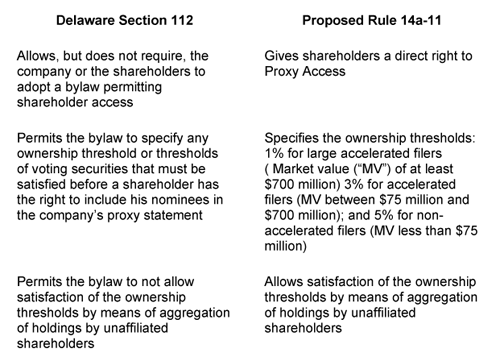
First, the SEC’s proposal sets a minimum ownership threshold for shareholder eligibility to the corporate proxy entirely too low, at 1% of the shares of a company with a market capitalization greater than $700 million (with higher thresholds of 3% and 5% for smaller companies). Lowering the bar to 1% (and permitting even smaller shareholders to aggregate their stakes for purposes of achieving the 1% threshold), in contrast to the 5% threshold in our model access bylaw, gives activist and special interest holders a very low cost avenue to seek to influence board composition and corporate strategy. This low threshold will enable shareholder activists to create disruption at many companies each year, and reduce the willingness of qualified directors to serve.

Second, if there are more shareholder nominations than slots available, the SEC’s proposal would give priority to shareholders who submitted their nominations the earliest, regardless of the size of the nominating shareholders’ stakes. This contrasts with the approach of our model access bylaw which prioritizes nominations based upon the relative holdings of the nominating shareholders. Under the SEC’s proposal, a long-term institutional investor holding well in excess of 5% of the company’s equity for many years may have to suffer the negative effects of routine director election contests initiated by holders of 1% for only one year, and also lose the opportunity to avail itself of proxy access merely because the smaller holders beat a faster path to the corporate secretary’s office. As a result, the SEC’s proposal does not merely facilitate access for the occasional proxy access election contest, but rather creates incentives for routine election contests, as shareholders race to make access nominations in order to gain control over the process.

The SEC’s proposal advances a mandatory proxy access regime that will not only weaken corporate boards, but also weaken the relative strength of long-term investors as compared to those investors that pursue short-term strategies often based on hollow financial engineering. The Delaware private-ordering approach to proxy access is more consistent with shareholder democracy in that it allows all the shareholders of each Delaware company to consider, debate and if appropriate adopt through shareholder action – rather than government fiat – shareholder access bylaws that suit the particular circumstances of each individual company and its shareholders. Accordingly, and as we have said before, we agree with the position taken by two of the SEC Commissioners, that a mandatory federal “one size fits all” rule is a serious policy error and the SEC should instead amend Rule 14a-8 to allow the issue to develop at the state law level.

Will proxy access enhance director accountability?

This post is by William Gleeson and Aaron Ostrovsky of K&L Gates LLP. Previous posts on this Forum concerning the SEC’s proposed proxy access rule are available here, here and here. This post is part of the Delaware law series, which is cosponsored by the Forum and Corporation Service Company; links to other posts in the series are available here.

The issue of allowing shareholders of public companies to include their nominees for director in the company’s proxy materials (“Proxy Access”) has been the subject of heated debate for years. In 2003, when there were no state law provisions addressing the issue, and in 2007 (when only the North Dakota statute addressed Proxy Access), the Securities and Exchange Commission proposed rules that would facilitate such inclusion, only to abandon the proposals. In March 2009, Delaware added Section 112 to its General Corporation Law, effective August 1, 2009, to allow for bylaws that permit Proxy Access. It has been widely expected that many other states would follow Delaware’s lead and adopt similar statutes. In May 2009, the SEC announced that it would propose a new rule, Rule 14a-11, dealing with Proxy Access that would preempt key parts (but not all) of Delaware Section 112. Proposed Rule 14a-11 would differ in three important respects from the Delaware provision:

In its release announcing that it would propose Rule 14a-11, the Commission focused on enhancing director accountability. According to the Commission, the current economic crisis has created widespread concern about “whether boards are exercising appropriate oversight of management, whether boards are appropriately focused on shareholder interests, and whether boards need to be held more responsible for their decisions regarding such issues as compensation structures and risk management.” The Commission’s solution to the above problems is Proxy Access:

Because of these concerns, the Commission has decided to revisit whether and how the federal proxy rules may be impeding the ability of shareholders to exercise their fundamental right under state law to nominate and elect members to company boards of directors.

But the connection between effective director accountability and Proxy Access for shareholders is not obvious and depends on the validity of several implicit and intermediate premises. We believe that the SEC should address and make a strong case on each of the following premises.

Proxy Access, as a component of corporate governance, is a matter more properly dealt with under state law. We believe that the SEC, as a federal agency, should make a strong case before regulating in an area traditionally regulated by states. This is especially true with respect to Proxy Access, where state legislation is only in its infancy. It is likely that the states will develop a significant body of experience in a relatively short time and it will not be long before more resolving evidence emerges whether or not Proxy Access initiatives at the state level are or are not an effective means of dealing with the issue of director accountability. (We do not address in this alert the issue of whether the SEC has the power to enact Rule 14a-11, an issue that others have dealt with.)

Accordingly, we believe that it would be appropriate for the SEC to adopt a rule consistent with Rule 14a-11, if, but only if, it can make a strong case that the proposed rule is likely to enhance director accountability; that state initiatives such as Delaware’s Section 112 are not likely to increase director accountability; and that the current problems with director accountability are severe enough that we cannot afford to wait to see whether state-level regulation proves out. In making that case, it should address each of the premises discussed below.

READ MORE »

PIPEs: Raising Equity Capital in Uncertain Times

In the midst of what we have come to know as the “global economic crisis,” credit markets continue to be frozen and, in understatement, equity markets continue to be volatile. Failing a substantial near-term recovery, any meaningful window for underwritten public offerings will remain closed. The question that many public companies are asking is what, if any, alternatives are there to raise cash?

Private investments in public equity, commonly referred to as PIPEs, are one option. Once used almost exclusively by small cap issuers or issuers who historically had not been able to sell securities to the public, today large, well-seasoned issuers are turning to the PIPEs market. Indeed, both General Electric Company and the Goldman Sachs Group issued a combined total of $8.0 billion to Berkshire Hathaway Inc. in the fourth quarter of 2008 in PIPEs transactions.[1] Mainstream hedge funds and private equity funds are now opportunistically looking at PIPE investments in distressed companies. Competition in these markets is increasing. Depressed valuations are offering investors attractive opportunities to invest in companies with the potential for future growth.

PIPEs, Deconstructed
What is a PIPE? A typical PIPE is a transaction where one or more investors purchase securities directly from a public company in a private placement rather than in a transaction registered with the Securities and Exchange Commission (SEC). Often, these transactions are conducted through an investment bank or other placement agent, but more recently a greater volume of PIPEs are being sold without an intermediary to one or few large investors. Since PIPE securities are purchased in a private transaction, they are considered “restricted securities” and cannot be immediately resold into the public market. In the transaction, the issuer agrees to file a resale registration statement with the SEC promptly after the closing of the financing. In this way, illiquidity is mitigated—once the resale registration statement becomes effective, the investor may immediately sell the securities purchased in the transaction (or issuable upon conversion in the case of convertible preferred stock or debt) in the public markets. This structure allows for speedy access to capital, a key attraction of a PIPEs transaction to issuers. PIPEs also provide issuers with lower transaction costs as compared to a traditional public offering.

Specifically, in a PIPE transaction, an issuer is contractually required to prepare and file a resale registration statement with the SEC promptly following the completion of the private placement. Typically, a registration rights agreement requires that the issuer use it best efforts to have the registration statement filed with the SEC within 30 to 45 days of closing and declared effective within 90 to 120 days of filing. Registration rights agreements typically contain penalty payments of 1% to 2% of the principal amount of proceeds per month if the issuer fails to meet the filing deadlines. Once the SEC declares the resale registration statement effective, investors may sell the PIPE securities in the public market. The registration statement must remain effective, and the issuer is required to update the registration statement for any material changes, during the period in which the investors are reselling the securities.

Registered Direct PIPEs
Issuers with existing effective shelf registration statements may find PIPEs transactions even more attractive. In a “registered direct” PIPE, an issuer sells securities directly from its shelf registration statement to one or more private investors in a transaction not involving a public offering. As in typical PIPEs, the time to closing may be quick. However, in a registered direct PIPE, investors do not receive “restricted securities” as they are purchasing the PIPE securities in a registered transaction. Unless the investor would be deemed an affiliate of the issuer, there is no need to file a resale registration statement with the SEC following the closing of the transaction. Indeed, this is an attractive option for issuers as not only are transaction costs even lower, the elimination of liquidity risk allows for more attractive pricing. Note, however, that the existing shelf registration statement must already cover the PIPE securities being offered (including any warrants) and the plan of distribution in the base prospectus must contemplate such private sales. In addition, as in all PIPE transactions that utilize the resources of an investment bank to place the securities, the investment bank does not act as an underwriter in an offering. Even though the PIPE securities are offered and sold from an issuer’s existing shelf registration statement, the investment bank acts merely as a placement agent and the transaction is not a firm underwriting.

PIPE Terms
The terms of PIPEs deals vary widely from deal to deal and can involve the offering of a number of different types of securities such as common stock, preferred stock, convertible preferred stock, convertible debt and warrants or any combination of these securities. Typically, PIPE securities are sold at a discount to the trailing average market price for some period prior to closing. However, this is highly negotiated and convertible PIPEs have been priced higher than current market value, especially if there is a conversion premium attached to a convertible security or the security includes warrant coverage.

READ MORE »

Implications of the sale of Chrysler

This post is based on a client memo from Donald S. Bernstein and Marshall S. Huebner of Davis Polk & Wardwell.

In an important ruling issued on Sunday, May 31, 2009, Bankruptcy Judge Arthur J. Gonzalez in the Southern District of New York approved the sale of Chrysler in exchange for two billion dollars in cash and the assumption of certain liabilities.[1]
[2]

In connection with approval of this sale transaction, Judge Gonzalez opined on sub rosa challenges, the ability of a secured lender to object to a transaction if the administrative agent has consented, and the survival of tort claims after assets have been sold pursuant to section 363 of the Bankruptcy Code. The ruling makes it yet easier for debtors to consummate sales under section 363.

Background
On April 30, 2009, the date Chrysler filed for bankruptcy protection, Chrysler, Fiat S.p.A (“Fiat”) and New CarCo Acquisition LLC (“New Chrysler”), an acquisition vehicle formed by Fiat, entered into a Master Transaction Agreement (the “MTA”) in accordance with section 363 of title 11 of the U.S. Code (the “Bankruptcy Code”). Under the MTA, Chrysler would transfer substantially all of its operating assets to New Chrysler, in exchange for two billion dollars in cash and the assumption of certain liabilities (the “Sale Transaction”). Upon consummation of the Sale Transaction, New Chrysler agreed, pursuant to the MTA, to issue stock to certain interested parties: 67.69% to an independent Voluntary Employee Beneficiary Organization (the “VEBA”) for the benefit of certain Chrysler employees and retirees, 9.85% to the U.S. Treasury, 2.46% to Export Development Canada (“EDC”) and 20% to Fiat.[3]

Objections
Among the objecting parties were: a group of pension funds from the State of Indiana (the “Indiana Funds”) objecting, inter alia, on the grounds that the Sale Transaction amounted to a sub rosa plan; certain Chrysler dealers objecting to the attempted rejection of their dealership agreements and arguing that state dealer protection laws are not preempted by the Bankruptcy Code; and various tort and consumer claimants objecting that their claims were not “interests in property” and that Chrysler’s assets could not, therefore, be sold free and clear of them pursuant to section 363(f)(5) of the Bankruptcy Code. Judge Gonzalez (i) distinguished a valid sale transaction under section 363 of the Bankruptcy Code (a “363 sale”) from a sub rosa plan, (ii) enforced contractual provisions that restrict a minority secured lender’s standing to object and (iii) ruled that tort claims are extinguished in a 363 sale.[4]

Court Denies that the Sale Transaction is a Sub Rosa Plan
The Indiana Funds argued that the Sale Transaction was an attempt to circumvent chapter 11 requirements for plan confirmation and, thus, was a sub rosa plan of reorganization. Judge Gonzalez, expanding on and clarifying prior case law,[5] ruled that it is not a sub rosa plan for “a debtor [to] sell substantially all of its assets as a going concern and later submit a plan of liquidation providing for the distribution of the proceeds of the sale,” if such proceeds both (i) exceed the value that could be received in a liquidation and (ii) go directly to the first priority lenders. Judge Gonzalez went on to state that the receipt of equity interests in New Chrysler by the VEBA, the U.S. Treasury, EDC and Fiat are the result of separately negotiated agreements with New Chrysler – including the unprecedented modifications to the collective bargaining agreement between the United Auto Workers and New Chrysler for the VEBA, the financing that the U.S. Treasury and EDC will provide to New Chrysler and the provision of small car technology by Fiat – and are not on account of any prepetition claims. As such, he ruled that there had not been an inappropriate attempt to divert sale proceeds away from the Indiana Funds or to affect anything other than a pro rata distribution of the proceeds to all first priority claimants.

READ MORE »

Page 28 of 48
1 18 19 20 21 22 23 24 25 26 27 28 29 30 31 32 33 34 35 36 37 38 48