Yearly Archives: 2021

A Test of Stakeholder Governance

Stavros Gadinis is Professor of Law and Amelia Miazad is Director and Senior Research Fellow of the Business in Society Institute at the University of California at Berkeley School of Law. This post is based on their recent paper, forthcoming in the Journal of Corporation Law. Related research from the Program on Corporate Governance includes The Illusory Promise of Stakeholder Governance (discussed on the Forum here) and Will Corporations Deliver Value to All Stakeholders?, both by Lucian A. Bebchuk and Roberto Tallarita; For Whom Corporate Leaders Bargain by Lucian A. Bebchuk, Kobi Kastiel, and Roberto Tallarita (discussed on the Forum here); and Restoration: The Role Stakeholder Governance Must Play in Recreating a Fair and Sustainable American Economy—A Reply to Professor Rock by Leo E. Strine, Jr. (discussed on the Forum here).

In our paper, A Test of Stakeholder Capitalism, we argue that companies turn to stakeholders to obtain more information about how to deal with looming risks. Many corporate choices affect stakeholders, whose reaction, if assessed beforehand, can help the company in its decisionmaking. When management realizes that stakeholder feedback can help it prepare a more effective response to a business challenge, it launches initiatives seeking to better understand stakeholders’ perspectives and, if pertinent, adjust its choices. Many have defended stakeholder capitalism on other grounds, ranging from improving aggregate social welfare (Edmans 2020), to addressing externalities (Condon 2020), to aligning with shareholders’ long-term interests (Strine 2019, Lipton 2017). Others have criticized managers’ embrace of stakeholderism as paying lip service to lofty ideas while failing to follow through in practice (Bebchuk and Tallarita 2021a, Bebchuk and Tallarita 2021b) and instead using broad discretion to benefit executives and directors (Bebchuk, Kastiel, and Tallarita 2021). Finally, others have questioned whether lumping all stakeholder interests together provides any real guidance to management and boards (Davidoff Solomon & Fisch 2021). In contrast, we focus on ESG as a technology for extracting information from and managing interactions with affected parties – not as purpose, but as governance.

READ MORE »

Books and Records Demands

Edward B. Micheletti and Jenness E. Parker are partners at Skadden, Arps, Slate, Meagher & Flom LLP. This post is based on their Skadden memorandum, and is part of the Delaware law series; links to other posts in the series are available here.

The right of stockholders to seek corporate books and records is a well-established feature of corporate law in Delaware, where most big American companies are incorporated. But the number of statutory records demands has spiked in recent years, and the scope of the requests has broadened, as Delaware courts have limited companies’ defenses and taken companies to task for aggressively resisting shareholder requests.

For boards and their companies, this has potential consequences. Stockholders, many with an eye toward litigation, are sometimes able to access emails, texts and other material through a records demand that can lay the grounds for a suit. What used to be a simple matter of granting access to formal, board-level books and records reflecting board decisions now has the potential to be more expansive and disruptive if casual communications that directors and executives assumed would not be part of the “official” corporate records are revealed to potential adversaries.

Below is a primer for directors on the evolving nature of these requests and what it means for boards.

READ MORE »

The New Landscape of Human Capital Metrics

Ariel Babcock is Head of Research, Allen He is Associate Director, and Devin Weiss is Research Associate at FCLTGlobal. This post is based on their FCLTGlobal memorandum. Related research from the Program on Corporate Governance includes The Illusory Promise of Stakeholder Governance (discussed on the Forum here) and Will Corporations Deliver Value to All Stakeholders?, both by Lucian A. Bebchuk and Roberto Tallarita; For Whom Corporate Leaders Bargain by Lucian A. Bebchuk, Kobi Kastiel, and Roberto Tallarita (discussed on the Forum here); and Restoration: The Role Stakeholder Governance Must Play in Recreating a Fair and Sustainable American Economy—A Reply to Professor Rock by Leo E. Strine, Jr. (discussed on the Forum here).

Intuitively, many companies understand the importance of strategically investing in their employees. Past academic research has found employees contribute materially to the long-term value creation of a corporation. For instance, the “100 Best Companies to Work in America” had significantly higher stock returns than industry averages. Higher firm investment in intangible assets is associated with higher revenue, and strong relationships have been demonstrated between employee satisfaction, productivity, and loyalty to the consumer base.

Given the links between employee support and firm performance, investors have cast increasing importance on companies’ disclosures of human capital metrics. In the U.S., the Securities and Exchange Commission has begun to regulate the matter. With the modernization of Regulation S-K, the SEC has signaled to companies the importance of keeping track and disclosing vital human capital metrics. This move has the potential to shake up the disclosure landscape amongst public companies in the U.S., and it is the first time in thirty years that these requirements have undergone significant changes.

READ MORE »

Taking Corwin Seriously

Itai Fiegenbaum is a Visiting Assistant Professor at Willamette University College of Law. This post is based on his recent paper, forthcoming in the Lewis & Clark Law Review, and is part of the Delaware law series; links to other posts in the series are available here.

Friendly sales of control are a well-known breeding ground for corporate agency costs. Managers, for instance, might be tempted to push through a transaction with a favored bidder instead of exploring an overture organized by a party against whom they hold a grudge. Or they might offer the buyer a sweetheart deal with the anticipation (if not expectation) of lavish compensation from the newly-sold entity. Both situations leave shareholders shortchanged.

Delaware law is aware of incumbents’ predilection to stray from shareholders’ interests and accordingly subjects friendly sales to a heightened standard of review. The Revlon standard, so named for the iconic case in which it was unveiled, stands for the proposition that usual business judgement rule deference is no longer warranted in a sale scenario. The courts are instead instructed to evaluate the board’s decision making process in an attempt to uncover deviations from the proper goal of shareholder value maximization. The standard used to have actual bite, as evinced by high profile transactions that were invalidated by the courts. While the doctrinal directive has remained essentially constant for three decades, its application today is quite different. Judges are loathe to nix a firm offer to purchase a company. Egregious misdeeds will at most be remedied by additional disclosure and a slight delay before the deal is sent to the shareholders for their approval. And under the powerful Corwin doctrine, a positive shareholder vote restores business judgment rule review, thereby insulating the transaction from judicial oversight.

READ MORE »

Delaware Supreme Court Clarifies the Standards for Demand Futility

Heather Benzmiller Sultanian is an associate at Sidley Austin LLP. This post is based on her Sidley memorandum, and is part of the Delaware law series; links to other posts in the series are available here.

A pair of opinions released by the Delaware Supreme Court in a single week have revisited longstanding precedent governing shareholder suits that claim corporate wrongdoing. As discussed in a companion post on this blog, the first of those opinions, Brookfield Asset Management Inc. v. Rosson, restricted the ability of shareholders to bring direct claims under certain circumstances, instead forcing them to pursue more procedurally challenging derivative suits. In the second case, United Food & Commercial Workers Union & Participating Food Industry Employers Tri-State Pension Fund v. Zuckerberg, the Delaware Supreme Court adopted a new three-part demand-futility test that clarifies the standard shareholders must meet to file such derivative suits, without first taking their complaints to the company’s board of directors.

Background

United Food arose from a vote by Facebook’s board of directors in 2016 to pursue a stock reclassification plan that would allow CEO Mark Zuckerberg to sell most of his Facebook stock — which Zuckerberg planned to do to fulfill the “Giving Pledge,” under which he had committed to giving the majority of his wealth to philanthropic causes — while still maintaining voting control over the company. Days after Facebook announced the reclassification plan, several investors filed class action suits to block the plan, alleging that it was a self-interested deal that put Zuckerberg’s interests ahead of Facebook’s in violation of the board of directors’ fiduciary duties. Shortly before trial was scheduled to begin, Facebook abandoned the reclassification plan and mooted the pending litigation.

READ MORE »

Climate Stewardship

Benjamin Colton is Global Co-Head of Asset Stewardship, Michael Younis is Vice President, and Devika Kaul is Asset Stewardship Analyst at State Street Global Advisors. This post is based on their SSgA memorandum.

Voting Record

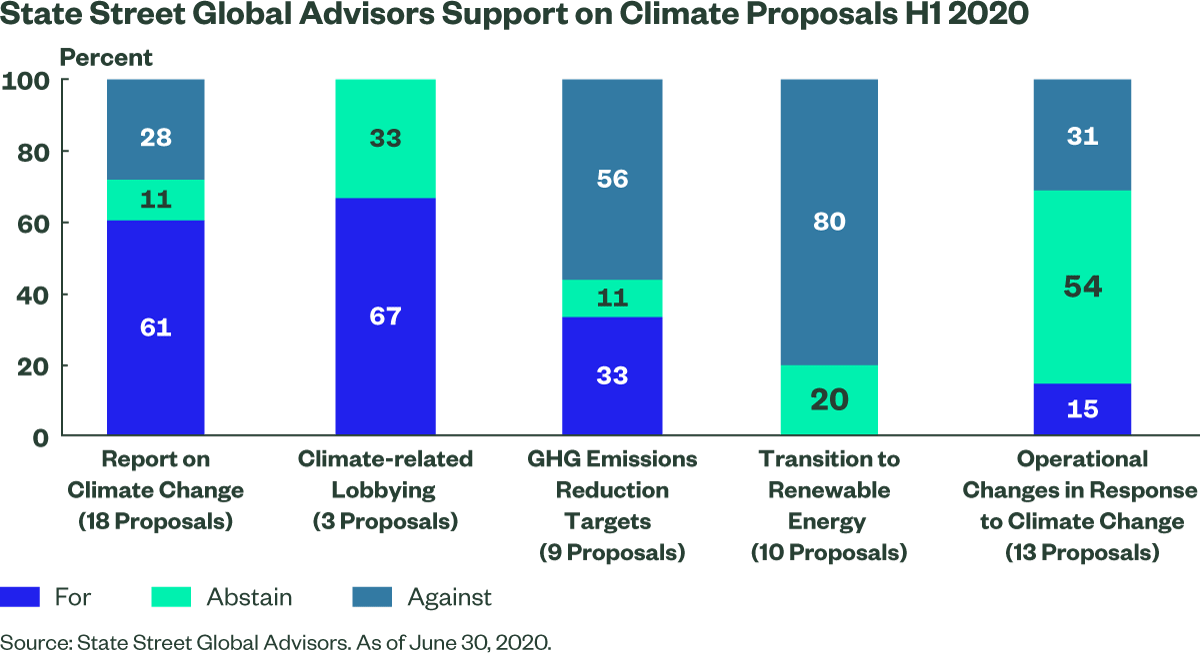
Our Voting Record on Climate Related Shareholder Proposals for 2ºC Scenario Proposals

Our voting on climate change is typically prompted by shareholder proposals. However, we may also take voting action against directors even in the absence of shareholder proposals for unaddressed concerns pertaining to climate change. The number of climate-related proposals on company ballots has been steadily increasing over the past few years. Annually, we review and vote every climate-related proposal in our portfolio. We also endeavor to engage with the proponents of shareholder proposals to gain additional perspective on the issue, as well as with companies to better understand how boards are managing relevant risks.

READ MORE »

Climate in the Boardroom 2021

Jessie Giles is Research Director, Eli Kasargod-Staub is Co-founder and Executive Director, and Bryant Sewell is Senior Research Specialist at Majority Action. This post is based on their Majority Action memorandum. Related research from the Program on Corporate Governance includes The Illusory Promise of Stakeholder Governance (discussed on the Forum here) and Will Corporations Deliver Value to All Stakeholders?, both by Lucian A. Bebchuk and Roberto Tallarita; For Whom Corporate Leaders Bargain by Lucian A. Bebchuk, Kobi Kastiel, and Roberto Tallarita (discussed on the Forum here); and Restoration: The Role Stakeholder Governance Must Play in Recreating a Fair and Sustainable American Economy—A Reply to Professor Rock by Leo E. Strine, Jr. (discussed on the Forum here).

In 2021 proxy voting by the largest asset managers remained wholly insufficient to the scale and urgency of the climate crisis, according to a new report by Majority Action. Following years of accountability efforts from clients, fellow shareholders, and climate advocates, substantial progress has been made in asset manager support for climate-related shareholder proposals. Despite this, benchmarking of the world’s largest greenhouse gas emitters by the investor initiative Climate Action 100+ demonstrates that the companies primarily responsible for the production and consumption of fossil fuels causing climate change are not on track to decarbonize their operations by 2050.

Majority Action recommends that asset managers and owners enact their fiduciary responsibility for mitigating climate risks to their clients’ and beneficiaries’ portfolios by adopting or updating proxy voting policies to target limiting warming to 1.5°C, setting expectations that portfolio companies will take action to reduce their emissions consistent with that goal, and enabling voting against directors at companies that fail to do so. They should also establish and communicate clear, industry-specific standards for assessing corporate decarbonization plans aligned with limiting warming to 1.5°C, in particular in the climate-critical industries of oil and gas, electric power, and financial services, and disclosing company assessments against those standards. Asset owners are urged to revise asset manager search criteria, requests for proposals and assessments to include criteria for proxy voting on systemic climate risk at climate-critical companies.

READ MORE »

Direct vs. Derivative Standing

Andrew W. Stern is partner at Sidley Austin LLP. This post is based on his Sidley memorandum, and is part of the Delaware law series; links to other posts in the series are available here.

Every once in a while, a court admits it made a mistake. And, in even rarer circumstances, that admission comes from a court as prominent as the Supreme Court of Delaware. But that’s exactly what happened last week in Brookfield Asset Management, Inc. v. Rosson, in which Delaware’s highest court overruled its own 2006 holding in Gentile v. Rosette that certain claims of corporate dilution are “dual-natured” and may be pursued both as derivative claims and as direct claims by stockholders. The Court’s decision to revisit a much-criticized decision is likely to restore some predictability and analytic consistency to the resolution of an important and threshold question frequently presented in stockholder litigation: whether a claim is properly characterized as direct (on behalf of one or a class of a company’s stockholders) or derivative (on behalf of the company itself).

Rosson arose from a private placement of common stock issued by TerraForm Power, Inc., at the time a public company controlled by a 51% stockholder. The controller purchased all of the newly issued stock, increasing its economic interest and voting power to 65.3%. Plaintiffs TerraForm common stockholders filed a derivative and class action complaint alleging that the stock had been issued for inadequate value, diluting the financial and voting interests of the minority stockholders and also damaging the company. Subsequent to the filing of the complaint, the controller acquired the balance of TerraForm shares that it did not already own, which under well-established Delaware precedent extinguished the ability of former TerraForm stockholders to pursue derivative claims. On defendants’ motion to dismiss the remaining direct claims, Vice Chancellor Sam Glassock noted that the type of claim at issue was classically derivative under Delaware jurisprudence: “the quintessence of a claim belonging to an entity: that fiduciaries, acting in a way that breaches their duties, have caused the entity to exchange assets at a loss.”

READ MORE »

BlackRock to Permit Some Clients to Vote

Cydney S. Posner is special counsel at Cooley LLP. This post is based on her Cooley memorandum. Related research from the Program on Corporate Governance includes The Agency Problems of Institutional Investors by Lucian Bebchuk, Alma Cohen, and Scott Hirst (discussed on the Forum here); Index Funds and the Future of Corporate Governance: Theory, Evidence, and Policy by Lucian Bebchuk and Scott Hirst (discussed on the forum here); and The Specter of the Giant Three by Lucian Bebchuk and Scott Hirst (discussed on the Forum here).

According to the Financial Times, “[p]ension funds and retail investors have complained for years over their lack of ability to vote at annual meetings when using an asset manager.” Last week, BlackRock, the largest asset manager in the galaxy with $9.5 trillion under management, announced that, beginning in 2022, it will begin to “expand the opportunity for clients to participate in proxy voting decisions.” BlackRock said that it has been developing this capability in response “to a growing interest in investment stewardship from our clients,” enabling clients “to have a greater say in proxy voting, if that is important to [them].” BlackRock will make the opportunity available initially to institutional clients invested in index strategies—almost $2 trillion of index equity assets in which over 60 million people invest across the globe. It is also looking at expanding “proxy voting choice to even more investors, including those invested in ETFs, index mutual funds and other products.” Will this be a good thing?

Clients will have four choices: they can cast votes themselves for all companies; they can vote in accordance with a shareholder proxy service, such as ISS or Glass Lewis; they can cherry pick certain proposals or companies that that they want to vote on themselves—perhaps the most controversial topics of day, such as climate or political spending disclosure—or they can continue to rely on BlackRock Investment Stewardship to vote their shares. BlackRock reports that, in the 12 months ended June 30, 2021, “BIS held more than 3,600 engagements with more than 2,300 companies. BIS voted at more than 17,000 shareholder meetings, casting more than 165,000 votes on behalf of our clients in 71 voting markets.” But now, if they so choose, some institutions will be able to conduct those engagements and make decisions themselves.

READ MORE »

Are Narcissistic CEOs All That Bad?

Brian Tayan is a researcher with the Corporate Governance Research Initiative at Stanford Graduate School of Business. This post is based on a recent paper by Mr. Tayan; David Larcker, Professor of Accounting at Stanford Graduate School of Business; Charles A. O’Reilly, the Frank E. Buck Professor of Management at Stanford Graduate School of Business; and Anastasia Zakolyukina, Associate Professor of Accounting and Neubauer Family Faculty Fellow at University of Chicago Booth School of Business.

We recently published a paper on SSRN, Are Narcissistic CEOs All That Bad?, which examines the prevalence of narcissism among corporate CEOs and the impact that narcissism has on corporate stock-price performance and other outcomes.

The role that a CEO’s personality plays in determining outcomes is a topic of considerable interest to researchers, the media, and the public. This includes not only the association between certain personality types and stock-price performance, but also the impact of personality on strategic choices, governance quality, ethical standards, and corporate image.

Among the broad spectrum of personality types, one that garners significant attention is narcissism, because of its association with larger-than-life personalities. Narcissism is characterized by an inflated sense of self-importance, an excessive need for attention and admiration, and lack of empathy (see Exhibit 1). Common perception is that narcissism is highly prevalent among CEOs. This is because some of the traits that contribute to workplace advancement among executives—self-confidence, risk tolerance, a focus on goal achievement, and more extraverted personalities—are common to narcissists. This has resulted in a number of interesting studies of the subject. Narcissism is by no means required for career advancement and in some settings may impede it. Narcissists might share observable attributes with confident, dynamic, or transformational leaders, but the two are not synonymous. From an external standpoint, however, distinguishing between narcissistic and self-confident leaders can be difficult.

READ MORE »

Page 16 of 90
1 6 7 8 9 10 11 12 13 14 15 16 17 18 19 20 21 22 23 24 25 26 90