Yearly Archives: 2022

The Corporate Contract and Shareholder Arbitration

Joseph A. Grundfest is William A. Franke Professor of Law and Business at Stanford Law School and Mohsen Manesh is Professor at University of Oregon School of Law. This post is based on their recent paper. This post is part of the Delaware law series; links to other posts in the series are available here.

Longstanding decisions of the U.S. Supreme Court coupled with more recent developments in the corporate law of Delaware have sparked renewed concerns that publicly traded corporations may adopt arbitration provisions precluding shareholder lawsuits, particularly securities fraud class actions. In particular, in a line of decisions spanning decades, the U.S. Supreme Court has steadily expanded the reach of the Federal Arbitration Act (“FAA”). Section 2 of that statute mandates

“[a] written provision in any … contract evidencing a transaction involving commerce to settle by arbitration a controversy thereafter arising out of such contract or transaction . . . shall be valid, irrevocable, and enforceable…..”

Applying the FAA, the Court has upheld contractual agreements compelling arbitration of claims made under both the Securities Act of 1933 and the Securities Exchange Act of 1934. Indeed, the Court has gone further, ruling that an agreement to arbitrate is enforceable even when made as part of an unnegotiated contract of adhesion, even if pursuing claims through individualized, bilateral arbitration (rather than in a class proceeding) would make it uneconomical to vindicate those claims, and even if applicable state law would otherwise hold the agreement to arbitrate to be unconscionable.

READ MORE »

Building Effective Cybersecurity Governance

Orla Cox and Hetal Kanji are Directors of Strategic Communications, and Simon Onyons is a Managing Director at FTI Consulting. This post is based on their FTI memorandum.

Executive Summary

Digitalisation has changed the way companies operate and given rise to a rapidly evolving set of risks that companies face and must prepare for – cybersecurity risks. The increasing prevalence of cyber attacks, notably ransomware, coupled with declining availability of cyber insurance, is leaving companies increasingly exposed to the often-significant impacts of a cybersecurity incident. There is naturally a short-term financial cost – research from IBM [1] reveals that the average total cost of a ransomware breach in 2022 is $4.54 million- but reputationally the impact of an incident may be longer lasting.

Aware of how companies are increasingly exposed to cybersecurity, governments, regulators and investors alike are increasing pressure on organisations to improve their cybersecurity measures, increase transparency around disclosures, and build governance and management structures that demonstrate cybersecurity is a priority at the top levels of the organisation.

Ensuring oversight structures are in place at board level is a key feature of cyber governance. As a material risk affecting companies, boards are increasingly held accountable for ensuring the executive team is taking appropriate steps to mitigate the risk of a cybersecurity attack, and also ensuring the organisation responds appropriately in the event of an incident. Often, boards have little to no experience in this field, and whilst the dynamic nature of cyber risk means that board members are not expected to be cyber experts – though there is merit to having expertise on the board – they are expected to be able to challenge management on this topic and inform shareholders on the measures in place to mitigate the impact of cybersecurity incidents.

For many companies, the Chief Information Security Officer (CISO) is the executive with accountability for cyber risk. With investors and regulators pushing for greater oversight at board level, the CISO will need to communicate cyber risk and metrics in terms that resonate with the board, and governance structures will need to prioritise engagement with the CISO on cyber risks.

READ MORE »

SEC Pay Versus Performance Disclosure Requirements: Initial Observations

Jordan Lute is a Research Analyst and Maria Vu is a Senior Director of Compensation Research at Glass, Lewis & Co. This post is based on their Glass Lewis memorandum. Related research from the Program on Corporate Governance includes Paying for long-term performance (discussed on the Forum here); and Pay without Performance: The Unfulfilled Promise of Executive Compensation both by Lucian A. Bebchuk and Jesse M. Fried.

Perhaps pushed by the sense of urgency brought on by November’s mid-term elections, the Securities and Exchange Commission has been on a regulatory tear. The agency’s revitalized rulemaking has seen final decisions handed down on rules that were initially mandated more than ten years ago. In this piece, we discuss one of the SEC’s latest, and longest-gestating, directives: Section 14(i), focusing on new pay versus performance disclosure requirements, as required by the Dodd-Frank Act of 2010 and first proposed by the SEC in 2015.

Section 14(i): New Compensation Disclosures

On August 25, 2022, the SEC released its final rules implementing Section 14(i) of the Securities Exchange Act of 1934, which requires companies to provide a clear description of the relationship between executive compensation and company performance. The final rules are effective for any fiscal years ending on or after December 16, 2022 and require companies to include a table in their proxy statement that reports the company’s executive compensation and various measures of corporate performance for the five most recently completed fiscal years, or the three most recently completed fiscal years for smaller reporting companies. The rules are subject to a phasing-in period.

The new table is required to incorporate several specific calculations of executive compensation, including:

  • The Summary Compensation Table (SCT) total for the principal executive officer (PEO; usually the chief executive officer),
  • The compensation “actually paid” to the PEO,
  • The average SCT total for the non-PEO NEOs, and
  • The average compensation “actually paid” to the non-PEO NEOs.

Summary Total vs Actually Paid

Compensation “actually paid” includes certain considerations for changes in pension value, above-market or preferential earnings on non-qualified deferred compensation, and changes in the value of equity awards throughout the year. Unlike the equity value reported in the Summary Compensation Table, compensation actually paid accounts for:

  • the year-end fair value of outstanding equity awards granted during the year,
  • the year-over-year change in outstanding equity awards granted in previous years,
  • the vesting date fair value of equity awards that were granted and vested during the year, and
  • the change in value of previously granted awards that vested during the year.

Given the SEC’s guidelines on the calculation of compensation actually paid, the new data point is distinct from the SCT measure of total compensation, and it may provide additional insight into the realizable value of equity awarded to the NEOs.

Measuring the Performance Element

In addition to the columns for executive compensation outlined above, the new table will include the following metrics for company performance:

  • The company’s total shareholder return (TSR),
  • The TSR of the company’s self-selected peer group,
  • The company’s net income, and
  • A self-selected financial performance metric (other than TSR and net income).

Additionally, each company will be required to report an unranked list of three to seven of the most important metrics that it uses to link executive pay outcomes to company performance. Non-financial metrics may be included in this list, however at least three of the metrics must be financial. While it is yet to be seen, this list may provide investors with a greater understanding of each company’s determination process for executive payouts.

Finally, companies will be required to provide a clear description of the relationship between executive compensation actually paid and company performance (as measured by the metrics outlined above); as well as the relationship between the company’s TSR and the TSR of a self-selected peer group over the required reporting period. These relationships may be described in graphical form, narrative form, or a combination of both.

Glass Lewis Analysis: Preliminary Thoughts

The first examples of the new disclosure will not be available until public companies file proxy statements covering fiscal years ending on or after December 16th, 2022. Thus, the value of the new disclosure is yet to be firmly established.

Nonetheless, detractors are plenty. Some of the public companies we’ve spoken to as part of Glass Lewis’ engagement program contend that the rules are unnecessary. They argue that compensation disclosure has advanced considerably since the original 2015 requirements, and much of the information the new disclosure rules call for is already part of common practice in 2022.

From our perspective, while we recognize that the landscape has shifted since 2015, we believe that standardized reporting requirements may help investors in assessing executive compensation across their portfolio. Moreover, noting that advances in compensation disclosure have not applied and maintained evenly, we are hopeful that the amendments will materially improve the level of context available in evaluating executive pay at smaller reporting companies (SRCs).

Over the last few years, SRCs have been exempt from providing a comprehensive discussion of their compensation policies and practices. While some SRCs have met the needs of their shareholders by continuing to include a complete Compensation Discussion and Analysis section in their proxy statement, we generally find that most SRCs’ compensation disclosure under the current regime is poor and does not facilitate shareholders’ ability to vote on the Say on Pay proposal in a thoroughly informed manner. This is costly for investors who, lacking clear disclosure, must expend additional time and effort in order to fulfill their fiduciary responsibilities. The new disclosure rules stop far short of reinstating a Compensation Discussion and Analysis section requirement for smaller reporting companies, of course. Yet after years of bare bones disclosure, shareholders may get a fair degree of additional context around pay practices; for example, via discussion of key metrics in determining executive pay outcomes.

Comparing Pay-for-Performance Analyses

In adopting the final rules, the SEC stated that this new reporting mandate will make the types of pay versus performance analysis done by proxy advisors like Glass Lewis or compensation consultants equally accessible to all investors in a consistent manner. However, there are some important distinctions between the different analyses.

Measuring Compensation: Whereas Glass Lewis’ Pay-for-Performance Model analysis is a snapshot of long-term granted pay relative to peers, the new disclosure rules provide a review of how reported and “actually paid” executive pay evolved over time without consideration of the peer compensation data used by the company or its compensation consultant to set pay levels.

Measuring Performance: The SEC rule only considers TSR performance on a relative basis; peer data for other metrics is excluded. The Glass Lewis analysis, in contrast, provides a snapshot of relative performance for all metrics used in the analysis. Also, to promote comparability, the Glass Lewis Pay-for-Performance Model uses a standardized rubric to determine the applicable metrics from a list of four (in addition to TSR), rather than mirroring each company’s disclosed key metrics.

The SEC’s new rules may succeed in bringing this type of analysis to the broader population — but in a distinctly different manner compared to the Glass Lewis methodology. It may also provide additional quantitative considerations for Glass Lewis’ analysis. In the absence of actual disclosure, the specifics remain to be seen. What is clear, however, is the new rules will not change Glass Lewis’ Pay-for-Performance methodology for the 2023 proxy season.

Public Company Concerns: Aligning the Timeframe & Lack of Clarity

Perhaps not surprisingly, our conversations with public companies on the matter show a lack of enthusiasm for the new disclosure requirements. An S&P 500 company we met with is considering using an index for comparison instead of a self-selected group of peers, but said the rules weren’t clear on whether this would be acceptable.

Apart from confusion as they prepare for compliance, some of the public companies we’ve engaged with conveyed their belief that the new compensation disclosure requirements will be misleading. In particular, they questioned why the SEC rules require awards based on prior year performance, but granted in the current year, to be reported alongside current year performance. These companies believe that awards based on the performance of the prior year should be considered compensation related to the prior year only, regardless of when they are granted.

This is largely an issue of perception, as most companies review the prior year’s performance to determine grant levels for the current year and continue to view awards as compensation for the year in which they are granted. Regardless, as with other types of compensation information, viewing compensation over a longer period of time such as the five years required by the new rules may help to smooth out any perceived risk of disconnect.

Integrating the New Disclosures: Wait and See

In conversation with our institutional clients following the release of the rules, we heard that granted pay, as used in Glass Lewis’ Pay-for-Performance methodology, is generally considered to be the strongest indicator of the compensation committee’s intentions. When assessing intended compensation levels, change in value of outstanding awards over time and the ending value of realized pay are both subject to too many variables outside of a company’s control. As such, we do not expect the availability of data on compensation actually paid to immediately have a fundamental impact on how most investors assess Say on Pay votes. However, the institutional investor clients we spoke to remain open to integrating this data point into their analysis, so long as its utility is demonstrated to them.

As such, the SEC’s new disclosure rules may, in time, provide another useful quantitative perspective on executive pay in the U.S. market, complementing the Summary Compensation Table total figure, granted pay as calculated under the Glass Lewis methodology, and realized pay as calculated by our partners at Diligent.

Do Diverse Directors Influence DEI Outcomes?

Joseph Pacelli is Associate Professor at Harvard Business School. This post is based on a recent paper by Professor Pacelli, Professor Wei Cai, Professor Aiyesha Dey, Professor Jillian Grennan, and Professor Lin Qiu. Related research from the Program on Corporate Governance includes Politics and Gender in the Executive Suite (discussed on the Forum here) by Alma Cohen, Moshe Hazan, and David Weiss; Will Nasdaq’s Diversity Rules Harm Investors? (discussed on the Forum here) by Jesse M. Fried; and Duty and Diversity (discussed on the Forum here) by Chris Brummer, and Leo E. Strine.

Do diverse boards foster more diverse workforces? Currently, women make up 28% of U.S. boards, and women of color, 6%. Over 1,300 directors joined their boards before the turn of the century and 40% of them are now nearing retirement. As the old guard steps down, there is a huge opportunity, now more than ever, to create more gender-balanced and diverse boards, especially as U.S. corporations face mounting pressure from various stakeholders to do so. Is it not essential, then, to determine how board diversity may, or may not, impact the internal dynamics of firms? As supporters of diversity in all forms often point out, “diversity is a fact, equity, a choice, inclusion, an action, and belonging, an outcome.” This quote highlights the challenges companies face in trying to ensure every employee can reach their full potential.  In our recent study, we examine whether diversity at the highest echelons of management encourages diversity across all levels of a company.

We focus on the depth and breadth of diversity-related initiatives, thus allowing us to assess whether greater board diversity generates trickle-down effects.  Specifically, we examine whether greater board diversity is associated with more diverse workforce hiring, more equitable pay practices, and more inclusive corporate cultures. To establish causal linkage between diverse boards and firms’ DEI practices, we introduce a novel regression discontinuity (RD) identification strategy that allows us to observe firms that quasi- randomly lie on either side of a fixed threshold. We supplement the RD analyses with existent identification strategies stemming from shifts in the supply of directors, state legislation mandating gender diversity, and social movements promoting racial and gender equality.

We propose and test three distinct channels through which diverse boards can promote work-place DEI practices within a firm. First, we adopt a broad view of diversity and predict that cognitively and demographically diverse boards can bring in a wider range of knowledge, skills, perspectives, and approaches to problem solving that improves decision-making. Next, we hypothesize and test whether specific dimensions of board diversity, related to under-represented groups (such as female and non-white directors), directly impact diversity initiatives within the firm. The second channel, labeled the “homophily” channel, is predicated on the tendency of individuals to associate, interact, and bond with others who possess similar characteristics and backgrounds. Unlike homophily, which stems from identity formation through intra-group social connections, the third channel, which we label as the “allyship” channel, occurs when a person in a position of privilege and power seeks to operate in solidarity with another marginalized group.

READ MORE »

Practical takeaways of universal proxy card

Louis L. Goldberg, William H. Aaronson, and Ning Chiu are Partners at Davis Polk & Wardwell LLP. This post is based on their Davis Polk memorandum. Related research from the Program on Corporate Governance includes Universal Proxies (discussed on the Forum here) by Scott Hirst.

We consider the practical takeaways of new SEC Rule 14a-19 and universal proxy card voting in contested director elections. The change to universal proxy cards is a prompt for companies to renew their focus on preparedness, including having a state of the art stock watch program in place, updating their vulnerability assessment, reviewing defenses and updating the board.

Under new SEC Rule 14a-19, universal proxy cards must now be used by management and shareholders soliciting proxy votes for their candidates in contested director elections involving domestic companies. The universal proxy card must include all director nominees presented by management and shareholders for election at the upcoming shareholder meeting.

The key difference from practice before this rule change is that shareholders previously voting by proxy in contested director elections could essentially only vote for one slate and were unable to vote for a combination of director nominees from competing slates (as they could if they voted in person at the shareholder meeting). This has meant that shareholders have had “an all or none choice” – vote the management proxy card (that would not have dissident slate names) or the dissident proxy card (that would only have dissident slate names). Using the universal proxy card, shareholders can now “pick and choose” a combination of candidates from each slate in a contested election.

READ MORE »

Crafting the ‘G’ in ESG: Accountability in the Boardroom

Amma Anaman is Associate General Counsel and Legal Relationship Manager, Helle Bank Jørgensen is CEO of Competent Boards, and Chantal Wessels is Vice President, Head of Global Reporting and Corporate ESG at Nasdaq, Inc. This post is based on a publication by the Nasdaq Center for Board Excellence. Related research from the Program on Corporate Governance includes The Illusory Promise of Stakeholder Governance (discussed on the Forum here) by Lucian A. Bebchuk and Roberto TallaritaDoes Enlightened Shareholder Value add Value (discussed on the Forum here) and Stakeholder Capitalism in the Time of COVID (discussed on the Forum here) both by Lucian A. Bebchuk, Koi Kastiel and Roberto TallaritaRestoration: The Role Stakeholder Governance Must Play in Recreating a Fair and Sustainable American Economy – A Reply to Professor Rock (discussed on the Forum here) by Leo E. Strine, Jr., and Corporate Purpose and Corporate Competition (discussed on the Forum here) by Mark J. Roe.

As investment in environment, social and governance (ESG) gains momentum, investors and stakeholders increasingly expect swift and concrete sustainability initiatives from companies across the globe. But boards have lagged behind the ESG fervor. While 40% of directors were found to be ESG conscious with some level of knowledge in the space, only 8% of board directors were found to be competent and capable of effective, embodied action, according to a 2021 study of the top 100 public corporations internationally.

We recently considered the evolving perspectives in ESG, as well as tools and strategies for boards to meet the ESG expectations of their stakeholders.

ESG investment has skyrocketed in recent years. According to the Forum for Sustainable and Responsible Investment, the leading voice in sustainable investing across all asset classes, ESG investments grew 42% in just two years, rising to a total of $17.1 trillion in assets under management.

READ MORE »

Governance and the Decoupling of Debt and Equity: The SEC Moves

Henry T. C. Hu is the Allan Shivers Chair in the Law of Banking and Finance at the University of Texas Law School.  This post is based on his recent paper, forthcoming in Capital Markets Law Journal, and is part of the Delaware law series; links to other posts in the series are available here.

“Decoupling”—the unbundling of the rights and obligations of equity and debt through derivatives and other means—has posed unique challenges for corporate and debt governance. Corporate governance mechanisms, such as shareholder voting and blockholder disclosure, have faced “empty voting with negative economic ownership” and “hidden (morphable) ownership” issues. Debtor-creditor contract-based interactions have faced “empty crediting with negative economic interest,” “hidden interest,” and “hidden non-interest” issues. In 2006, the initial version of an analytical framework for decoupling was introduced. In that decade, foreign regulators, Delaware and other substantive law authorities, and private ordering started responding.

In 2021 and 2022, the Securities and Exchange Commission (SEC) voted out proposals directed at decoupling, as well as other proposals that may affect decoupling. My article, Governance and the Decoupling of Debt and Equity: The SEC Moves (forthcoming in Capital Markets Law Journal, 2022), is the first work to: (1) analyze the SEC proposals as a whole, propose significant changes, and offer ideas for enhancing the proffered cost-benefit analysis (CBA); and (2) situate the prospective SEC role with the roles that substantive law authorities and private ordering are already playing.

READ MORE »

Establishing Norms for Director Behavior to Enhance Board Culture and Effectiveness

Holly J. Gregory is a Partner and co-chair of the Global Corporate Governance practice at Sidley Austin LLP. This post is based on her Sidley memorandum.

Board culture—the shared values, beliefs, assumptions, and expectations that influence behavior in the boardroom—plays a considerable role in the board’s ability to govern in an effective and efficient manner. It affects how directors engage with one another and with management, the candor with which differing viewpoints are raised and deliberated, and the ease with which directors determine priorities and reach consensus. A positive board culture marked by trust, respect, and candor provides the foundation for collaborative and constructive discussions as the board assesses corporate opportunities and risks, manages transitions, and navigates crisis. Attentiveness to issues of board culture in normal times helps boards withstand stress in times of volatility and crisis.

The Value of Positive Behavioral Norms

Effective governance depends on how directors weigh in with their perspectives, stimulating discussion that challenges assumptions and biases in constructive ways. Moving from identification and deliberation of options and alternatives to formation of consensus (or at least a majority agreement) in an efficient manner requires a positive board culture built on norms for how directors will conduct themselves in undertaking their service as fiduciaries and in interacting with one another and management.

READ MORE »

The Role of Long-Term Shareholder Voice

Benjamin Colton is Global Head of Asset Stewardship, and Ryan Nowicki is Assistant Vice President of Asset Stewardship at State Street Global Advisors. This post is based on their SSGA memorandum.

Key Takeaways

  1. As a long-term investor, representing quasi-permanent capital for companies held in our clients’ index portfolios, we are uniquely positioned and incentivized to encourage portfolio companies to consider long-term risks and opportunities in order to maximize long-term value for our clients.
  2. With many portfolio companies improving their shareholder engagement practices and approach to long-term financially material issues, our support for incumbent directors in contested elections has steadily increased over the last five years, reaching a new high in 2022.
  3. Some activist shareholders, companies, and policymakers are engaging in and/or proposing activities that can circumvent shareholder voice; such measures could result in capital markets characterized by a focus on short-termism, amplifying the influence of certain investors and stakeholders, often with limited investment time horizons.
  4. Boards and management teams that focus on managing material risks and emerging opportunities can maximize value for both companies and their diverse shareholder bases, thereby bridging the gap between short and long-term interests.

Introduction: A Critical Juncture for Shareholders

Faced with inflationary pressures, geopolitical uncertainty, and market volatility, companies’ commitment to an elevated culture of shareholder engagement has never been more critical. Coupled with these headwinds are the introduction of a universal proxy card and a shifting legislative environment. These developments have the potential to significantly alter the landscape of shareholder activism.

The universal proxy card (see below) presents a meaningful shift in how investors participate in shareholder democracy, as well as how companies and activist shareholders approach contested elections. In parallel with this development, new measures are currently being considered by policymakers, which intend to further empower individual investors. While we are supportive of the spirit and intent of these proposals to democratize the voice of shareholders, without thoughtful implementation these measures may result in unintended consequences for investors and companies alike.

At the same time, a short-term focus is being demonstrated by company actions, activist shareholder settlements, and legislative proposals, each of which has the potential to silence the long-term shareholder voice. Against this backdrop, the importance of considering long-term perspectives in these discussions has never been more important.

Our Role as a Long-term Investor amidst Diverse Shareholder Views

We appreciate that different investors have a broad spectrum of investment philosophes, risk appetites, and time horizons. We respect this diversity and value building relationships with our portfolio companies given our mutual objective of achieving long-term, risk-adjusted returns for our clients, who are the underlying shareholders in these companies. As a long-term investor, particularly in our index portfolios where we own a company for the duration of its inclusion in the index, we are a stabilizing force for our portfolio companies. We are uniquely positioned and incentivized to use our stewardship tools to encourage portfolio companies to consider long-term risks and opportunities, in an effort to create long-term value for our clients .[1]

By providing cost-effective and efficient vehicles to achieve diversification, our index products have increased access to financial markets for all investors – from individual workers saving for retirement to the world’s most sophisticated institutional investors.

State Street Global Advisors’ Asset Stewardship team aims to address all financially material issues – including environmental, social, and governance (“ESG”) issues – through our proxy voting and company engagement, thereby promoting the reduction of risk in our clients’ investments. In pursuing this mission, we have long recognized that activist shareholders can bring positive change to underperforming companies[2], particularly when boards or management do not respond to investor concerns. However, we are wary of activist shareholder models of engagement that favor short-term gains at the expense of long-term investor interests.

Our Approach to Engaging with Activist Shareholders and Nominee Candidates

We have a broad history of constructive engagement with management and boards of our portfolio companies, as well as with the activist shareholders who challenge them. This has occurred through dialogue and/or proxy contests. In recent years, we have increasingly witnessed activist shareholders dive deeper into emerging areas of company performance and board oversight, including financially material ESG issues[3]. As a result, board candidates increasingly offer multidisciplinary expertise in addition to direct industry experience[4].

Activist shareholders, often with short-term time horizons, would be well served to focus on bridging the gap between short and long-term interests. By demonstrating a compelling case for how their proposed strategy and director nominees are superior to the incumbent’s approach to value creation, activist shareholders could increase their base of support among voting shareholders. A focus on this approach is particularly relevant in today’s market environment marked by volatility and uncertainty, in which activist shareholders may be incentivized to drive their agendas and advocate for change.[5]

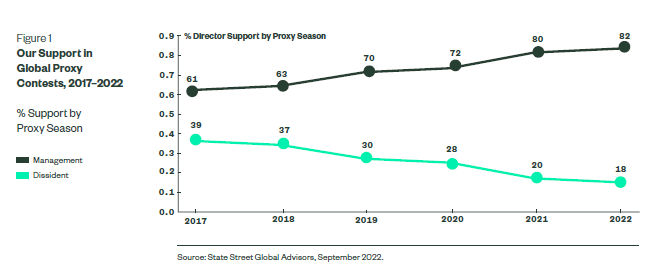
Despite a renewed focus on director quality by activist shareholders, our support for incumbent directors in proxy contests has increased year-over-year since 2017, reaching a new high in 2022 as seen in Figure 1[6].

This increase in support can be attributed to:

  • A lack of focus and substance on long-term strategy in dissidents’ rationale, coupled with engagement models that over-emphasize short-term performance periods, which come at the expense of long-term investor interests and could result in the “greenwashing“ of ESG issues[7]
  • The greater responsiveness of incumbent management and boards of target companies, as well as improved board independence, enhanced focus on ongoing board refreshment, and elevated quality and experience of incumbent directors
  • Our commitment to standing behind portfolio companies during the global pandemic, while they focused on financial resiliency and navigated immediate challenges, including employee health, customer protection, and supply chain safety

Figure 1: Our Support in Global Proxy Contests, 2017-2022

Our approach to nominee selection reflects our belief that strong, independent, and effective boards underpin value creation at companies in which we invest. On behalf of the company’s shareholders, Boards: 1) oversee management; 2) provide guidance on strategic matters; 3) select the CEO and other senior executives; 4) create a succession plan for the board and management; 5) provide risk oversight; and, 6) assess the performance of the management team.[8]

As previously emphasized, nominating committees that comprise independent directors are best placed to assess which individuals can properly fulfill these duties, and act as effective fiduciaries. As long-term shareholders, we vote for members of the board, including nominating committee members, who play a critical role in determining board composition. While our default position is to support the committees’ judgement, we consider the following factors when evaluating dissident nominees:

  • Strategy presented by dissident nominees versus that of current management, as overseen by the incumbent board
  • Effectiveness, quality, and experience of the management slate
  • Material governance failures and the level of responsiveness to shareholder concerns and market signals by the incumbent board
  • Sustained company underperformance and lack of a compelling recovery plan
  • History of both company and activist shareholder engagement cultures

Universal Proxy

Starting August 31, 2022, the use of universal proxy cards is now required in all non-exempt director election contests at publicly-traded companies in the US.[9] The changes are as follows:

  • Shareholders voting by proxy in contested elections have the same flexibility in voting for directors as shareholders who physically attend and vote at the shareholder meeting
  • All shareholders have the ability to vote for a combination of director nominees from competing slates, gaining the ability to “mix and match” for the first time
  • The minimum share ownership required for shareholders to nominate a director to the board has been significantly lowered, decreasing associated costs and barriers to entry

Academic evidence has indicated this change will not systemically favor either activist shareholders or incumbent boards[10]. As such, we welcome this development, since it has the potential to strengthen shareholder voice and may lead to more balanced vote outcomes.[11]

Nonetheless, we will carefully monitor evidence of an increase in the following possible outcomes, as well as their potential unintended consequences:

  • Settlements between activist shareholders and companies, with board seats used as bargaining chips[12]
  • Proxy campaigns used in place of shareholder proposals to further a broader set of topics of interest to shareholders
  • Contested elections due to decreased cost and lower barriers to entry[13]

As long-term investors in portfolio companies on behalf of our clients, we will remain invested well after dissident directors leave the board and short-term investors exit the stock. We believe that leveraging board seats as bargaining chips diminishes shareholder democracy. This also mutes our opportunity to advocate for a company’s long-term performance that aligns with our clients’ interests.

Upholding Shareholder Democracy

Despite improvement in shareholder engagement, companies are increasingly engaging in entrenchment tactics that circumvent shareholder voice and the democratic process. These developments come against the backdrop of recent market volatility, the global pandemic, and inflationary concerns. Such practices include, but are not limited to:

  • Entering into preferred financing agreements that require investors to vote their shares in line with all management proposals
  • Establishing new special voting class shares (e.g., “Founder’s shares”) well after the company has gone public
  • Failing to provide sufficient disclosure that explains compelling rationale behind changes to shareholder rights, capital allocation, and/or governance structure
  • Refusing to engage constructively with shareholders regarding board composition, shareholder rights, or competitive offers to buy the company and/or its assets
  • Adopting shareholder rights plans (“poison pills”) with no time-bound limits and/or compelling rationale

Unsurprisingly, these company actions are often cited by activist shareholders in their argument for board refreshment.[14] Through our engagement with portfolio companies and activist shareholders, we will continue to apply close scrutiny to the practices above.

Supporting Investor Choice on Proxy Voting

We are supportive of giving our clients greater choice around how their shares are voted. Today, clients invested through our separately managed account structures have the option to retain proxy voting authority over the securities held in their accounts that we manage for them. We are continuing to explore the possibility of providing investor choice to more products and client types.

In parallel with this client offering, some policymakers have proposed new measures that intend to further empower individual investors. While we are supportive of the spirit of these legislative proposals, we are concerned by possible unintended consequences, including:

  • Amplifying the voting influence of select shareholders, such as activists with short-term interests, those outsourcing responsibility to proxy research advisors, and company insiders
  • Creating challenges for companies to reach a voting quorum
  •  Diminishing the opportunity for clients to benefit from the experience of institutional investors in exercising a long-term perspective in voting decisions

The Long-Term Shareholder Provides a Stabilizing Voice

In an environment increasingly defined by market volatility and the outsized influence of a few short-term oriented actors, long-term shareholders play a unique and important role. Shareholders focused on maximizing long-term value creation and sound corporate governance practices – a precondition for long-term performance – are more important than ever. Indeed, when making any significant decisions relating to capital allocation and long-term strategy, particularly those with voting implications, companies can benefit from soliciting and considering the long-term shareholder voice in this process.

Investors with long-term horizons, sufficient resources, and productive relationships with their portfolio companies are ideally positioned to deliver value for their clients. These stewards of capital can advocate for enhanced governance practices and risk mitigation of financially material issues, and keep companies focused on long-term strategy.

For these reasons, defensive company entrenchment tactics, last-minute settlements with activist shareholders, and evolving legislative environments all have the potential to cause adverse effects on constructive engagement – silencing the voice of long-term shareholders and potentially upending shareholder democracy. This outcome would be detrimental to the critical role that effective boards – who are elected by shareholders to represent their interests – play in keeping management focused on the long-term goals of their companies.

Conclusion: Bridging the Time-Horizon Gap

The diverse investment philosophies among capital markets participants represent an inherent mismatch between investors with short and long-term time horizons. As a long-term investor, and stabilizing presence for our portfolio companies, we provide a consistent and constructive voice to portfolio companies through our voting and engagement activities.

While our quasi-permanent holding period may differ from that of activist shareholders, enhancing long-term value creation at companies that we both own is a mutually beneficial goal. Boards and management teams can bridge the gap between short and long-term interests by remaining focused on managing material risks and emerging opportunities.

Activist shareholders can better build consensus among voting shareholders by nominating dissident directors focused on long-term strategy and value creation. Generally, director nominees who serve as responsible stewards by fulfilling their fiduciary duty will more likely have the support of long-term shareholders.

At State Street Global Advisors, we will continue to serve as a constructive partner to our portfolio companies and a consistent voice to their boards and management teams. In contested elections, we will continue to engage with both companies and activist shareholders, giving stronger consideration to approaches that bridge short and long-term interests. This will effectively improve long-term, risk-adjusted returns, well after activist shareholders exit an investment.

While there may always be an inherent divergence between investors with short and long-term objectives, we believe that healthy competition, constructive dialogue, and transparent debate fuel shareholder democracy. As such, resisting any efforts to disenfranchise the voice of long-term shareholders will benefit the average investor, who has benefited greatly from the development of strong and efficient capital markets.

The complete memorandum is available here.

Endnotes

1“Why Index Investing is Good for Markets – And Investors”. State Street Global Advisors. (August 2019)
https://www.ssga.com/investment-topics/environmental-social-governance/2019/10/why-index-investing-is-good-for-markets.pdf (go back)

2Brav, Alon. Jiang, Wei and Kim, Hyunseob. ”The Real Effects of Hedge Fund Activism: Productivity, Asset Allocation, and Labor Outcomes” Oxford University Financial Review. (June 2015) http://rfs.oxfordjournals.org/content/28/10/2723.full.pdf (go back)

3“H1 2022 Review of Shareholder Activism”, Lazard Capital Markets Advisory Group. (July 2022)
H1 2022 Review of Shareholder Activism (lazard.com) (go back)

4“Shareholder Activism in 2021” Insightia. (January 2022) (go back)

5Gonzalez, Juan Pablo, Goodman, Anthony, van Biesen, Tanya, Olson, Nels. “The Return of the Activist Investor” Korn Ferry (August 2022) https://www.kornferry.com/insights/this-week-in-leadership/the-return-of-the-activist-investor (go back)

6State Street Global Advisors Voting Data as of date 8/1/2022 (go back)

7“The Effect of Shareholder Activism on Corporate Strategy”, Spencer Stuart, Evercore & NYSE Governance Services. (April 2016) https://www.spencerstuart.com/research-and-insight/the-effect-of-shareholder-activism-on-corporate-strategy (go back)

8“Global Proxy Voting and Engagement Guidelines” State Street Global Advisors. (March 2022).(go back)

9“Fact Sheet: Universal Proxy Rules for Director Elections”, U.S. Securities and Exchange Commission. (July 2022)
https://www.sec.gov/files/34-93596-fact-sheet.pdf (go back)

10Hirst, Scott. “Comment Letter to SEC: Universal Proxy”. (June 7, 2021) https://www.sec.gov/comments/s7-24-16/s72416-8893542-241143.pdf (go back)

11Hirst, Scott. “Universal Proxies”. Yale Journal on Regulation. Vol 35, No.2. (September 25, 2017)
https://ssrn.com/abstract=2805136 (go back)

12“The Activist Report: 13D Monitor. 10 Questions with Ben Colton”, 13D Monitor. (February 2022) (go back)

13Liekefett, Kai H.E. “Welcoming the Universal Proxy”, Sidley (July 2022) https://www.sidley.com/-/media/publications/welcoming-the-universal-proxy.pdf?la=en (go back)

14Bebchuk, Lucian A. and Brav, Alon and Jiang, Wei and Keusch, Thomas, “Dancing with Activists” (June 1, 2017). Journal of Financial Economics, Harvard Law, Columbia Business School and European Corporate Governance Institute.
https://ssrn.com/abstract=2948869 (go back)

Revisiting the Effect of Common Ownership on Pricing in the Airline Industry

Patrick Dennis and Carola Schenone are Associate Professors of Commerce at the University of Virginia, McIntire School of Commerce and Kristopher Gerardi is a financial economist and senior adviser in the research department of the Federal Reserve Bank of Atlanta. This post is based on their recent paper, forthcoming in the Journal of Finance. Related research from the Program on Corporate Governance includes Index Funds and the Future of Corporate Governance: Theory, Evidence and Policy (discussed on the Forum here) by Lucian A. Bebchuk and Scott Hirst; New Evidence, Proofs, and Legal Theories on Horizontal Shareholding (discussed on the Forum here) and Horizontal Shareholding both by Einer Elhauge.

The common ownership hypothesis suggests that large, institutional investors who own equity stakes in firms that compete in the same industry have an incentive to reduce competition by, for example, increasing prices, lowering production, or increasing barriers to entry. The theory behind the hypothesis is relatively straightforward. Firms are tasked with maximizing shareholder value, which typically coincides with simply maximizing their own profits. However, if shareholders also own equity in direct competitors, then maximizing shareholder value implies that firms have an incentive to maximize some combination of their own profits as well as those of their competitors. But if firms consider their competitors’ profits when making business decisions then competition may decline and consumer welfare may decrease.

The hypothesis began to garner significant attention from academic researchers, regulators, and practitioners with a highly influential and provocative paper by Azar, Schmalz, and Tecu (2018) (hereafter AST) that claimed to find evidence of anti-competitive effects from increased institutional common ownership. The AST paper provided empirical evidence from the airline industry showing that markets with higher levels of common ownership concentration are characterized by higher average ticket prices.

READ MORE »

Page 12 of 89
1 2 3 4 5 6 7 8 9 10 11 12 13 14 15 16 17 18 19 20 21 22 89