Yearly Archives: 2022

The Effect of Intermediary Coverage on Disclosure: Evidence from a Randomized Field Experiment

Andrew Belnap is Assistant Professor of Accounting at the University of Texas at Austin McCombs School of Business. This post is based on his recent paper, forthcoming in the Journal of Accounting & Economics.

A fundamental factor in a firm’s disclosure choice is the extent to which market participants can process the information the firm discloses. Because market participants have limited attention and resources, they often rely on intermediaries to reduce processing costs by collecting, analyzing, and distributing firms’ disclosures and other information. By easing these frictions, intermediaries play a key role in capital markets and can significantly affect the cost-benefit equilibrium that firms face when making optimal disclosure decisions.

However, the ways in which intermediaries affect disclosure are relatively unexplored, in part due to several empirical challenges. First, intermediary coverage often occurs simultaneously with firm disclosure and other intermediaries’ coverage, making it difficult to isolate the effects of any one intermediary. Second, firm and disclosure characteristics typically drive intermediary coverage, introducing selection problems. Third, intermediaries often discuss multiple topics, making it difficult to isolate coverage of a particular disclosure.

In this paper, I examine the effect of coverage from two key intermediaries—non-governmental organizations (NGOs) and the media—on firms’ disclosure decisions. Specifically, I study whether coverage of a deficient disclosure can affect the targeted disclosure, how the disclosure changes, and why coverage affects the disclosure. To do this, I conduct a field experiment that, by randomizing intermediary coverage, can address the empirical challenges of this literature. In addition, I supplement the field experiment with a survey of tax executives, cross-sectional tests, and spillover tests that shed light on the roles played by stakeholders for which processing costs are reduced.
READ MORE »

EU Corporate Sustainability Reporting Directive—What Do Companies Need to Know

Kolja Stehl and Leonard Ng are partners and Matt Feehily is senior managing associate at Sidley Austin LLP. This post is based on a Sidley memorandum by Mr. Stehl, Mr. Ng, Mr. Feehily, and Katie Chin.

Non–EU companies with a significant presence in the EU or with securities listed on an EU-regulated market will become subject to new EU rules on corporate sustainability disclosures (the Corporate Sustainability Reporting Directive, or CSRD). The text of the CSRD has now been agreed by the EU institutions. [1] CSRD is expected to become EU law later this year. Once implemented into the national law of EU member states, its requirements will be phased in from 2024.

CSRD will significantly expand the scope and content of the EU’s existing non-financial reporting regime under the Non-Financial Reporting Directive (NFRD). Under Article 8 of the EU Taxonomy Regulation, entities in scope of NFRD are also required to report on their Taxonomy alignment. The amendments made by CSRD therefore mean that a broader range of entities will also be required to make disclosures of their Taxonomy alignment. Another key difference between NFRD and CSRD is that the new rules will introduce a mandatory audit and assurance regime to ensure the reliability of data and avoid greenwashing and/or double accounting.

The new EU rules differ substantially from approaches taken in the U.S. and the UK. This post explores the implications of CSRD for companies with headquarters outside the EU, including the scope of application of CSRD and the content of its disclosure requirements.

READ MORE »

ESG + Incentives 2022 Report

John Borneman is Managing Director, and Jennifer Teefey and Matthew Mazzoni are Senior Associates at Semler Brossy Consulting Group LLC. This post is based on a Semler Brossy memorandum by Mr. Borneman, Ms. Teefey, Mr. Mazzoni, Mira Yoo, and Jay Veale.

Related research from the Program on Corporate Governance includes Paying for Long-Term Performance (discussed on the Forum here) by Lucian Bebchuk and Jesse Fried; and The Perils and Questionable Promise of ESG-Based Compensation (discussed on the Forum here) by Lucian A. Bebchuk and Roberto Tallarita.

There has been a rapid increase in the adoption of ESG metrics for executive incentive plans across the S&P 500 over the past several years. This has largely been driven by continued shareholder focus on human capital management (HCM) and environmental issues. By adding these ESG metrics to incentive plans, Companies are signaling a heightened sense of commitment to their stated ESG goals.

Key Takeaways

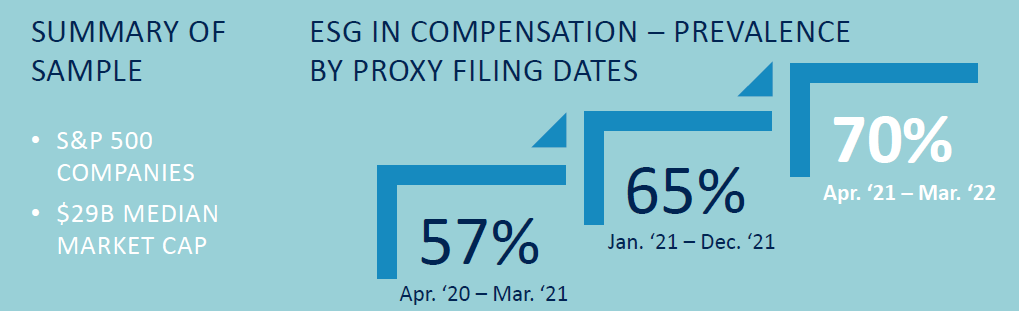
This year, there was a nearly 23% increase in the proportion of S&P 500 companies applying ESG metrics in incentive plans, at 70% prevalence compared to 57% prevalence a year ago. Diversity & Inclusion (D&I) and Carbon Footprint metrics had the largest year over year increases.

  • Investors are strongly focused on HCM and environmental topics as the most important ESG issues. In this year’s data, we have specifically analyzed the prevalence of metrics within these two categories
  • Although D&I continues to lead as the most prevalent metric (46%), companies appear to be taking a holistic approach to HCM in incentives by using other HCM metrics along with D&I
  • Environmental metrics remain uncommon in incentive plans. However, prevalence is increasing, with Carbon Footprint emerging as the environmental measure of choice

READ MORE »

The Proposed SEC Climate Disclosure Rule: A Comment from Shivaram Rajgopal

Shivaram Rajgopal is the Roy Bernard Kester and T.W. Byrnes Professor of Accounting and Auditing at Columbia Business School. This post is based on his comment letter submitted to the U.S. Securities and Exchange Commission regarding the Proposed SEC Climate Disclosure Rule.

Related research from the Program on Corporate Governance includes The Illusory Promise of Stakeholder Governance (discussed on the Forum here) by Lucian A. Bebchuk and Roberto Tallarita; Does Enlightened Shareholder Value Add Value? (discussed on the Forum here) and Stakeholder Capitalism in the Time of COVID (discussed on the Forum here), both by Lucian Bebchuk, Kobi Kastiel, and Roberto Tallarita; Restoration: The Role Stakeholder Governance Must Play in Recreating a Fair and Sustainable American Economy—A Reply to Professor Rock (discussed on the Forum here) by Leo E. Strine, Jr.; and Corporate Purpose and Corporate Competition (discussed on the Forum here) by Mark J. Roe.

This post is based on a comment letter submitted to the SEC regarding the Proposed SEC Climate Disclosure Rule by Professor Rajgopal. Below is the text of the letter with minor adjustments to eliminate the correspondence-related parts.

I write in support of your proposed climate risk disclosures. To frame my comments, it is useful to summarize what the climate risk disclosure rule would require registrants to disclose:

  • the firm’s governance of climate-related risks and relevant risk management processes;
  • how any climate-related risks identified by the firm have had or are likely to have a material impact on its business and consolidated financial statements, which may manifest over the short-, medium-, or long-term;
  • how any identified climate-related risks have affected or are likely to affect the firm’s strategy, business model, and outlook; and
  • the impact of climate-related events and transition activities on the line items of a registrant’s consolidated financial statements, as well as on the financial estimates and assumptions used in the financial statements.

My support is based on my assessment of the costs and benefits of the proposal. Let us start with the costs.

1. Compliance costs are not a significant portion of market capitalization

On page 390 of the proposal, the SEC estimates costs in the first year of compliance to be around $640,000 and annual costs in subsequent years to be $530,000 for larger companies. On page 399, the SEC estimates assurance costs for large companies to be around $75,000 to $145,000. A well-done academic paper by Alexander et al. (2013) estimated the average annual costs of complying with section 404(b) for accelerated filers at $1.2 million.

READ MORE »

More Prescriptive Proposals, Less Support for 2022 Proxy Season

Cydney S. Posner is special counsel at Cooley LLP. This post is based on her Cooley memorandum.

This proxy season, companies saw more shareholder proposals than in the past, a change that has been widely attributed to actions by the SEC and its Division of Corporation Finance that had the effect of making exclusion of shareholder proposals—particularly proposals related to environmental and social issues—more of a challenge for companies. As discussed in this article in the WSJ, investors are taking the opportunity to press for more changes at companies. Nevertheless, the prescriptive nature of many of the proposals, especially climate-related proposals, has prompted many shareholders, including major asset managers, to vote against these proposals. Will next season reflect lessons learned by shareholder proponents from this proxy season?

READ MORE »

Tech Companies Lean on Cyber to Go Faster and Gain Trust

Alex Holt is Global Head of Technology, Media & Telecommunications, Mark Gibson is U.S. National Sector Leader of Technology, Media & Telecommunications, and Vijay Jajoo is Principal of Cyber Security Services, at KPMG LLP. This post is based on their KPMG memorandum.

Tech company leaders name cyber security as both the greatest threat and greatest operational priority. In response, they are investing in skills, culture, and technology to build cyber resiliency, accelerate digital and business model transformation, and foster stakeholder trust.

Technology companies continue to provide the products and services that have powered digital transformation throughout the COVID-19 pandemic and allowed the wheels of global industry to keep turning. Yet this digital acceleration has also caused an explosion in the number of potential cyber vulnerability points due to an immediately virtual workforce, increased cloud adoption, hastily reworked supply chains, and new business partnerships. The rapid integration of new technologies also created an avalanche of new data to be stored and protected.

While some of these trends were already underway, the pandemic dramatically accelerated them. Technology companies were forced to react quickly like all others. In this new reality, technology company CEOs rank cyber risk as the greatest threat to their organization’s growth over the next three years, higher than even supply chain disruption, climate change, or talent risk.

They also cite cyber security resiliency as their most important operational priority. Additional research indicates the average cost of a data breach involving one million compromised records is $52 million, and the cost escalates from there. When more than 50 million records are compromised, the average cost of the breach is $401 million.

READ MORE »

The Proposed SEC Amendments to Shareholder Proposal Rule: A Comment from Shareholder Rights Group

Sanford Lewis is Director of the Shareholder Rights Group. This post is based on a comment letter submitted to the U.S. Securities and Exchange Commission regarding the Proposed SEC Substantial Implementation, Duplication, and Resubmission of Shareholder Proposals Under Exchange Act Rule 14a-8 by the Shareholder Rights Group. Related research from the Program on Corporate Governance includes The Case for Increasing Shareholder Power and Letting Shareholders Set the Rules, both by Lucian A. Bebchuk.

This post is based on a comment letter submitted to the SEC regarding the Proposed SEC Substantial Implementation, Duplication, and Resubmission of Shareholder Proposals Under Exchange Act Rule 14a-8 by the Shareholder Rights Group. Below is the text of the letter with minor adjustments to eliminate the correspondence-related parts.

The Shareholder Rights Group (SRG) is an association of proponents of shareholder proposals, organized to defend investor rights to engage with public companies on governance and long-term value creation. We are writing in support of the proposed rulemaking on Substantial Implementation, Duplication, and Resubmission of Shareholder Proposals Under Exchange Act Rule 14a-8.

The proposed amendments to Rule 14a-8, the shareholder proposal rule, would clarify when a proposal can be excluded as substantially implemented, and when a proposal seeking different objectives or means may block another proposal submitted for the current or subsequent year. We support these overdue changes which would reduce costs and uncertainties to proponents and issuers alike. We appreciate the leadership of Chairman Gensler, the Commissioners and SEC staff making the proposal process more efficient, objective and predictable.

The current rules have placed the staff in the awkward position of making highly subjective determinations on substantial implementation, duplication or resubmission, and have increased the number and length of no action requests. They have also led to exclusion of numerous proposals, the consideration of which would have been of clear benefit to companies and their investors.

READ MORE »

Better Succession Planning Starts with Knowing Your CEO

Richard Holt is Managing Director at Alvarez & Marsal, and Amerino Gatti is Energy Executive at Helix Energy. This post is based on an NACD BoardTalk publication.

The average age of CEOs is nearly 60 years of age within the S&P 500. As the average age of CEOs grows older, the average CEO tenure is growing shorter, to about 6.9 years. In this environment, your organization will likely look soon for a replacement, as will many other companies. Are you ready?

Understandably, many companies have been preoccupied with the major economic disruption in the market and may not have invested the time or leveraged the expertise of their board members to focus on effective CEO succession planning.

If you’re not thinking about this topic now, though, you may be in need of a wake-up call, especially in today’s competitive labor market. All signs point to a hiring desert for companies that are unprepared. Some companies are late to the game—but it’s not too late. Boards can act now to ensure their plans are ready to meet the challenges of the future.

Get to Know Your CEO and Plan

The best medicine for healthier succession planning is garnering a deep understanding of what your company needs in a CEO, and that means really getting to know your current CEO and engaging in robust business scenario planning with the CEO and executive team.

Data suggest that many boards of directors are unprepared for engaging in the process of CEO development and succession. A study by The Rock Center for Corporate Governance at Stanford University and Heidrick & Struggles found that only 51 percent of boards can identify their internal successor CEO. Thirty-nine percent say they have zero internal candidates. This isn’t surprising given that when boards do meet to discuss succession planning, they on average only spend 1.14 hours on the topic, according to a separate study by The Rock Center and the Institute of Executive Development.

READ MORE »

2021: The Year of CFO Turnover and Strides in Gender Diversity

Jenna Fisher is senior partner and co-leader of the Global Financial Officers Practice; Jim Lawson is co-leader of the Global Financial Officers Practice; and Rose Mistri-Somers is managing director at Russell Reynolds Associates. This post is based on a Russell Reynolds memorandum by Ms. Fisher, Mr. Lawson, Ms. Mistri-Somers, and Catherine Schroeder.

Related research from the Program on Corporate Governance includes Politics and Gender in the Executive Suite (discussed on the Forum here) by Alma Cohen, Moshe Hazan, and David Weiss; Will Nasdaq’s Diversity Rules Harm Investors? (discussed on the Forum here) by Jesse M. Fried; and Duty and Diversity (discussed on the Forum here) by Chris Brummer and Leo E. Strine, Jr.

CFO turnover is running high, with 2021 surpassing 2020 and 2019 churn rates, Russell Reynolds Associates’ recent analysis of the S&P 500 revealed. In 2021, there were 89 CFO transitions in the S&P 500, bringing CFO turnover to 18%—the highest its been in the past few years.

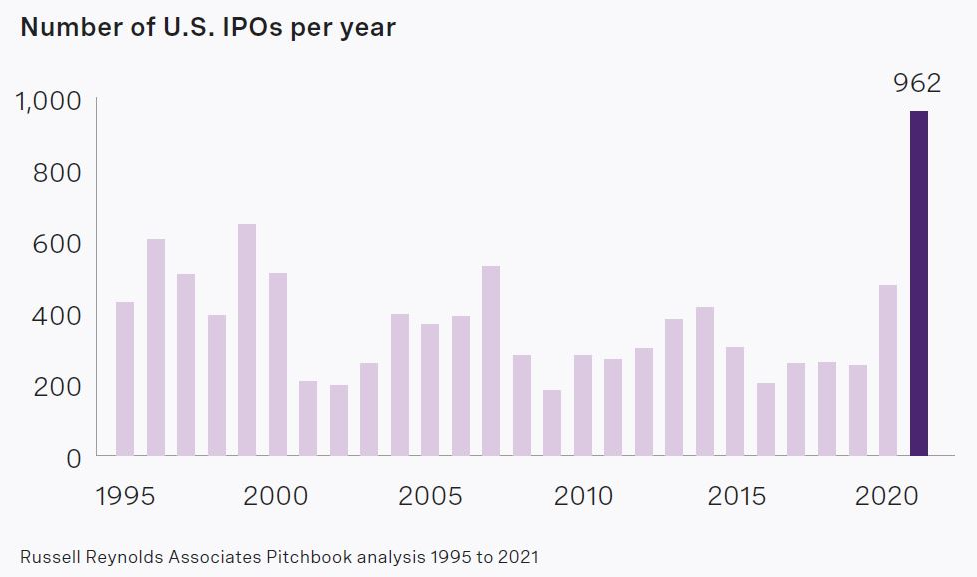
This high churn rate is the result of a combination of factors, including a frothy IPO market that has significantly increased the number of public company CFO opportunities, as well as overall strong equity performance that puts retirement in closer reach for some.

READ MORE »

Weekly Roundup: August 12-18, 2022


More from:

This roundup contains a collection of the posts published on the Forum during the week of August 12-18, 2022.

CSOs Have More Impact When Aligned To The CEO


Should Your Company Go Private?


What CEOs Must Consider When Wading Into Politics and Policy Discussions


PE Firms Poised for Diversity Drive


On Index Investing


BlackRock Response to the Exposure Draft Climate-Related Disclosures Issued by ISSB


ESG Trends and Expectations


Identifying Corporate Governance Effects: The Case of Universal Demand Laws


Proxy Season 2022 Briefing: United States


Proxy Voting: Managers Focus on Environmental and Social Themes


Gender Pay Gap Across Cultures


Can High ESG Ratings Help Sustain Dividend Growth?

Page 30 of 89
1 20 21 22 23 24 25 26 27 28 29 30 31 32 33 34 35 36 37 38 39 40 89

