Monthly Archives: August 2026

Delaware Court of Chancery Reinforces Limits on Oversight Liability; Stresses Importance of Conscientious Board Oversight

Sharon L. Nelles, Leonid Traps, and Oliver W. Engebretson-Schooley are Partners at Sullivan & Cromwell LLP. This post is based on a Sullivan & Cromwell memorandum by Ms. Nelles, Mr. Traps, Mr. Engebretson-Schooley, David M.J. Rein, William S.L. Weinberg, and Samuel J. Winick, all at Sullivan & Cromwell LLP; and is part of the Delaware Law Series; links to other posts in the series are available here.

On August 13, 2026, in In re The Boeing Co. Derivative Litigation, Justice Morgan T. Zurn, recently appointed to the Delaware Supreme Court and sitting by designation in the Delaware Court of Chancery, dismissed Caremark failure of oversight claims asserted against current and former directors and employees of The Boeing Company.[1] Granting defendants’ motion to dismiss in full and with prejudice, the Court emphasized the deference accorded to directors of Delaware corporations under the business judgment rule and held that liability under Caremark does not arise where directors reasonably believe they are fulfilling their oversight duties.[2] S&C represents Boeing and the director and employee defendants in the litigation.

READ MORE »

Seven Questions Boards Should Ask After the 2026 Proxy Season

Lee Henderson is the Center for Board Matters Leader and Jamie Smith is the Center for Board Matters Director at EY. This post is based on their EY memorandum.

The proxy landscape is becoming more complex and less predictable.

In brief

  • Regulatory and stewardship shifts are making investor signals harder to read and proxy voting outcomes harder to predict.
  • Boards may need to evaluate whether their oversight structures and disclosures reflect growing expectations around AI governance.
  • Directors should reassess investor engagement strategies, governance practices and board readiness for a rapidly evolving environment.

Headline voting results from the 2026 proxy season reflect relative calm: continued high support for directors, hardly any failed say-on-pay votes and a sharp decline in shareholder proposals reaching the ballot. Yet those results mask a more complex reality.

READ MORE »

Delaware Court of Chancery Examines Fiduciary Duties of PBC Directors in a Change-of-Control Transaction For the First Time

Susan H. Mac Cormac, Michael Santos, and Michael G. O’Bryan are Partners at Morrison & Foerster LLP. This post is based on a MoFo memorandum by Ms. Mac Cormac, Mr. Santos, Mr. O’Bryan, Spencer Klein, Daniel Irvin, and Mariam Zahran, all at Morrison & Foerster LLP; and is part of the Delaware Law Series; links to other posts in the series are available here.

On July 29, 2026, the Delaware Court of Chancery dismissed with prejudice the stockholders’ complaint in Drakes Landing Associates, L.P. v. Tilden Park Capital Management, L.P.,[1] holding that the plaintiffs failed to rebut the statutory safe harbor for directors of a public benefit corporation (PBC). This is the first Delaware Chancery decision to address the balancing test of PBC director fiduciary duties in a change-of-control context.

The dispute arose out of a financing transaction at MPower Financing, PBC, a Delaware PBC (the “Company”), in which two of the Company’s largest lenders obtained control of the Company. The plaintiffs alleged that the special committee formed to evaluate the transaction, although independent and disinterested, nonetheless breached its fiduciary duties and that the lenders aided and abetted the breach. The Court found that the plaintiffs failed to plead facts sufficient to rebut the safe harbor protecting PBC directors under DGCL Section 365(b). The Court also addressed the applicability to PBCs of Revlon, concluding that the duty to maximize the sale price of a corporation does not apply to the conduct of PBC directors, but leaving open the question of whether a modified form of enhanced scrutiny might still apply as a standard of review.

READ MORE »

2026 Board Index Director Snapshot

George Anderson and Rebecca Thornton are both Partners and Co-Leaders of the Board practice at Spencer Stuart. This post is based on a Spencer Stuart memorandum by Mr. Anderson, Ms. Thornton, and Ann Yerger, all at Spencer Stuart.

Class of 2026: S&P 500 boards appoint more CEOs

Board refreshment slows

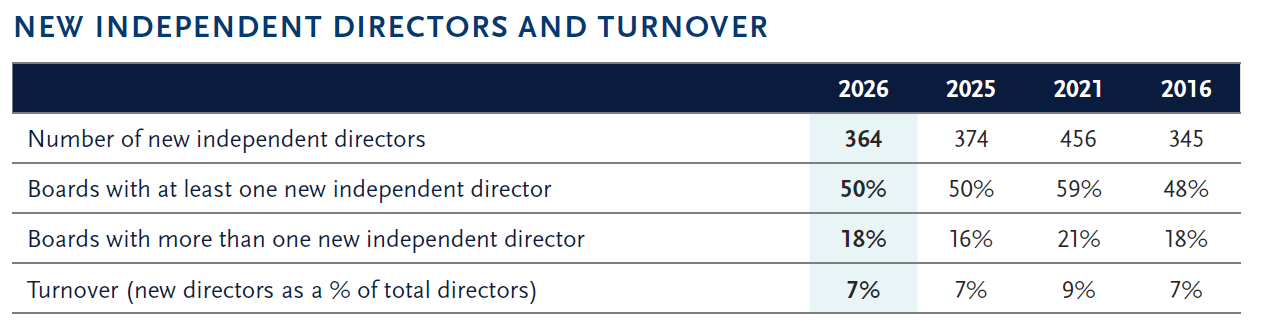
S&P 500 boards appointed 364 new independent directors in 2026, out of a total of 5,204 — the lowest number of new directors since 2016. Overall turnover remains low, declining from 0.8 new directors per board last year to 0.7 in 2026.

In previous years, declines in director appointments generally mirrored the number of directors leaving boards. For example, 374 directors departed S&P 500 boards in 2024, matching the number of new director appointments in 2025. That pattern did not continue in 2026: 418 directors left boards  last year, 15% higher than this year’s appointments.

READ MORE »

Splitting Caremark’s Atom

Ryan Bubb is a Professor of Law and the Director of Strategic Initiatives at the USC Gould School of Law, and Gabriel Cohen is a Law Clerk on the U.S. District Court for the Eastern District of Pennsylvania and will join Bernstein Litowitz Berger & Grossmann LLP in the fall. This post is based on their recent paper and is part of the Delaware Law Series; links to other posts in the series are available here.

In December 2025, Vice Chancellor Will dismissed a derivative claim against a director whose sexual harassment of employees had produced roughly $1.6 million in liability for the corporation. Such “interpersonal” conduct, she held in Brola v. Lundgren, was “not a matter of corporate internal affairs,” and “[t]he legal system provided a remedy for his wrongdoing through New York’s employment laws.” She warned against turning the duty of loyalty into “a general morality code” and inviting “doctrinal sprawl” that would reach “a breakroom fistfight, a defamatory social media post, or theft of office supplies.”

READ MORE »

Delaware and New York State Courts Reject Unusual Theory Under the Securities Act

Amy D. Roy and Robert A. Skinner are Partners and Cole A. Goodman is a Counsel at Ropes & Gray LLP. This post is based on their Ropes & Gray memorandum and is part of the Delaware Law Series; links to other posts in the series are available here.

In a pair of recent decisions, the Delaware Superior Court and the New York State Supreme Court each dismissed with prejudice nearly identical cases brought against the First Eagle and JPMorgan mutual fund complexes, respectively, relating to their application of industry standard accounting practices. Putting forth an unusual theory under the Securities Act of 1933 (the “Securities Act”), the lawsuits alleged that certain mutual funds’ registration statements were misleading because they failed to disclose that, under the funds’ accounting practices, the funds’ realized income and capital gains were temporarily treated as assets (rather than liabilities) prior to those earnings being distributed to fund shareholders (typically on a quarterly or annual basis). Plaintiffs argued that this allegedly undisclosed practice artificially inflated the funds’ NAV, which caused investors to suffer various forms of harm, including higher asset-based fees and increased tax liabilities. However, plaintiffs’ theories were not grounded in the relevant accounting guidance (ASC 946-320-25-4[1]), which does not (i) require that earnings be immediately classified as liabilities, or (ii) prescribe how frequently a fund should declare distributions.

READ MORE »

The Strategic Blind Spots Attracting Shareholder Activists

Victoria Tellez is the Research Director at FCLTGlobal. This post is based on her FCLTGlobal memorandum.

2025 was a record year for shareholder activism. Over 255 campaigns were launched globally in the most prolific year to date. Activity in the United States was up 28 percent year over year; Japan reached its own record with 56 new campaigns.

READ MORE »

2026 Proxy Season Review: Structural Change in a Lower-Volume Season

Matteo Tonello is the Head of Data Benchmarking and Analytics at The Conference Board, Inc. This post is based on a report developed by The Conference Board in partnership with ESGAUGE, Russell Reynolds Associates, and Rutgers Law School’s Center for Corporate Law and Governance, and authored by Ariane Marchis-Mouren, Senior Researcher, Corporate Governance and Keil Lapore, Program Manager, Corporate Governance at The Conference Board.

The 2026 proxy season was shaped less by volume than by procedural change. Proposal filings continued to decline, the number of activism campaigns fell sharply, and say-on-pay support improved—even as boards faced heightened legal complexity, more fragmented voting influence, and a regulatory environment in flux. This report reviews shareholder voting trends from the first half of the year and considers implications for offseason preparation heading into 2027.

READ MORE »

AI Governance for Private Companies

Hillary Flynn is the Director, Drew Morales is the Associate Director, and Courtney Hugger is an Associate of the Private Investments Value Creation team at Wellington Management. This post is based on a publication by Wellington Management’s Private Investments Value Creation Team in collaboration with its Public Markets ESG Team, and authored by Ms. Flynn, Mr. Morales, Ms. Hugger, and Caroline Conway, all at Wellington Management.

Artificial intelligence has moved rapidly from experimentation to deployment. For fast-growing private companies, the opportunity is substantial: AI can improve productivity, enhance customer experience, accelerate decision-making, and help teams scale without adding commensurate headcount. AI tools are also now increasingly embedded in core business processes and capable of taking actions with limited human involvement.

Notably, nearly three in four companies plan to deploy agentic AI within two years despite only one in five having a mature governance model for autonomous agents.[1]

This gap creates risk. Companies that move quickly without appropriate oversight may expose themselves to operational, legal, cybersecurity, customer, and reputational challenges. We believe it is critical for companies to adopt best practices that create the confidence and discipline required to safely deploy AI across their businesses.

READ MORE »

Weekly Roundup: August 14-20, 2026


More from:

This roundup contains a collection of the posts published on the Forum during the week of August 14-20, 2026


Shareholder Engagement Responses to Adverse Sayon-Pay Votes


Wildest Campaigns of 2026


2026 Director Compensation Report


Page 2 of 6
1 2 3 4 5 6