Yearly Archives: 2025

California Climate Disclosure Law SB 261 Implementation Halted: Ninth Circuit Grants Injunction Pending Appeal

Stephanie Hurst, Paul de Bernier, and Dario Frommer are Partners at Mayer Brown LLP. This post is based on a Mayer Brown memorandum by Ms. Hurst, Mr. de Bernier, Mr. Frommer, and McKaela Broitman.

We know our clients have been following California’s climate-disclosure laws closely – including the timing of effectiveness and the various legal challenges. This update relates to a new Ninth Circuit ruling that has effectively hit “pause” on one key pillar of California’s climate-disclosure package.

On November 18, 2025, the Ninth Circuit Court granted a partial injunction blocking enforcement of California’s climate-related financial risk disclosure law – SB 261. Notably, the green house gas emissions reporting law under SB 253 remains in effect, with CARB, in its most recent presentations to the public, proposing August 10, 2026 as the deadline for initial SB 253 disclosures.

READ MORE »

Beyond the First 100 Days Rhetoric: How to Ensure the Long-Term Success of New CEOs

Ty Wiggins is a Consultant at Russell Reynolds Associates. This post is based on a Russell Reynolds memorandum by Mr. Wiggins, Flávia Leão Fernandes, Marie-Osmonde Le Roy de Lanauze-Molines, and Andrew White.

Few ideas in leadership transitions carry as much weight as the “First 100 Days.” Boards expect quick wins. Investors look for visible signals of confidence. Employees want immediate clarity on direction. The first 100 days have become a near-mythical window for proving a leader’s legitimacy.

202 CEOs stepped down from the world’s largest public companies in 2024—up 9% since 2023.

Source: CEO Turnover Index, Russell Reynolds Associates

The problem is that this narrative, while powerful, is also overplayed. Early wins matter—but they do not alone secure a CEO’s success.

In fact, many of the challenges that determine a CEO’s long-term success don’t surface until well beyond the first 100 days: entrenched cultural resistance, stakeholder misalignment, strategy execution gaps, or the simple fatigue that follows the intensity of the early sprint. So, while a strong first impression is important, it can mask deeper vulnerabilities if it becomes the sole yardstick of success.

For boards and CHROs, the task is to shift the lens. The real test of CEO effectiveness lies not just in the opening months but in sustaining momentum through the first year and beyond.

Here, we explore why support during a CEO’s “First 100 Days” is not enough, and what CHROs can do to ensure new CEOs are supported for long-term impact.

READ MORE »

Back to Basics: Delaware’s Genius of Simplicity

Lori W. Will is a Vice Chancellor of the Delaware Court of Chancery. This post is based on her recent article, forthcoming in the Journal of Corporation Law, and is part of the Delaware law series; links to other posts in the series are available here.

Adapted from Remarks at the Journal of Corporation Law’s 51st Annual Symposium

Delaware corporate law has endured for decades because of its simplicity.  In a recent keynote address at the Journal of Corporation Law’s annual symposium, I reflected on why, amid intensifying governance debates, we cannot lose our bearings.  We must resist the intellectual gravity that pulls us toward complexity and invites us to mistake it for rigor.

Delaware’s strength lies not in creating elaborate doctrine, but in maintaining a stable structure that empowers directors to lead, enables investors to rely on durable standards, and guides courts to remain faithful to their institutional role.  It is time to recenter on those enduring first principles.

The Fiduciary Promise

The fiduciary relationship is the centerpiece of Delaware law.  When stockholders invest in a corporation, they entrust their property to the stewardship of its directors and officers.  In return, those fiduciaries make a simple, powerful promise to be loyal and careful.  Loyalty demands an undivided allegiance to the corporation and its stockholders.  Care requires an informed and engaged process—not a guarantee of results.

We do not expect directors to be infallible.  Nor do we hold them liable when well-intentioned decisions go wrong.  We ask—and presume—that they engage, deliberate, and exercise independent, good-faith judgment.

These duties point managers toward a clear purpose: promoting the corporation’s long-term value for its stockholders.  That clarity of purpose is not a limitation.  It ensures predictability, renders performance measurable, and makes duties enforceable.

READ MORE »

Annual State of Board Evaluations in the U.S 2025

Anthony Goodman is a Partner and Christine Abbamonte is a Principal at Korn Ferry, and Aaron Briggs is a Partner at Gibson, Dunn & Crutcher LLP. This post is based on a Korn Ferry and Gibson Dunn memorandum by Mr. Goodman, Ms. Abbamonte, Mr. Briggs, Sarah Oliva, Joe Griesedieck, and Lauren Assaf-Holmes.

INTRODUCTION

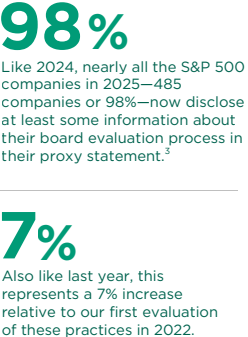
As in prior years, we collaborated with Gibson, Dunn & Crutcher LLP to analyze the board evaluation disclosures of S&P 500 companies as presented in their proxy statements.[1] This study represents one of the most comprehensive assessments of board evaluation practices in the United States.

Korn Ferry and Gibson Dunn have conducted research of similar scope for the past four years. Where relevant, this report includes year-over-year and three- or four-year comparisons to highlight shifts and developments in board evaluation practices.

New for this year:

  • We have analyzed the practices of the World’s Most Admired Companies[2] within the S&P 500 to identify how they differ from the rest of the companies in the index—with some surprising results.
  • We have included a survey of board evaluation practices in major markets around the world.
[3]

Notable Trends in Board Evaluation Practices – HIGHLIGHTS FROM 2025

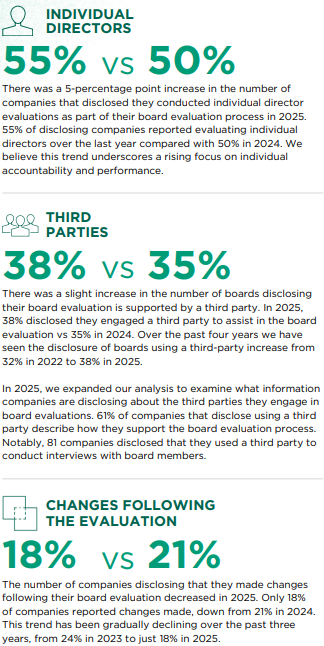
Board evaluation disclosure among S&P 500 companies in 2025 reflected a range of developments. Some practices saw a notable growth in disclosure including three-tier evaluations,[4] varying the process year-to-year, and individual director assessments. In contrast, others, like reporting changes made following evaluations, declined.

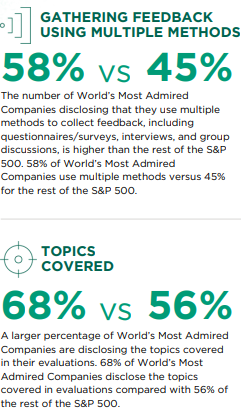
Notably, the World’s Most Admired Companies in the S&P 500 are leading the way in several key areas, including greater transparency around evaluation methodology, broader use of third parties, and more detailed disclosure of evaluation topics.
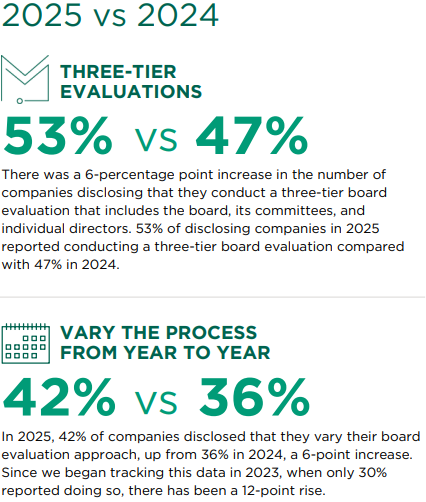
WORLD’S MOST ADMIRED COMPANIES IN THE S&P 500 VS REST OF THE S&P 500
KORN FERRY COMMENT

Much of the 2025 data reveals a continued shift toward greater transparency and sophistication in board evaluation practices among S&P 500 companies. The increase in three-tier evaluations, greater disclosure around varying evaluation processes year-to-year, the rise in individual director evaluations, and the expanded use of third-party support reflect a governance landscape that is becoming more reflective, adaptive, and performance-focused.

This trend is especially evident among the World’s Most Admired Companies in the S&P 500. The boards of these companies are more likely to disclose detailed information about their evaluation processes, use multiple methods to gather feedback, engage thirdparty facilitators, and share the specific topics covered in their evaluation. However, while boards are increasingly investing in and reporting on the tools and processes used to assess performance, they offer limited insight into how those evaluations translate into action.

Board evaluation practices are only effective when they lead to action; assessment without follow-through does not result in improved governance. Without clear disclosure of post-evaluation outcomes, it becomes difficult for investors to gauge how committed boards truly are to enhancing governance quality.

See the rest of the report here.


1 In preparing this report, Korn Ferry collaborated with attorneys and summer associates from Gibson, Dunn & Crutcher LLP between June and September 2025 to design and conduct the analysis of S&P 500 board evaluation disclosures. (go back)

2 Korn Ferry partners with Fortune to determine the World’s Most Admired Companies ranking.(go back)

3 All percentages in this report represent percentages of the 485 disclosing companies, unless otherwise noted.(go back)

4 A three-tier evaluation assesses the board, the board committees, and individual board members. (go back)


2025 CPA-Zicklin Index Finds Strong Corporate Support for Robust Political Disclosure and Accountability

Dan Carroll is the Vice President, David Pahlic is the Director, and Bruce Freed is the President at Center for Political Accountability. This post is based on the 2025 CPA-Zicklin Index.

The number of leading U.S. companies with the most robust policies for transparency and accountability around their political spending increased significantly from 103 in 2024 to 112 this year, according to the recently released 2025 CPA-Zicklin Index.

These public companies scoring 90 percent or above in the benchmarking study, designated Trendsetters, comprised more than 22 percent of all S&P 500 companies evaluated. This reflected a continuing trend “despite [companies] facing the greatest pressures of a lifetime,” in a period of turmoil and national division, the study said.

The 2025 CPA-Zicklin Index of Corporate Political Disclosure and Accountability, the annual benchmarking of the political disclosure and accountability policies of the Russell 1000, was released at an event at the Wharton School of the University of Pennsylvania. It is a joint effort of the Center for Political Accountability, a Washington, DC based non-profit, and The Wharton School’s Zicklin Center for Governance and Business Ethics.

For the first time, representatives of five major U.S. public companies – all of them Trendsetters – participated in the announcement event. From the telecommunications, payments technology, and utilities sectors, the companies in attendance were Visa Inc. (Index score of 100.0 percent); Comcast Corp. (94.3 percent); Consolidated Edison Inc. (100.0 percent); Sempra (100.0 percent); and FirstEnergy Corp. (94.3 percent). Each were awarded certificates for earning Trendsetter status; all other Trendsetter companies are receiving the recognition digitally.

READ MORE »

Board Practices and Composition in the Russell 3000 and S&P 500

Matteo Tonello is the Head of Benchmarking and Analytics at The Conference Board, Inc. This post is based on a report developed by The Conference Board in partnership with ESGAUGE, KPMG, Russell Reynolds Associates, and the Weinberg Center for Corporate Governance at the University of Delaware and co-authored by Ariane Marchis-Mouren, Senior Researcher, Corporate Governance at The Conference Board, and Andrew Jones, Principal Researcher, Governance & Sustainability Center at The Conference Board.

This report examines how board composition and governance practices evolved in 2025 across US public companies in the Russell 3000 and S&P 500, drawing on longitudinal data from corporate filings and disclosures.

Trusted Insights for What’s Ahead® 

  • Most boards now operate with eight to 12 directors and three to four committees, balancing effective oversight with agility amid growing regulatory and technological demands.
  • Average director age continues to climb as boards favor experience and continuity; this trend strengthens institutional knowledge but may heighten long-term challenges around succession, refreshment, and leadership pipeline development.
  • Women now hold about one-third of US board seats—a record high—although momentum has slowed as turnover declines and some boards downplay demographic characteristics.
  • Board director demographic diversity reporting has contracted sharply, with racial and ethnic disclosure falling from 2024 peaks and complicating year-over-year benchmarking.
  • Boards are diversifying beyond traditional CEO backgrounds and adding expertise in technology, cybersecurity, human capital, and sustainability as oversight broadens from financial stewardship to further encompass strategic and risk governance.
  • Board turnover and election of new directors slowed in 2025, reflecting both a natural cyclical pause and companies’ tendency to favor stability in uncertain external conditions.
  • Board governance is evolving from rigid rules to flexible oversight: term limits remain rare, mandatory retirement ages are relaxing, and overboarding policies are standard but increasingly calibrated to balance capacity, experience, and accountability.

READ MORE »

2025 Top 250 Report

Sarah Lindenberg Cohen and Tom Kohn are Consultants, and Rachel Chiu is a Principal at FW Cook. This post is based on their FW Cook report.

Introduction

The 53rd edition of the Top 250 Report explores executive long-term incentive practices at the 250 largest companies by market capitalization, with an emphasis on how prolonged 5-year market volatility and uncertainty has influenced and shaped plan design and structure.

Since 2020, overlapping shocks from the COVID-19 pandemic, geopolitical conflicts, trade tensions, policy shifts from a new administration, Federal Reserve rate hikes, and changing investor sentiment have fueled heightened volatility in US markets. In response, companies have reshaped and de-risked long-term incentive (“LTI”) designs while balancing program objectives such as the alignment of pay with performance and the retention of key employees during uncertain times.

READ MORE »

Using AI in the Boardroom—New Opportunities and Challenges

Paul DeNicola is a Principal, Barbara Berlin is a Managing Director, and Ariel Smilowitz is a Director at PricewaterhouseCoopers LLP. This post is based on their PwC memorandum.

All boards are different, but there are three critical assets that great boards possess to contribute to their effectiveness. First, they have deep and varied experiences that enhance their business judgment. Second, they take a long-term, enterprisewide approach to evaluating the success of the business. Third, they work closely with management, but they maintain their oversight role and one-step separation from the daily operations of the business so they can provide perspective and ask challenging questions about strategy.

AI can significantly enhance those critical functions of the board by addressing the longstanding issue of information asymmetry between boards and management. At the same time AI capabilities offer opportunities for boards, the technology can raise new risks that boards and management should anticipate and address together.

READ MORE »

Merger Agreements are Too Long

Melissa Sawyer is Global Co-Head of M&A at Sullivan & Cromwell LLP.

When I first started doing M&A deals in 2000, the average public company merger agreement was about 50 pages long.  Twenty-five years later, the average length of a merger agreement has more than doubled.

This 25-year period of increasing verbosity coincided with M&A lawyers having better access to copy material from their competitors’ drafts.  Often, one of a deal team’s first tasks is to create a reference set:  an electronic compilation of the counterparty’s, its key competitors’ and its primary outside counsel’s publicly available merger agreements.  A variety of legal tech tools, now super-charged with AI, then make it possible for deal lawyers to cobble together Frankenstein drafts from different sources within the reference set in record time.

This practice of using a reference set and document assembly tech to prepare a merger agreement has two detrimental effects on the quality of legal drafting: (1) feature creep; and (2) recency bias.

READ MORE »

Weekly Roundup: November 21-27, 2025


More from:

This roundup contains a collection of the posts published on the Forum during the week of November 21-27, 2025

Remarks by Commissioner Uyeda on the Diversification Deficit: Opening 401(k)s to Private Markets


Navigating Shareholder Engagement and Shareholder Activism: Essentials and Best Practices


Key Governance Considerations in PIPE Transactions


Chancery Court Dismisses Derivative Challenge to The Trade Desk CEO’s Compensation Award for Lack of Demand Futility


2025 Sustainability Reporting: Global Trends in Framework Adoption


Striking the Balance: Managing Shareholder Engagement in 2025


Is Delaware Different? New Empirical Evidence on Attorneys’ Fees in Stockholder Litigation


Q3 2025 Gender Diversity Index


Active Stewardship Engagement Quarterly Report


Page 6 of 75
1 2 3 4 5 6 7 8 9 10 11 12 13 14 15 16 75