Yearly Archives: 2021

Introducing the “Technergy” ESG Reporting Strategy

Dan Romito is Consulting Partner, ESG Strategy & Integration, at Pickering Energy Partners. This post is based on a Pickering Energy Partners memorandum by Mr. Romito and Addison Holmes. Related research from the Program on Corporate Governance includes The Illusory Promise of Stakeholder Governance by Lucian A. Bebchuk and Roberto Tallarita (discussed on the Forum here); For Whom Corporate Leaders Bargain by Lucian A. Bebchuk, Kobi Kastiel, and Roberto Tallarita (discussed on the Forum here); and Restoration: The Role Stakeholder Governance Must Play in Recreating a Fair and Sustainable American Economy—A Reply to Professor Rock by Leo E. Strine, Jr. (discussed on the Forum here).

Across the existing spectrum of ESG ratings, guidelines, and frameworks, higher quality environmental scores are commonly associated with technology companies while lower relative scores are typically linked to energy companies. This is not necessarily a novel statement, but it does highlight a critical inefficiency. We feel ESG-ratings agencies and, in some cases, reporting frameworks, currently miss the mark in their respective evaluation environmental impact for both sectors. Digitalization, artificial intelligence, and big data are evolutionary trends affecting every sector; however, these trends mean something inherently different for energy. Long-term success for the energy space is contingent upon developing greener technologies and adopting advanced data analytics, yet ratings agencies provide less of an opportunity for energy companies to showcase these explicit talents.

As a result, the narrative conveyed by ESG ratings data fails to outline the longer-term economic reality for most capital-intensive businesses, particularly energy. Empirically speaking, the data indicates environmental impact metrics for the energy and technology sectors are actually converging, but existing ratings data does not reflect this. As paradigm shifts within the global economy materialize, technology and energy are becoming increasingly interlaced. As big data and technological advances continue to represent a greater proportion of the overall global economy, think about the respective “inputs” the technology world will require just to keep the lights on.

READ MORE »

2021 Say on Pay Failures Partly Due to Covid-19 Related Pay Actions

Todd Sirras is Managing Director, Justin Beck is Consultant, and Austin Vanbastelaer is Senior Consultant at Semler Brossy LLP. This post is based on a Semler Brossy memorandum by Mr. Sirras, Mr. Beck, Mr. Vanbastelaer, Alexandria AgeeSarah Hartman, and Kyle McCarthy. Related research from the Program on Corporate Governance includes the book Pay without Performance: The Unfulfilled Promise of Executive Compensation, and Executive Compensation as an Agency Problem, both by Lucian Bebchuk and Jesse Fried.

2021 Say On Pay Results

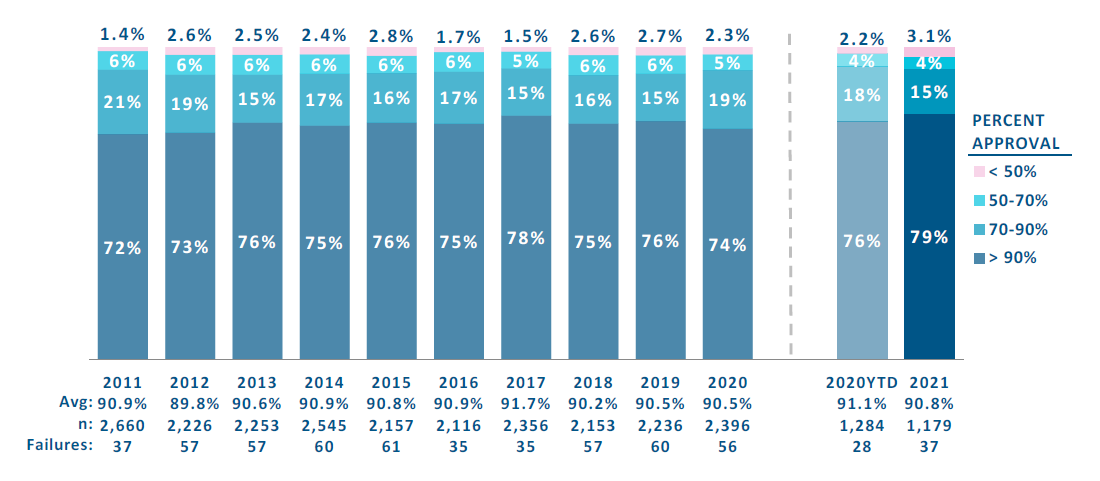
37 Russell 3000 companies (3.1%) failed Say on Pay thus far in 2021, 14 of which are in the S&P 500. 15 companies failed since our last report and are highlighted in bold later in this post. Our evaluation of the likely reasons for failure indicates that ten of the thirty-seven failed Say on Pay votes are due in part to Covid-19 related actions.


READ MORE »

Do UK and EU Companies Lead US Companies in ESG Measurements in Incentive Compensation Plans?

John Ellerman and Mike Kesner are partners, and Lane Ringlee is managing partner at Pay Governance LLC. This post is based on their Pay Governance memorandum. Related research from the Program on Corporate Governance includes The Illusory Promise of Stakeholder Governance by Lucian A. Bebchuk and Roberto Tallarita (discussed on the Forum here); For Whom Corporate Leaders Bargain by Lucian A. Bebchuk, Kobi Kastiel, and Roberto Tallarita (discussed on the Forum here); Socially Responsible Firms by Alan Ferrell, Hao Liang, and Luc Renneboog (discussed on the Forum here); and Restoration: The Role Stakeholder Governance Must Play in Recreating a Fair and Sustainable American Economy—A Reply to Professor Rock by Leo E. Strine, Jr. (discussed on the Forum here).

In January 2021, Pay Governance conducted a comprehensive survey of the use of Environmental, Social, and Governance (ESG) metrics in incentive compensation as reported by 95 participating US companies. The survey documented the prevalence of this emerging trend and explored the types of metrics used, the ways in which they were measured, the types of incentive plans incorporating such metrics, and other important incentive design details. The survey revealed that only 22% of the US companies included ESG metrics in their 2020 incentive plans, whereas 29% of the same companies reported they were planning on including ESG measurements in their 2021 incentive plans. In summarizing the data and citing our conclusions about the survey results, Pay Governance stated that there appeared to be significant hesitancy among US companies to adopt such metrics, as companies considered which metrics and goals would be the most meaningful and consistent with their business objectives. Despite the reluctance on the part of many US companies in moving forward on this issue, we noted that “the inclusion of ESG in incentive plans is perhaps one of the most significant changes in executive compensation in over a decade.” [1]

In our desire to further study this issue, Pay Governance examined the use of ESG metrics in the incentive compensation plans of a select sample of companies in the United Kingdom (UK) and European Union (EU). Our research confirmed that UK and EU companies are well ahead of the US in the inclusion of ESG metrics in incentive plans, and their approach to measuring and rewarding ESG achievements could be a harbinger of strategies used by US companies over the next several years.

READ MORE »

Sidley Sends Formal Comment Letter on the SEC’s Universal Proxy Proposal

Kai H.E. Liekefett, Derek Zaba, and Beth E. Berg are partners at Sidley Austin LLP. This post is based on a Sidley memorandum by Mr. Liekefett, Mr. Zaba, Ms. Berg, Holly J. Gregory, and Leonard Wood. Related research from the Program on Corporate Governance includes Universal Proxies by Scott Hirst (discussed on the Forum here); The Case for Shareholder Access to the Ballot by Lucian Bebchuk (discussed on the Forum here); and Private Ordering and the Proxy Access Debate by Lucian Bebchuk and Scott Hirst (discussed on the Forum here).

On June 7, 2021, we sent a formal comment letter regarding the recent proposal of the U.S. Securities and Exchange Commission (SEC) to adopt a universal proxy (File No. S7-24-16) under the Securities Exchange Act of 1934 (as amended, the Exchange Act) (the Proposed Rule). We summarize our comments in this post (our full 20-page comment letter, including citations, can be reviewed here.

Since proxy contests are the context in which universal proxy cards would be used, we believe that our experience affords us with relevant perspectives on legal, procedural, and practical considerations. We have been involved in over 85 proxy contests in the past five years, more than any other law firm representing companies. In 2020, Sidley was ranked as the No. 1 legal advisor to companies in proxy contests by number of representations in the league tables maintained by Bloomberg, FactSet, Refinitiv (formerly Thomson Reuters), and Activist Insight.

READ MORE »

Weekly Roundup: June 11–17, 2021


More from:

This roundup contains a collection of the posts published on the Forum during the week of June 11–June 17, 2021.

President Biden Signs Executive Order on Addressing Climate Change Risk through Financial Regulation


The Director’s Guide to Shareholder Activism


Second Circuit Reaffirms that Confidentiality Agreements Can Create a Relationship of Trust for Insider Trading Purposes


New York Appellate Division, First Department Gives Green Light to First Post-Cyan Case


Wachtell Lipton’s Spin-Off Guide


Statement by Commissioner Peirce and Commissioner Roisman on Chair Gensler’s Regulatory Agenda


Opportunities for Postdoctoral and Doctoral Corporate Governance Fellows


NYSE Amends Related Party Transaction Approval Requirements


Federal Corporate Law and the Business of Banking


Director Compensation Practices in the Russell 3000 and S&P 500


Trust: A Critical Asset

Trust: A Critical Asset

Don Fancher is Principal of Risk & Financial Advisory, Jennifer Lee is Canadian Managing Partner, and Debbie McCormack is Managing Director at Deloitte. This post is based on a Deloitte memorandum by Mr. Fancher, Ms. Lee, Ms. McCormack, and Bob Lamm.

Introduction

The responsibilities of boards of directors continue to evolve and increase, particularly given the events of the past year. In addition to perennial topics such as strategy, succession, financial reporting, compliance, and culture, boards are experiencing broader demands on their oversight from expanding stakeholder and shareholder considerations; continuing challenges of the ongoing global pandemic and its aftermath; and addressing the changing role of the corporation in society at large on matters such as racial justice and climate. The growth in the number and complexity of board responsibilities is taking place in an environment of growing skepticism towards our various institutions.

Against that background, companies and their boards can help to address these multiple challenges by considering one of the most critical assets not on their balance sheets―trust.

What is trust?

Trust has been defined as “our willingness to be vulnerable to the actions of others because we believe they have good intentions and will behave well toward us.” [1] However, particularly for a business enterprise, trust is not an ephemeral quality or attitude. Rather, it is a critical asset, albeit one that is not reported on the balance sheet or otherwise in the financial statements, as it has no intrinsic value.

READ MORE »

Repairing the US Financial Reporting System

Lynn E. Turner is Former SEC Chief Accountant and Senior Advisor to Hemming Morse LLP. This post is based on an open letter to SEC Chairman Gary Gensler, authored by Mr. Turner and 33 other individuals.

The under-signed individuals and organizations share a deep concern about the present state of the financial reporting infrastructure in the United States. Two decades after a wave of major accounting scandals swept U.S. markets and Congress responded with passage of the Sarbanes-Oxley Act (SOX), many of the root causes of that crisis—deeply flawed and outdated accounting standards, weak and ineffective auditor oversight, and auditors who lack both independence and professional skepticism—have reemerged as pressing issues. For too many years, the Commission itself has been either complicit or passive in the face of these developments. We are writing to urge you to take bold action to restore the financial reporting infrastructure on which investor protection, the fair and orderly functioning of our markets, and the efficiency of the capital formation process all depend.

The original federal securities laws are based on a principle that is elegant in its simplicity—that “all investors, whether large institutions or private individuals, should have access to certain basic facts about an investment prior to buying it, and so long as they hold it.” [1] As the Alliance of Concerned Investors (AOCI) stated in their April letter, “investors are empowered to make useful investment decisions only when they are provided with robust and timely financial information.” [2] Increasingly, there is a growing demand for that information to include applicable disclosures regarding environmental, social and governance (ESG) issues. It’s not just investors, however, but effective market oversight and capital formation, that benefit from the transparency needed to ensure that capital flows efficiently to its best uses. For that system to work, the information that companies report must be complete and accurate. When financial reporting fails to provide the information that investors are demanding, or when investors lose faith in financial reports’ reliability, our markets suffer, as we saw to devastating effect two decades ago.

READ MORE »

SEC Announces Latest Amendments to Proxy Advisor Rules Will Not Be Enforced, Pending Additional Review

David A. Bell is partner and Ryan Mitteness and Jennifer Hitchcock are associates at Fenwick & West LLP. This post is based on a Fenwick memorandum by Mr. Bell, Mr. Mitteness, Ms. Hitchcock, and Soo Hwang.

Gary Gensler, the new chairman of the U.S. Securities and Exchange Commission, released a statement on June 1, 2021, directing SEC staff to consider revisiting its interpretation and guidance from September 2019 regarding the application of the proxy rules to proxy advisors (the 2019 Guidance), and the amendments that it adopted in July 2020 that modified Rules 14a-1(l), 14a-2(b) and 14a-9 under the Securities Exchange Act of 1934 (the 2020 Amendments).

The 2019 Guidance and the 2020 Amendments were further discussed in our prior alert, “SEC Tightens Regulations on Proxy Advisory Firms.” They defined voting recommendations and related materials provided by proxy advisory firms, such as Institutional Shareholder Services (ISS), as “solicitations” subject to antifraud rules and imposed conditions that must be met in order for proxy advisory firms to rely on the exemptions from filing full proxy solicitation materials that had been historically available to them. These new conditions included disclosure of conflicts of interest, providing companies with the opportunity to respond to voting recommendations at or prior to the time such recommendations are released, and providing access to responses by the subject company to the advisory firms’ recommendations. The amendments also specified the circumstances that would cause proxy advice to be “misleading” within the meaning of anti-fraud Rule 14a-9.

READ MORE »

Director Compensation Practices in the Russell 3000 and S&P 500

Matteo Tonello is Managing Director of ESG Research at The Conference Board, Inc. This post is based on co-publication by The Conference Board, Semler Brossy, and ESGAUGE, authored by Mr. Tonello, Mark Emanuel, Todd Sirras, Elijah Ostro, and Paul Hodgson. Related research from the Program on Corporate Governance includes the book Pay without Performance: The Unfulfilled Promise of Executive Compensation, and Executive Compensation as an Agency Problem, both by Lucian Bebchuk and Jesse Fried.

Director Compensation Practices in the Russell 3000 and S&P 500: 2021 Edition documents trends and developments in non-employee director compensation at 2,855 companies issuing equity securities registered with the US Securities and Exchange Commission (SEC) that filed their proxy statement in the period between January 1 and December 31, 2020, and, as of January 2021, were included in the Russell 3000 Index. The project is a collaboration among The Conference Board, compensation consulting firm Semler Brossy, and ESG data analytics firm ESGAUGE.

Data from Director Compensation Practices in the Russell 3000 and S&P 500: 2021 Edition can be accessed and visualized through an interactive online dashboard at https://conferenceboard.esgauge.org/directorcompensation. The dashboard is organized into six parts.

Part I: Compensation Elements, with benchmarking information on the prevalence, value, and year-on-year increases of cash retainers, meeting fees, stock awards, stock options, and any benefits and perquisites.

Part II: Supplemental Compensation, including the cash retainer and meeting fees granted for serving on board committees and the premiums offered for board and committee leadership roles.

Part III: Equity-Based Compensation, which reviews cash and equity compensation mix, the prevalence and value of various equity award types, and the vesting schedules of awarded equity.

Part IV: Stock Ownership Guidelines and Retention Policies, for a detailed analysis of the features of ownership guidelines for board members (including their disclosure, their compliance window, the definition of ownership adopted, and whether the guidelines revolve around a multiple of the cash retainer or a specific number of shares) and the types of retention requirements applicable to equity-based compensation (including the retention ratios and the duration of the retention period).

Part V: Compensation Limits, including the prevalence of limits by type (whether total compensation limits, dollar-denominated limits or share-denominated limits) and the median and average value of these ceilings.

Part VI: Deferred Compensation and Deferred Stock Units (DSUs), including elective and mandatory deferrals, to what compensation element the deferral applies, the form of the deferred compensation payout, the use of deferred cash investment vehicles (such as money-market or savings accounts, retirement accounts, or others) and the prevalence, value, holding requirements, vesting periods, and payout forms of DSUs.

READ MORE »

Federal Corporate Law and the Business of Banking

Morgan Ricks is Professor of Law at Vanderbilt University Law School, and Lev Menand is an Academic Fellow, Lecturer in Law, and Postdoctoral Research Scholar at Columbia Law School. This post is based on their recent paper, forthcoming in the University of Chicago Law Review.

It is a bedrock (though still controversial) principle of American business law that corporate formation and governance are the province of state, not federal, law. But for more than a century and a half there has been one giant exception to this basic principle of American federalism: around 1,200 national banks, which hold $13 trillion in assets. National banks aren’t just federally licensed; they are federally chartered. And as the federal government’s creations, they reside outside the jurisdiction of any state’s corporate laws. The Office of the Comptroller of the Currency (OCC), a century-and-a-half old federal government agency, issues national bank charters and promulgates rules governing national bank formation, governance, and dissolution. By contrast, other federally regulated businesses—including stock exchanges, broker-dealers, investment companies, and bank holding companies—although licensed by federal agencies, owe their corporate existence to the states.

In a forthcoming paper, Federal Corporate Law and the Business of Banking, we examine this corporate law anomaly. Our paper reinterprets the National Bank Act (NBA)—the organic statute governing the OCC and national banks—as a corporation law and analyzes the business of banking through a corporate law lens. It reveals that national banks are a corporate governance solution to an economic governance problem. National banks were designed as federal instrumentalities charged with creating money—a delegated sovereign privilege. Congress recruited private shareholders and managers as an economic governance device: to serve as a check on monetary overissue as well as to avoid politicized asset allocation within the federal government’s monetary framework.

READ MORE »

Page 49 of 90
1 39 40 41 42 43 44 45 46 47 48 49 50 51 52 53 54 55 56 57 58 59 90