Yearly Archives: 2017

Appraisal Decision Sole Reliance on Merger Price: PetSmart

Gail Weinstein is senior counsel and Brian T. Mangino is a partner at Fried, Frank, Harris, Shriver & Jacobson LLP. This post is based on a Fried Frank publication by Ms. Weinstein, Mr. Mangino, Steven J. SteinmanChristopher EwanDavid L. Shaw, and Scott B. Luftglass. This post is part of the Delaware law series; links to other posts in the series are available here.

In In re Appraisal of PetSmart, Inc. (May 26, 2017), which related to the acquisition of PetSmart, Inc. (the “Company”) by funds managed by private equity firm BC Partners, Inc., the Delaware Court of Chancery determined “fair value” for appraisal purposes to be equal to the merger price.

READ MORE »

Decreasing Patience for IPOs with Poor Shareholder Rights

Robert Kalb is a Senior Associate at Institutional Shareholder Services, Inc. This post is based on an ISS publication by Mr. Kalb. Related research from the Program on Corporate Governance includes The Untenable Case for Perpetual Dual-Class Stock by Lucian Bebchuk and Kobi Kastiel (discussed on the Forum here).

For many years, companies have often held their initial public offerings (IPOs) while maintaining potentially shareholder-unfriendly features, such as multi-class share structures, restrictions on shareholders’ ability to amend bylaws, supermajority vote requirements, and classified boards. Arguments for those practices include giving management room to maneuver during its initial public years, protecting certain shareholder classes, and more. Recently, however, shareholder tolerance for these features has waned, with proxy advisers following suit as reflected in their voting policies and recommendations.

READ MORE »

Weekly Roundup: May 26–June 1, 2017


More from:

This roundup contains a collection of the posts published on the Forum during the week of May 26–June 1, 2017.


2017 Venture Capital Report


2017 M&A Report

2017 M&A Report

Jay Bothwick and Hal Leibowitz are partners at Wilmer Cutler Pickering Hale and Dorr LLP. This post is based on a WilmerHale publication.

Market Review and Outlook

Review

In 2016, the number of reported M&A transactions worldwide dipped by 2%, from a record 34,838 deals in 2015 to 34,191, but still represented the second-highest annual tally since 2000. Worldwide M&A deal value decreased 16%, from $3.64 trillion to $3.06 trillion—a total that was still the third-highest annual figure since 2000, lagging behind only 2015’s record tally and 2007’s $3.17 trillion result.

The average deal size in 2016 was $89.4 million, 14% below 2015’s average of $104.5 million, and just shy of 2014’s average of $91.0 million, but 40% above the annual average of $64.0 million for the five-year period preceding 2014.

The number of worldwide billion-dollar transactions decreased 9%, from 540 in 2015 to 489 in 2016. Aggregate worldwide billion-dollar deal value declined 21%, from $2.68 trillion to $2.11 trillion.

READ MORE »

Proxies and Databases in Financial Misconduct Research

Jonathan M. Karpoff is Professor of Finance at the University of Washington. This post is based on an article forthcoming in Accounting Review, authored by Professor Karpoff; Allison Koester, Assistant Professor of Accounting at Georgetown University; D. Scott Lee, Professor of Finance at University of Nevada, Las Vegas; and Gerald S. Martin, Associate Professor of Finance at American University.

Research on the causes and consequences of financial misconduct has exploded in recent years, due partly to the availability of electronic databases that make it easy to compile samples of misconduct events. We identify more than 150 papers that examine financial misconduct based on samples drawn from one or more of four electronically-available databases: the Government Accountability Office (GAO) and Audit Analytics (AA) databases of restatement announcements, the Stanford Securities Class Action Clearinghouse (SCAC) database of securities class action lawsuits, and (4) the Securities and Exchange Commission’s (SEC’s) Accounting and Auditing Enforcement Releases, most recently as compiled by the University of California-Berkeley’s Center for Financial Reporting and Management (CFRM).

READ MORE »

Potential Liability for PE Firms When Preferred Stock Is Redeemed by a Non-Independent Board—Hsu v. ODN

Gail Weinstein is senior counsel and Robert C. Schwenkel is a partner at Fried, Frank, Harris, Shriver & Jacobson LLP. This post is based on a Fried Frank publication by Ms. Weinstein, Mr. Schwenkel, Brian T. ManginoAndrew J. ColosimoMatthew V. Soran, and David L. Shaw. This post is part of the Delaware law series; links to other posts in the series are available here.

In Frederic Hsu Living Trust v. ODN Holding Corporation (April 14, 2017, corrected April 25, 2017), Hsu, a common stockholder (and co-founder) of ODN Holding Corporation (the “Company”), brought suit claiming that the Company’s directors had breached their fiduciary duties to the common stockholders, aided and abetted by Oak Hill Capital Partners, a private equity firm that was the controlling stockholder and the holder of the Company’s Preferred Stock. The plaintiff contended that, over the two-year period prior to the exercise date of Oak Hill’s redemption right, rather than managing the Company to maximize its long-term value for the benefit of the common stockholders, the directors had operated the Company so that it would be in a position to redeem the maximum amount of Preferred Stock as quickly as possible after the redemption right was exercised.

READ MORE »

What’s (Still) Wrong with Credit Ratings

Frank Partnoy is George E. Barrett Professor of Law and Finance and Director of the Center for Corporate and Securities Law at University of San Diego School of Law. This post is based on his recent article, forthcoming in the Washington Law Review.

Scholars and regulators generally agree that credit rating agency failures were at the center of the 2007-08 global financial crisis. Government investigations found that the credit rating agencies, particularly Moody’s and S&P, were central villains and that the crisis could not have happened without their misconduct. The Financial Crisis Inquiry Commission called the ratings agencies “key enablers of the financial meltdown.” The U.S. Senate Permanent Subcommittee on Investigations concluded: “Inaccurate AAA credit ratings introduced risk into the U.S. financial system and constituted a key cause of the financial crisis.” The Securities and Exchange Commission and the President’s Working Group on Financial Markets reached similar conclusions.

READ MORE »

U.S. Proxy Season Half-Time Update

John Roe is Head of ISS Analytics at Institutional Shareholder Services, Inc. This post is based on an ISS publication by Mr. Roe.

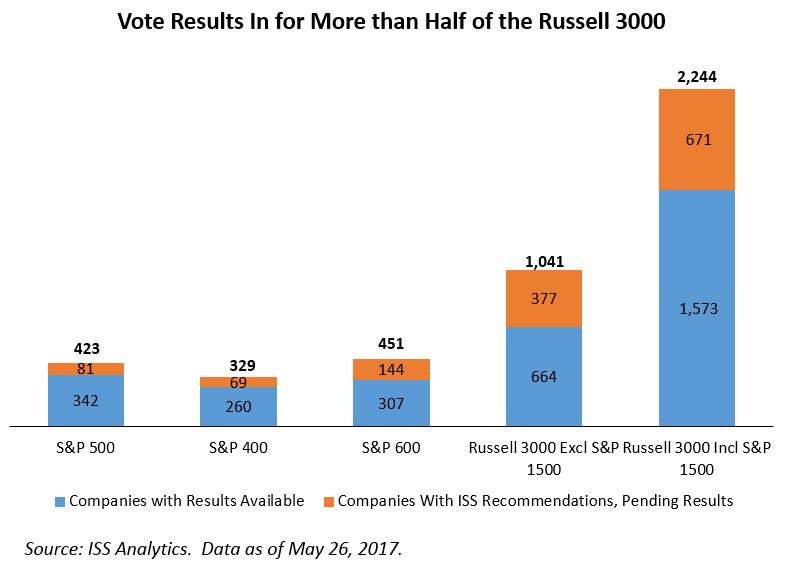
With peak meeting day in the rear-view window and wrapping up the last of the four busiest meeting days of the year today, more and more issuers are reporting their meeting results—and it’s time to take stock of what the numbers are telling us. Through today and among Russell 3000 companies, ISS has issued recommendations on more than 22,000 ballot items at 2,244 companies. And voting results are coming in quickly—we’re calling this proxy season “half-time” because, as of today, just over half—52.4% – of the Russell 3000 has disclosed 2017 shareholder vote results.

READ MORE »

Clarity on the “Quasi-Appraisal” Remedy and Post-Closing Claims

Ignacio E. Salceda is a partner at Wilson Sonsini Goodrich & Rosati. This post is based on a Wilson Sonsini publication by Mr. Salceda, and is part of the Delaware law series; links to other posts in the series are available here.

On May 11, 2017, Chancellor Andre G. Bouchard of the Delaware Court of Chancery issued another noteworthy opinion, dismissing with prejudice post-closing merger claims in In re Cyan, Inc. Stockholders Litigation. [1] The case arose out of the August 2015 acquisition of Cyan, Inc., a networking solutions company, by Ciena Corporation through a mostly stock-for-stock transaction, consisting of 89 percent stock and 11 percent cash. Before the deal closed, shareholder plaintiffs filed five lawsuits in the Court of Chancery, which were later consolidated. The plaintiffs did not seek expedited injunctive relief; rather, they elected to pursue damages for their process and disclosure claims post-closing. Specifically, the plaintiffs’ amended complaint asserted two counts for: (1) breach of fiduciary duty against Cyan’s seven-member board in connection with approval of the merger; and (2) equitable relief in the form of “quasi-appraisal.”

READ MORE »

Dancing with Activists

Lucian Bebchuk is Professor of Law, Economics, and Finance, and Director of the Program on Corporate Governance, at Harvard Law School; Alon Brav is Professor of Finance at Duke University; Wei Jiang is Professor of Finance at Columbia Business School; and Thomas Keusch is Assistant Professor of Accounting and Control at INSEAD. This post is based on their study, Dancing with Activists, available here. This study is part of the research undertaken by the Project on Hedge Fund Activism of the Program on Corporate Governance. Related Program research includes The Long-Term Effects of Hedge Fund Activism by Bebchuk, Brav and Jiang (discussed on the Forum here); and The Law and Economics of Blockholder Disclosure by Lucian Bebchuk and Robert J. Jackson Jr. (discussed on the Forum here).

We recently released a study, entitled Dancing with Activists, that focuses on “settlement” agreements between activist hedge funds and target companies. Using a comprehensive hand-collected data set, we provide the first systematic analysis of the drivers, nature, and consequences of such settlement agreements.

Our study identifies the determinants of settlements, showing that settlements are more likely when the activist has a credible threat to win board seats in a proxy fight. We argue that, due to incomplete contracting, settlements can be expected to contract not directly on the operational or leadership changes that activists seek but rather on board composition changes that can facilitate operational and leadership changes down the road. Consistent with the incomplete contracting hypothesis, we document that settlements focus on boardroom changes and that such changes are subsequently followed by increases in CEO turnover, increased payout to shareholders, and higher likelihood of a sale or a going-private transaction.

We find no evidence to support concerns that settlements enable activists to extract significant rents at the expense of other investors by introducing directors not supported by other investors or by facilitating “greenmail.” Finally, we document that stock price reactions to settlement agreements are positive and that the positive reaction is higher for “high-impact” settlements. Our analysis provides a look into the “black box” of activist engagements and contributes to understanding how activism brings about changes in its targets.

Below is a more detailed account of the analysis and findings of our study.

READ MORE »
Page 48 of 83
1 38 39 40 41 42 43 44 45 46 47 48 49 50 51 52 53 54 55 56 57 58 83
